

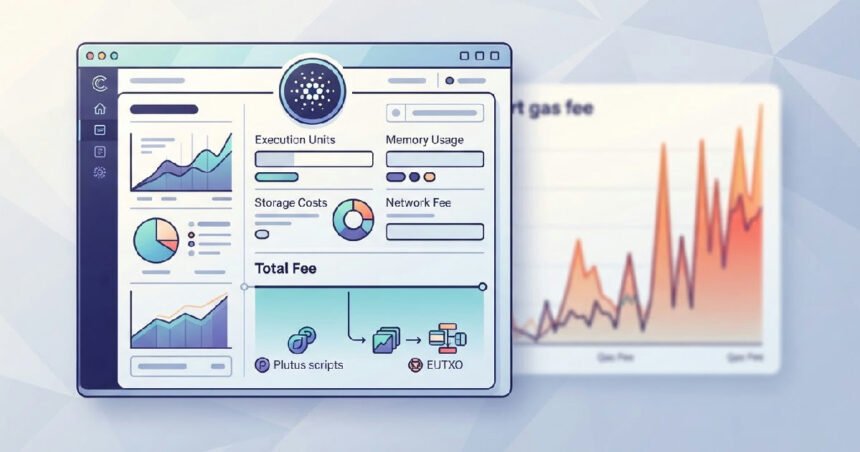
Cardano smart contract fees are meticulously designed to be predictable and deterministic, ensuring users have a clear understanding of transaction costs before committing to the blockchain. This predictability stems from Cardano’s Extended Unspent Transaction Output (EUTXO) model, which contrasts with the variable “gas” fees often seen in account-based systems.
Unlike networks where congestion can rapidly alter transaction prices, Cardano’s fee structure allows for precise calculation based on transaction size and the computational resources a script requires. This transparency offers significant advantages for developers building decentralized applications (dApps) and for end-users interacting with them.
Understanding Cardano smart contract fees and its layered structure
Cardano’s transaction fee mechanism combines a base fee applicable to all network interactions with additional charges for operations involving its Plutus smart contracts. This layered approach ensures that both simple value transfers and complex script executions are accounted for fairly.
The system is built on protocol parameters that can be adjusted through on-chain governance, reflecting the network’s evolving needs and efficiency goals. This adaptability underpins Cardano’s long-term sustainability and performance.
Base Transaction Fee Calculation
Every transaction on the Cardano blockchain, regardless of whether it involves a smart contract, incurs a base fee. This fee is determined by a linear formula: fee = a × size + b. It accounts for the fundamental costs of processing and storing transaction data on the ledger.
Currently, the per-byte component (a or minFeeA) is 44 lovelace, while the fixed component (b or minFeeB) is 155,381 lovelace. The size refers to the serialized transaction size in bytes; larger transactions, such as those including native tokens or extensive metadata, naturally incur higher base fees.
Plutus Script Execution Costs
Transactions that deploy or interact with Plutus scripts, Cardano’s native smart contract language, incur an additional fee. This charge reflects the computational resources consumed during the script’s execution. These resources are quantified using “Execution Units” (ExUnits).
ExUnits measure two primary aspects: memory units, representing the peak memory a script allocates, and CPU steps, indicating the computational execution time. Each CPU step is equivalent to one picosecond of processing on a benchmark machine.
How Execution Units Are Priced
The script execution fee is derived from the formula: script_fee = mem_price × memory_units + step_price × cpu_steps. The mem_price and step_price parameters are integral to the Plutus cost model, which assigns a specific cost to every operation performed within the Plutus Virtual Machine.
Transaction-building software and wallets simulate script execution offline to accurately compute the necessary ExUnits. This crucial step ensures that the total execution fee is known precisely before the transaction is submitted, upholding Cardano’s commitment to predictability. For a broader view of the ecosystem’s development, past initiatives involving the Cardano Foundation are notable.
Reference Script Fees and Collateral
A third fee component applies to transactions utilizing reference scripts. This charge is levied per byte for each reference script included in a transaction’s inputs, irrespective of whether it’s spent or merely referenced. The initial cost begins at 15 lovelace per byte (minFeeRefScriptCostPerByte).
For exceptionally large scripts, this fee escalates in tiers, with the price multiplying by 1.2 for every successive 25,600-byte increment, up to a hard cap of 200 KiB of referenced script per transaction. This mechanism incentivizes efficient script design and usage.
The Role of Collateral in Plutus Transactions
When submitting a Plutus transaction, users must set aside a collateral amount in ADA. This acts as a security deposit, typically 150% of the transaction’s fee, as dictated by the collateralPercentage protocol parameter. This collateral is only forfeited if the script’s on-chain validation fails during its “phase-2” execution.
The collateral mechanism serves to compensate the network for wasted computational effort and discourages the submission of poorly constructed or malicious scripts. Since the Vasil hard fork, transactions can specify a collateral return address, ensuring only the exact amount needed is consumed in case of failure.
Predictability Through the EUTXO Model
A cornerstone of Cardano’s fee predictability is its Extended Unspent Transaction Output (EUTXO) model. This advanced accounting system, a significant enhancement over Bitcoin’s UTXO model, allows for rigorous off-chain validation of transaction validity and resource consumption.
Because the transaction’s size and the exact computational resources required by any included Plutus scripts can be determined before submission, the precise fee is known in advance. This stands in stark contrast to account-based blockchain models, where fluctuating “gas” prices due to network congestion can lead to unpredictable and often high transaction costs.
The network’s design for robust and predictable operations supports various integrations. Discussions around institutional token controls provide further context.
Market Implications and Future Outlook
The deterministic nature of Cardano’s smart contract fees offers substantial benefits for the broader ecosystem. Developers can build dApps with greater certainty regarding operational costs, enabling more accurate budgeting and pricing for their services. This predictability reduces risk for users, fostering greater trust and adoption.
As the Cardano network continues to mature, its predictable fee structure remains a key differentiator, particularly as institutional interest in blockchain grows. This design choice supports the creation of stable and reliable decentralized finance (DeFi) applications and other on-chain services, which is critical for long-term growth.
The stability also plays a role in the broader perception of its native asset, ADA. For more on its market dynamics, historical data on Cardano ADA’s performance can be reviewed.