

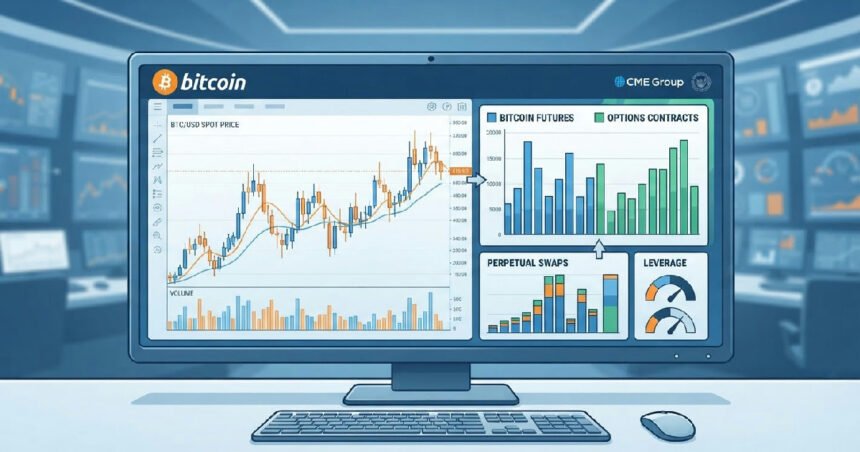
Bitcoin derivatives fundamentally influence the cryptocurrency’s spot price and overall market liquidity. These financial contracts, encompassing futures, options, and perpetual swaps, let participants gain exposure to Bitcoin’s price movements without direct ownership.
Their growing prevalence expands market participation and deepens liquidity. They also facilitate crucial functions like price discovery and hedging, profoundly impacting Bitcoin’s market trends.
Understanding Bitcoin Derivatives
Bitcoin derivatives are financial contracts whose value is derived directly from the price of Bitcoin. They allow traders to speculate on future price changes or to protect against volatility, all without needing to hold the underlying asset.
Key instruments include futures contracts, which are agreements to buy or sell Bitcoin at a set price on a future date. Options contracts grant the right, but not the obligation, to buy or sell Bitcoin at a predetermined strike price by a specific expiration date.
Key Derivative Instruments
Perpetual swaps, a crypto market innovation, function as futures contracts without an expiry date. They utilize a funding rate mechanism to maintain alignment with the spot price. These instruments often involve leverage, which is the use of borrowed capital to amplify trading positions.
Leverage can magnify potential returns, but it also increases potential losses. Hedging involves mitigating risk in existing portfolios, frequently by opening an offsetting trade with a related derivative. This strategy helps manage Bitcoin’s inherent price volatility for investors.
How Derivatives Impact Bitcoin’s Spot Price
Bitcoin derivatives influence the spot market through several interconnected mechanisms. Futures markets, especially regulated platforms like the CME Group, play a significant role in transparent price formation.
Futures prices reflect the market’s collective expectation about Bitcoin’s future value. If futures prices exceed the spot price, known as contango, it signals bullish sentiment. Conversely, backwardation, where futures prices are lower than spot, suggests bearish expectations.
Price Discovery Mechanisms
Arbitrageurs actively exploit price differences between spot and derivatives markets. They buy in the cheaper market and sell in the more expensive one, quickly closing price gaps. This process transmits new price information from derivatives to the spot market, ensuring market cohesion.
Major price movements and significant breakouts often originate within the derivatives market. Institutional algorithms and high-frequency trading firms deploy capital where liquidity is deepest, leading to these crucial market shifts.
Leverage and Speculation Effects
Derivatives enable traders to use substantial leverage, controlling larger positions with less capital. This amplifies both potential profits and risks, leading to increased trading volume and market activity.
In volatile periods, rapid price movements can trigger cascading liquidations of leveraged positions. These forced sell orders can exaggerate spot price declines for brief, intense periods. Options allow speculation with limited downside risk for the buyer, capped at the premium paid.
Enhancing Market Liquidity and Risk Management
The expansion of the derivatives market has substantially boosted Bitcoin’s overall liquidity and market efficiency. Futures contracts offer diverse strategies, attracting traditional financial institutions and professional investors.
Many of these institutional players might otherwise avoid direct participation in the spot market. This capital inflow invigorates the entire Bitcoin ecosystem, deepening its financial infrastructure.
Hedging Strategies for Volatility
Derivatives provide tools for investors, especially institutional ones, to hedge against Bitcoin’s inherent price volatility. For example, an investor holding spot Bitcoin can purchase put options to protect against potential price drops, effectively setting a floor on possible losses.
Similarly, major Bitcoin holders, including miners or investment funds, utilize futures to mitigate potential spot price declines. They achieve this by shorting futures contracts, thereby locking in the USD value of their holdings. This reduces the need for panic selling in the spot market.
Boosting Overall Market Depth
The massive trading volume and open interest in the derivatives market increase market depth. This allows larger trades to execute smoothly without significantly impacting the asset’s price, supporting spot market stability. The ability to hedge also attracts institutional participants, thereby increasing overall market participation.
Tighter bid-ask spreads, characteristic of highly liquid markets, also contribute to lower transaction costs for all participants. Bitcoin ETF options, particularly those approved by regulators, provide robust financial tools for risk management and enhance market liquidity.
Regulatory Landscape and Market Participants
Regulated exchanges and bodies play a crucial role in the derivatives landscape. The CME Group, for instance, offers cash-settled Bitcoin futures and options contracts. These are based on the CME CF Bitcoin Reference Rate (BRR).
The Securities and Exchange Commission (SEC) in the U.S. has approved the listing and trading of options on Bitcoin ETFs, such as BlackRock’s iShares Bitcoin Trust (IBIT). This approval marks a significant step for institutional involvement.
Key Market Participants and Regulators
The Commodity Futures Trading Commission (CFTC) oversees futures and options markets. In May 2026, the CFTC notably approved the first perpetual futures in the US, specifically a Kalshi market for Bitcoin perpetual futures contracts. BitMEX initially introduced perpetual swaps to the crypto market in 2016.
Aggregate Bitcoin options open interest reached approximately $65 billion in January 2026. This figure surpassed futures open interest for the first time since July 2025, indicating shifting market dynamics and preferences. This suggests growing interest in options contracts.
Addressing Common Misconceptions
A common misconception is that derivatives trading solely serves speculation and increases market instability. While derivatives facilitate speculation and can amplify volatility through leverage, they also provide crucial functions.
These functions include risk management and price discovery, which often contribute to overall market stability and efficiency. Hedging by institutional players can also reduce panic selling in the spot market following rapid price movements. Another misconception suggests owning derivatives means owning the underlying Bitcoin, which is not the case.
The Future of Bitcoin Derivatives
Bitcoin derivatives have become an indispensable component of the broader cryptocurrency market, extending beyond simple speculative tools. They provide critical infrastructure for price discovery, risk management, and liquidity enhancement.
As regulatory frameworks evolve and institutional participation grows, these instruments will likely continue to shape Bitcoin’s market dynamics. Derivatives attract traditional financial institutions and contribute to broadening market participation with each new product approval.