

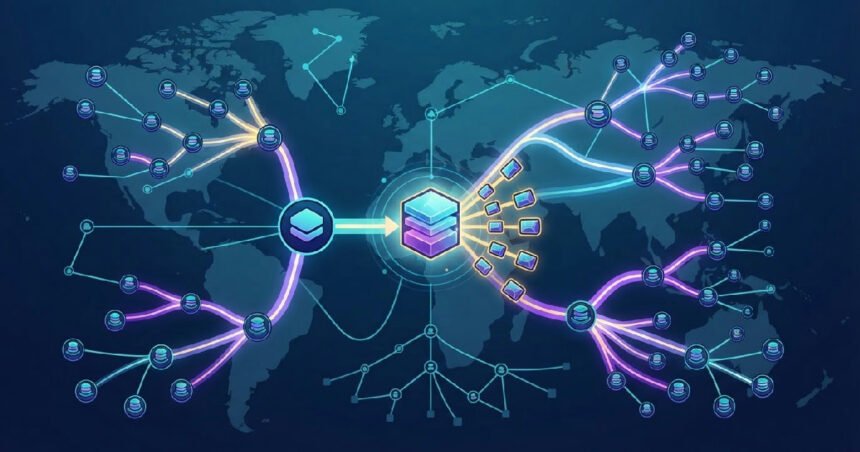
Solana’s Turbine protocol is a fundamental multi-layer block propagation mechanism that efficiently distributes ledger entries across its validator network. It efficiently distributes ledger entries, known as blocks, across its extensive validator network. This system is crucial for enabling Solana’s signature rapid performance and high transaction throughput.
The Turbine protocol operates by fragmenting large data blocks into smaller, manageable packets called “shreds.” These shreds are then disseminated through a unique hierarchical, tree-like structure. This approach significantly reduces bandwidth requirements and minimizes latency for individual validators across the network.
What is Solana’s Turbine Protocol?
At its core, Turbine addresses the challenge of scaling blockchain networks without sacrificing decentralization or speed. It ensures every validator receives block data quickly, vital for maintaining consensus and processing transactions at high velocity. This innovative design helps overcome common blockchain bottlenecks.
How Turbine Protocol Works
Turbine’s operation involves several interconnected steps, designed for both speed and resilience. This multi-step process ensures that block data reaches the entire network efficiently, even in the face of potential data loss. It’s a ballet of data fragmentation and organized distribution.
Block Production and Shredding
First, the designated block leader for a specific time slot gathers and orders transactions into a complete block. This comprehensive block represents the latest set of validated transactions. Once assembled, this block undergoes a critical transformation.
The block is then fragmented into thousands of smaller, fixed-size data packets. These packets, known as “shreds,” are approximately 1.5 KB each. This fragmentation makes the data easier to transmit across the network.
Erasure Coding for Resilience
Before propagation begins, these shreds are not just sent as is; they are encoded using Reed-Solomon erasure coding. This forward error correction technique generates redundant data, known as “coding shreds.” These coding shreds are vital for network robustness.
Erasure coding allows validators to reconstruct the complete original block even if some shreds are lost or corrupted during transmission. This redundancy significantly enhances the protocol’s resilience, ensuring data integrity across a distributed network.
Hierarchical Data Dissemination
The core of Turbine’s efficiency lies in its hierarchical distribution model, often referred to as the Turbine Tree. This dynamic, tree-like network topology structures how shreds are disseminated among validators. It prevents direct broadcast to all nodes, which would overwhelm the network.
Each node within this Turbine Tree is assigned a limited “fanout,” meaning it retransmits shreds to only a small, specific number of downstream validators. This controlled fanout minimizes the load on individual validators while ensuring wide-reaching data propagation.
Technical Components Driving Efficiency
Solana’s Turbine protocol relies on key technical components working in concert. These elements are specifically chosen and designed to optimize for speed, reliability, and efficient resource use. Understanding them sheds light on Solana’s high throughput, a characteristic often compared with other novel consensus mechanisms.
Block Propagation: This is the overarching process of transmitting a new block from the producing validator (the “leader”) to all other validators. Turbine optimizes this by breaking it down into manageable parts.
Shreds: These 1.5 KB packets are the fundamental unit of data in Turbine. They are specifically optimized to fit within standard User Datagram Protocol (UDP) packets, typically around 1,200 to 1,280 bytes, ensuring efficient network transit.
UDP (User Datagram Protocol): Turbine utilizes UDP for transmitting shreds because of its speed and low overhead. As a connectionless protocol, UDP doesn’t require handshake agreements, making it ideal for rapid, continuous data streaming critical for Solana’s performance goals.
Fanout: This crucial concept limits the number of downstream validators each node retransmits shreds to. By controlling this fanout, Turbine avoids network congestion and ensures a balanced distribution load across the validator network.
Market Implications and Solana’s Performance
The Turbine protocol is more than just a technical detail; it’s a cornerstone of Solana’s market positioning. Its efficient data spreading capability directly translates into high transaction throughput and low latency. These features attract decentralized applications and users.
This efficiency allows Solana to handle large volumes of activity without succumbing to congestion, a factor often considered in broader Solana price outlooks.
In the competitive blockchain landscape, protocols like Turbine offer a distinct advantage. By enabling faster block finality and reliable data delivery, Solana can support complex applications. This performance is vital for platforms involving digital asset tokenization.
The protocol’s design also contributes to network decentralization. By reducing individual validator bandwidth requirements, it lowers the barrier to entry for running a node. This encourages a more diverse set of participants, enhancing the network’s security and resilience against single points of failure.
The Bottom Line on Solana’s Data Spreading
Solana’s Turbine protocol stands as a critical innovation in blockchain architecture, directly addressing the scalability trilemma by optimizing data distribution. It effectively balances the need for speed, security, and decentralization through its clever use of data shredding, erasure coding, and hierarchical fanout. This makes it a key differentiator for the Solana network.
The protocol’s mechanics — from fragmenting blocks into small shreds to their resilient transmission via UDP — underscore Solana’s commitment to high performance. For developers and users, this translates into a blockchain experience characterized by rapid transaction confirmations and a robust, scalable infrastructure. Turbine is central to Solana’s vision of a high-throughput blockchain.