

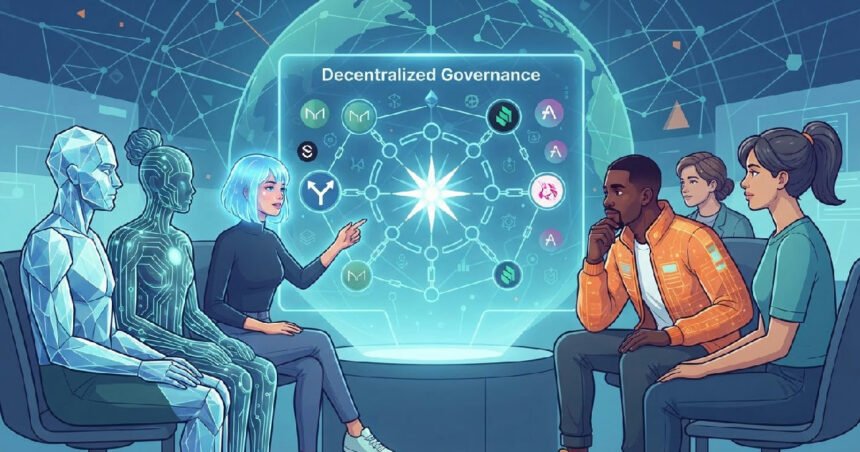
Decentralized Autonomous Organizations (DAOs) are fundamentally reshaping the decision-making and evolution of new altcoin initiatives. These blockchain-based structures replace traditional, centralized governance with transparent, community-driven models powered by smart contracts. This shift allows stakeholders, primarily token holders, to collectively propose, discuss, and vote on critical changes, guiding a project’s direction without central authorities.
At its core, a DAO represents a new organizational paradigm, operating without a singular leader. It fosters a more democratic and transparent approach to managing crypto projects. This shift has profound implications for how resources are allocated and how development priorities are set within the altcoin funding models.
Understanding Decentralized Governance in DAOs
A Decentralized Autonomous Organization (DAO) functions as a blockchain-based entity where rules and protocols are encoded as self-executing smart contracts. This means decisions, fund distributions, and voting rights are all governed by publicly available code, not a central command. The aim is to eliminate intermediaries and foster a truly autonomous, community-led project.
Decentralized governance, a cornerstone of DAOs, refers to the process where power and authority are distributed across a network, rather than concentrated. For blockchain projects, this often translates to token holders directly influencing changes to the underlying blockchain. This mechanism is crucial for the ongoing evolution and integrity of altcoins.
The Mechanics of DAO Operation in Crypto
DAOs operate through a structured, multi-stage process involving proposals, voting, and automated execution. This robust framework ensures that collective decisions are implemented efficiently and transparently.
The operational flow typically begins with community members identifying needs or opportunities within the project, which then translate into formal proposals. These proposals are crucial for driving the evolution of the protocol, from minor parameter adjustments to significant architectural upgrades. The system relies heavily on the active participation of its token holders to maintain its decentralized integrity.
Once proposals are submitted, they undergo a rigorous voting process, where token holders cast their votes based on their stake in the project. The outcome of these votes is then automatically executed by pre-programmed smart contracts, eliminating the need for human intermediaries.
This automation not only speeds up decision implementation but also significantly reduces the potential for corruption or bias. It reinforces the core principles of decentralization and trustlessness.
Membership and Voting Rights
Membership and voting power in a DAO are typically tied to holding its native governance token. The more tokens a member holds, the greater their voting weight, often following a one-token-one-vote model. Members can also delegate their voting rights, allowing participation without constant direct engagement.
Some DAOs are experimenting with alternative models, like quadratic voting or reputation-based voting. These methods aim to mitigate the outsized influence of large token holders, often referred to as “whales,” promoting broader community participation and fairer representation.
Proposal and Decision-Making Processes
Any member holding a minimum amount of governance tokens can typically submit a proposal. These proposals often undergo informal discussions in community forums first, allowing for feedback and refinement. This preliminary stage helps gauge community sentiment before formal steps are taken.
Many DAOs also use “temperature checks” or off-chain voting platforms, such as Snapshot, to test the waters. Proposals that gain sufficient informal support then move to a formal on-chain voting stage.
These formal voting periods typically last several days. A predefined quorum and a majority of “for” votes are usually required for a proposal to pass.
Treasury Management and Funding
Most DAOs maintain built-in treasuries that are inaccessible to any single entity without collective approval. These treasuries hold funds, frequently including the DAO’s native governance token. They are essential for funding new projects, covering operational costs, and making strategic investments.
Decisions regarding the allocation or spending of these treasury funds are made through the established governance process. This ensures financial transparency and prevents unilateral spending, aligning expenditures with community consensus.
Transparency and Immutability
All activities within a DAO, including submitted proposals, voting outcomes, and executed actions, are recorded on the blockchain. This public ledger makes every step transparent and fully auditable by anyone. Such transparency builds trust and accountability among community members.
The rules embedded within a DAO’s smart contracts are designed to be immutable, meaning they cannot be altered without another formal governance vote. This immutability ensures consistent operations and protects against arbitrary changes, securing the long-term vision of the project.
Leading Altcoins Embracing DAO Governance
Many prominent altcoin projects have adopted DAOs as their primary governance structure, showcasing diverse approaches to decentralized decision-making. These examples highlight the practical application of DAO principles in real-world crypto ecosystems.
The varied implementations of DAO governance among leading altcoins demonstrate the flexibility and adaptability of this model. DAOs are proving to be effective mechanisms for large-scale, community-driven projects, from managing stablecoins to overseeing lending platforms and decentralized exchanges.
Each project tailors its governance framework to its unique operational needs and community characteristics. This reflects the dynamic nature of the blockchain space.
These real-world applications underscore the growing maturity of decentralized governance. They serve as blueprints for emerging projects, illustrating both significant advantages, such as enhanced community ownership and resilience.
Ongoing challenges persist, including achieving broad participation and preventing voter apathy. The continued evolution of these systems will be critical in shaping the future trajectory of the broader altcoin market.
MakerDAO’s Scientific Governance
MakerDAO, founded by Rune Christensen in 2014, governs the Dai stablecoin, which maintains a soft peg to the US Dollar. MKR token holders are central to its “scientific governance” system. They vote on crucial parameters like stability fees, acceptable collateral types, and risk parameters for Maker Vaults.
This system integrates both Executive Voting and Governance Polling to ensure robust decision-making. The community collectively manages the stability and efficiency of the Dai ecosystem, demonstrating a mature model of decentralized financial governance.
Compound’s Protocol Upgrades
Compound, a leading decentralized lending platform, empowers COMP token holders to govern its evolution. Users can earn interest and borrow cryptocurrencies through the platform. Token holders propose and vote on protocol changes, including deploying new versions such as Compound III or adding new assets.
COMP token holders also have the option to delegate their voting rights to others. Proposals function as executable code; once passed, they are queued and implemented after a short delay, typically a three-day voting period followed by a week for implementation.
Aave DAO and DeFi Lending
Aave DAO oversees the Aave protocol, a significant player in decentralized finance (DeFi) lending. Governance is managed by AAVE, stkAAVE, and aAAVE token holders. Aave Governance v3 extends voting capabilities to lower transaction fee networks like Polygon POS and Avalanche C-Chain, even when token balances remain on the Ethereum mainnet.
The governance process includes forum discussions, Snapshot votes (off-chain), and on-chain votes for Aave Improvement Proposals (AIPs). While Aave Labs handles day-to-day risk and asset listings for specific aspects like Horizon, the Aave DAO retains full ownership and control over core contract upgrades.
This multi-chain voting capability is crucial for their expanding ecosystem, allowing token holders to participate more efficiently.
Uniswap’s Decentralized Exchange Model
Uniswap, a prominent decentralized exchange protocol, uses a multi-stage governance process. This typically begins with forum discussions, which must last at least seven days. Following this, a five-day Snapshot “temperature check” requires at least 10 million UNI votes to advance the proposal.
Formal on-chain votes are then conducted via contracts such as Governor Bravo. A proposal threshold, for instance, 1 million UNI delegated votes, is necessary to submit a proposal. Furthermore, a substantial number of votes, often 40 million UNI, are required for a proposal to pass.
Voting processes include delays and timelocks. For example, a two-day delay and a seven-day vote are often followed by a two-day timelock before execution.
Market Implications and Future Outlook for Altcoins
The rise of Decentralized Governance DAOs marks a significant shift in the altcoin market. This model promises greater transparency, community engagement, and resilience against single points of failure. Investors often view this as a positive, fostering increased trust and broader participation in project development.
However, challenges persist. The “one-token-one-vote” model can lead to concentration of power among large token holders. Ensuring diverse participation and preventing apathy in voting remain ongoing hurdles.
The regulatory landscape for DAOs also continues to evolve. This adds a layer of uncertainty to their operations.
Despite these complexities, DAOs are likely to become even more integral to the future of altcoins. Their ability to adapt and evolve through collective intelligence positions them strongly.
The ongoing development of more sophisticated governance mechanisms could further democratize crypto projects. This would influence everything from daily operations to broader market trends for top altcoins.
Community-Driven Evolution: The Bottom Line
Decentralized Autonomous Organizations represent a foundational paradigm shift for altcoin projects. By empowering token holders with direct influence over development and strategic decisions, DAOs foster unprecedented levels of transparency and community control. This model continues to shape the trajectory of emerging cryptocurrencies, pushing towards a more decentralized and inclusive financial future.
Frequently Asked Questions About DAOs
- What is the primary purpose of a DAO?
- A DAO’s primary purpose is to enable decentralized governance for a project, typically a blockchain-based one. It allows token holders to collectively make decisions on protocol upgrades, treasury management, and other key aspects without a central authority.
- How do I participate in a DAO?
- Participation in most DAOs involves holding their native governance tokens. These tokens grant you voting rights, allowing you to submit proposals or vote on existing ones. Many DAOs also have community forums where discussions and informal polls take place.
- Are all DAOs the same?
- No, DAOs can vary significantly in their structure, voting mechanisms, and areas of focus. While the core principle of decentralized governance remains, some might use one-token-one-vote, others quadratic voting, and their treasuries and proposal processes can differ based on the project’s specific needs.
- What are the main benefits of DAO governance?
- The main benefits include increased transparency, enhanced community engagement, resistance to censorship, and a more robust and adaptable project due to collective decision-making. It aims to create a more democratic and resilient ecosystem.