

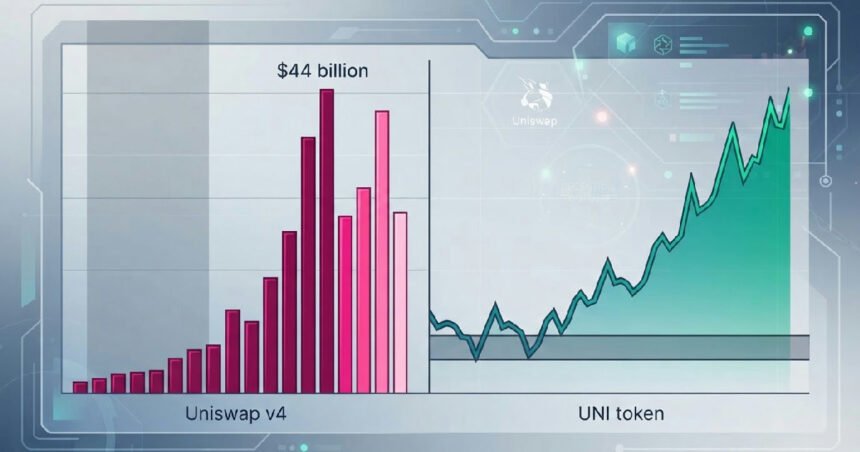
Uniswap v4, the fourth iteration of the prominent decentralized exchange protocol, has demonstrated formidable growth, processing over $44 billion in trading volume in the 30 days leading up to October 13, 2026. This substantial activity accounts for nearly half of the entire Uniswap protocol’s trading volume during that period.
Simultaneously, the UNI token, Uniswap’s governance asset, showed signs of a potential price reversal, successfully defending the $6.80 daily demand zone.
Uniswap v4’s Ascendant Trading Volume Dominance
This dual momentum — robust protocol usage and a nascent token price recovery — presents a critical juncture for the altcoin. While the surge in Uniswap v4 volume underscores its increasing adoption, the long-term sustainability of the UNI token’s upward trajectory hinges on consistent buyer demand beyond this initial bounce.
The latest data confirms Uniswap v4’s rapid ascent, capturing 49.9% of the total trading volume across all Uniswap versions over the past month, equating to more than $44 billion. This figure significantly outpaces Uniswap v3, which registered 44.9% of the volume, and Uniswap v2, holding 5.2%.
Uniswap v4, launched in January 2025, introduced several innovative features designed to enhance efficiency and flexibility for both traders and liquidity providers. These include “hooks” for custom logic, a singleton architecture reducing gas costs, flash accounting for efficient multi-pool swaps, and native ETH support.
Its Total Value Locked (TVL) has also grown impressively, reaching $1.336 billion and increasing by 30.2% over the last 30 days, operating across 20 different chains with Ethereum hosting the largest share at 57.5%.
UNI Token Price Action and Market Sentiment
Amid the surge in protocol activity, the UNI token has shown encouraging signs on its price charts. Buyers effectively defended the crucial $6.80 daily demand zone, triggering a bullish shift in short-term momentum. This defensive action marks a notable rebound after a period of weakness, positioning UNI above its 20-day, 30-day, and 50-day Exponential Moving Averages (EMAs) on the daily chart.
However, this recovery isn’t without its risks. Analysis of the Long/Short Ratio indicates a clear bullish preference among traders, with approximately 63% of tracked positions being longs. While this sentiment can fuel further gains if spot demand intensifies, it also creates vulnerability.
A sudden market reversal or a decline in buying pressure could trigger forced liquidations, amplifying selling pressure and potentially undermining the recent recovery. Sustained organic demand is vital to prevent such a scenario.
The Road to $11 and Potential Hurdles
The impressive trading volume on Uniswap v4 naturally prompts questions about its impact on the UNI token’s price potential. While protocol activity signifies widespread usage of the exchange, it doesn’t directly translate to buying pressure for UNI itself, as the volume reflects swaps across various supported tokens.
Nevertheless, some indicators suggest a potential upside target for UNI. The Liquidation Heatmap reveals a substantial cluster of liquidations, approximately $535.10 million, positioned around the $11 mark. This area represents a conditional objective for buyers, where sustained upward momentum could trigger cascading liquidations and propel the price higher.
For altcoin projects looking to strengthen their market position, what defines strong leadership often includes navigating such market dynamics effectively.
But reaching this target is not guaranteed. Any renewed market weakness or a significant unwinding of leveraged long positions could interrupt the recovery before UNI approaches the $11 level. The current scenario requires continued demand to push past resistance and secure more substantial gains.
Evolution and Governance of the Uniswap Protocol
Uniswap has been a cornerstone of decentralized finance since its inception. Founded in 2018 by Hayden Adams, who drew inspiration from Ethereum co-founder Vitalik Buterin, the protocol has undergone several pivotal upgrades. Uniswap v1, launched in November 2018, pioneered the Automated Market Maker (AMM) model, followed by Uniswap v2 in May 2020, which introduced direct ERC-20 token swaps and flash swaps.
The significant Uniswap v3 upgrade in May 2021 brought concentrated liquidity, allowing liquidity providers to allocate capital within specific price ranges and drastically improving capital efficiency. Uniswap v4, building on v3’s foundations, further enhanced customization and efficiency, rapidly becoming a major player in stable-to-stable swaps, handling between $11 billion and $14 billion monthly in this category alone.
The UNI Token’s Role and Economic Shift
The UNI token, launched in September 2020, serves as the governance mechanism for the entire Uniswap protocol. Holders wield significant influence, able to propose and vote on crucial protocol changes, fee structures, and future development initiatives. This governance model provides a decentralized framework for the protocol’s evolution.
A major economic shift occurred in December 2025 with the activation of the “fee switch.” This mechanism introduced a token burn feature, transforming UNI into a deflationary asset. Protocol fees now contribute directly to these token burns, with an estimated 4 million UNI tokens removed from circulation annually. Such tokenomics often influence long-term holder sentiment and could play a role in UNI’s future price appreciation.
Broader Implications for Decentralized Finance
Uniswap v4’s impressive volume figures underscore a broader trend within the decentralized finance (DeFi) landscape: the continuous innovation and increasing maturation of DEX technology. The ability to handle such vast trading volumes, coupled with features designed to reduce gas costs and enhance capital efficiency, positions Uniswap as a dominant force.
This success story could also serve as a benchmark for other DeFi protocols and altcoins striving for greater adoption and market share. As these platforms evolve, how emerging altcoins achieve seamless cross-chain interoperability will be critical for scaling liquidity and user bases.
The regulatory environment, while still evolving, is seeing increased clarity in major jurisdictions by 2026, influencing how centralized exchanges operate and presenting ongoing challenges for decentralized protocols.
The strong performance of Uniswap v4 reinforces the argument for decentralized trading solutions, even as the crypto market navigates complex dynamics.
For the UNI token to fully capitalize on this, the current short-term bullish momentum needs to translate into sustained demand, demonstrating that the market recognizes the value inherent in the protocol’s innovations and its deflationary governance token.
The next few weeks will be telling for whether UNI can maintain its rally and break past key resistance levels.