

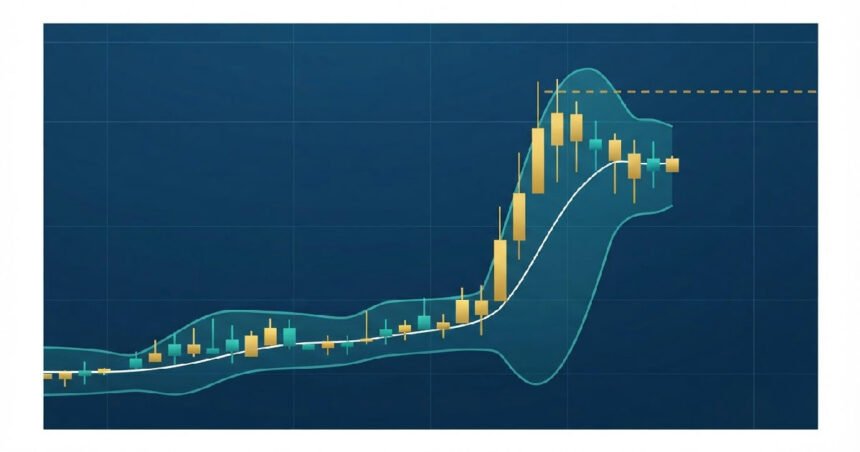
The native token for Kamino Finance, KMNO, posted an impressive 17% surge in value over the past day, extending a significant rally seen throughout the last couple of weeks. This sharp climb, however, has triggered an “overbought” signal on technical charts, prompting caution among some market watchers.
While the immediate price action suggests strong bullish momentum, the Bollinger Bands indicator points to a potential risk of a pullback. Historically, when KMNO has entered this upper band territory, a price decline towards the mid-band level has often followed, according to recent analysis.
Technical indicators flash caution for Kamino Finance KMNO
Despite the robust 17% gain witnessed on September 26, technical analysis using Bollinger Bands suggests that KMNO is currently trading in an overbought region. This condition typically indicates that the asset’s price has risen rapidly and may be trading above its intrinsic value.
In the past, each of the four instances where KMNO’s price pierced the upper Bollinger Band has preceded a correction, with the token receding towards the indicator’s mid-band. For traders, this pattern often signals an increased risk of a short-term price reversal.
Conversely, the Moving Average Convergence Divergence (MACD) presents a more optimistic outlook, showing a strong upward trajectory and maintaining a positive position. This indicator suggests that market momentum remains firmly on the side of the bulls, indicating sustained buying pressure despite the overbought signal.
On-chain metrics underpin bullish sentiment
Beyond the price charts, underlying on-chain data from Kamino Finance offers a compelling narrative for continued bullish sentiment. Data from DeFiLlama reveals a substantial increase in the protocol’s Total Value Locked (TVL), which has swelled by over $253 million since September 2.
The TVL now stands at approximately $1.541 billion, reflecting a significant commitment of user funds to the platform. This surge points to growing confidence among investors, who are locking assets into Kamino Finance to capitalize on potential long-term price appreciation and earn annual percentage yield (APY).
Further strengthening the bull case, the fees generated by the Kamino protocol have shown consistent growth, recently surpassing $169,000. Steady fee generation is often a key indicator of a healthy and actively utilized decentralized finance (DeFi) platform, suggesting ongoing engagement from its user base.
Kamino Finance’s expanding DeFi ecosystem
Kamino Finance operates as a comprehensive DeFi protocol built on the Solana blockchain, offering a suite of services designed to simplify complex financial strategies. Launched in August 2022, it initially focused on automated concentrated liquidity management, an area where it quickly established itself.
The platform later expanded its offerings in 2023 to include lending capabilities, ultimately becoming the largest DeFi protocol on Solana by TVL. Its core products now encompass Kamino Lend, providing isolated-pool money markets, and Kamino Liquidity, which manages automated concentrated liquidity vaults on decentralized exchanges like Orca and Raydium.
Additionally, Kamino Finance offers innovative leveraged products such as Multiply, allowing users to increase asset exposure, and Long/Short for directional leveraged trading. The platform also integrates a Swap feature, utilizing a meta-aggregator to optimize liquidity across various Solana DEXs.
KMNO token: governance and utility
The KMNO token, which officially debuted on April 30, 2024, plays a crucial role as the native utility and governance asset within the Kamino Finance ecosystem. It grants holders the ability to participate in key decisions, including voting on protocol parameters, managing treasury funds, and influencing incentive programs.
With a total supply of 10 billion tokens, KMNO was initially distributed via a community airdrop, rewarding early users based on their historical activity. The tokenomics strategically allocated 35% to community and grants, including a 7.5% genesis community allocation, ensuring broad participation and decentralized control.
Staking KMNO also provides additional benefits, allowing users to boost their rewards within the platform’s vaults. This incentive structure encourages long-term holding and active engagement, aligning the interests of token holders with the protocol’s overall growth and stability.
Strategic expansion and institutional focus
Kamino Finance has been aggressively pursuing strategic expansion and an institutional focus throughout 2026, marked by significant leadership appointments and product innovations. Michael Weisz, co-founder of Yieldstreet, assumed the role of CEO on September 15, 2026, with a clear mandate to drive US expansion and institutional engagement.
Just days later, on September 25, 2026, Kamino debuted fixed-rate USDC borrowing, a move aimed at providing predictable financing options for institutional clients. This followed a private beta launched in August 2026, signaling a concerted effort to cater to more sophisticated market participants.
Further diversifying its offerings, the protocol launched a tGBP (Tokenised GBP) lending market on September 23, 2026, enabling Solana users to borrow sterling against various collateral assets. This initiative, curated by Steakhouse Financial, represents a notable step into traditional currency-backed DeFi services. Such developments reflect the diverse innovations across the altcoin space, including efforts by emerging altcoins tackling data privacy.
Innovative lending markets and partnerships
Kamino Finance isn’t shying away from novel asset classes either, as evidenced by its new lending market for sUSDai, a stablecoin collateralized by GPU loans, which opened on September 24, 2026. This market allows users to borrow USDC against this real-world asset (RWA) collateral at an 80% maximum loan-to-value ratio, showcasing the platform’s adaptability.
Institutional interest in Kamino is also on the rise. An institutional-level yield vault, initially sized at 25 million USDC, was launched on August 3, 2026. Moreover, Galaxy, a prominent Nasdaq-listed digital assets firm, expanded its curation with new USDC and USDT yield vaults on Kamino in September 2026.
These developments, coupled with strategic collaborations for liquidity and oracle providers, position Kamino Finance as a key player in the evolving DeFi landscape. The consistent accumulation seen in spot trades, despite the negative CoinGlass Netflow of roughly $65,000 following a $3.5 million buy, suggests sustained investor interest, even if the gap between buyers and sellers remains tight.
Navigating conflicting signals: what’s next for KMNO?
The current market for Kamino Finance’s KMNO token presents a fascinating dichotomy. On one hand, a robust 17% price rally has propelled it into technically overbought territory, suggesting a potential short-term correction. This technical signal, primarily from Bollinger Bands, has historically preceded price pullbacks.
On the other hand, the foundational strength indicated by soaring Total Value Locked, consistent fee generation, and persistent on-chain accumulation points to deep-seated bullish conviction. Traders are actively committing capital, seemingly undeterred by the cautionary technical indicators.
This dynamic tension highlights a critical decision point for investors. While a minor retracement could occur due to the overbought status, the strong underlying utility, expanding product suite, and institutional adoption efforts suggest significant long-term potential.
The ongoing accumulation suggests that many investors view any short-term dip as a buying opportunity, reinforcing the token’s broader appeal across the decentralized finance landscape, distinct from other market sectors like tokenized stocks Binance.