

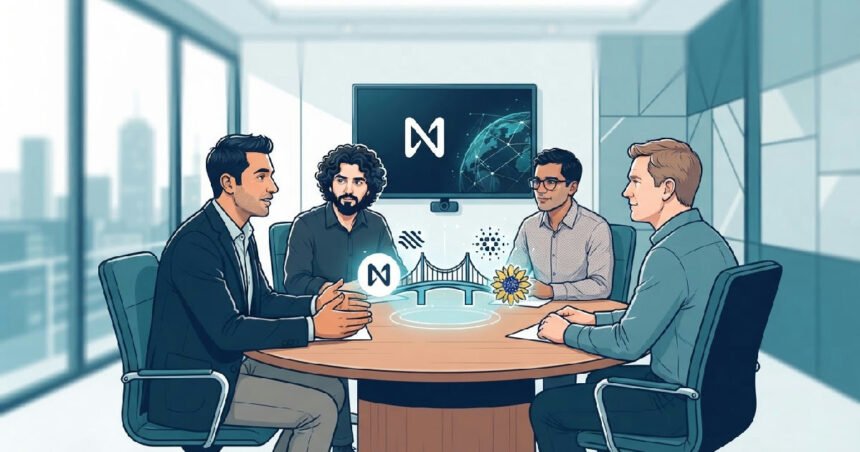
Helius CEO Mert Mumtaz was appointed to the NEAR Foundation’s governing Council on March 27, 2024, signaling growing blockchain interoperability. The appointment places a prominent Solana developer and leader at the heart of NEAR’s strategic decision-making body, signaling a potential shift in how layer-one protocols approach talent and governance.
Mumtaz joins a council that includes NEAR co-founder Illia Polosukhin, Anchorage Digital co-founder Diogo Mónica, and former NEAR Foundation COO Chris Donovan. His role will involve guiding product strategy, ecosystem growth, and governance as NEAR pursues its ambitious vision for a private on-chain market. The move is particularly noteworthy given Mumtaz’s deep roots in the Solana ecosystem, a direct competitor to NEAR.
Helius CEO Mert Mumtaz brings Solana expertise to NEAR
Mert Mumtaz is a well-regarded figure in the crypto development space, primarily known for co-founding and leading Helius. The company is a critical infrastructure provider for the Solana blockchain, offering services like remote procedure call (RPC) nodes, validators, and data streaming. Helius counts major Solana projects, including the Phantom wallet, Jupiter aggregator, Coinbase, and Bitwise, among its clients.
Before his work at Helius, Mumtaz was an engineer at Coinbase, where he worked on trading infrastructure and the platform’s integration with Solana. His technical expertise is widely respected, making his appointment to a strategic role at a competing protocol a major point of discussion. This isn’t just a symbolic gesture; it’s the integration of a rival’s top architectural mind into a core leadership group.
Despite his Solana-centric career, Mumtaz has been a vocal and early advocate for NEAR Intents, a protocol feature he lauded as the “market of markets” before it gained wider industry recognition.
According to the NEAR Foundation, NEAR Intents has already processed over $33 billion in all-time volume, with its confidential total value locked (TVL) now exceeding $160 million. This background suggests Mumtaz’s interest in NEAR is rooted in a shared technical vision for cross-chain functionality.
What Mumtaz’s appointment means for NEAR’s strategy
NEAR co-founder Illia Polosukhin praised Mumtaz as a “rare force in crypto,” citing his technical depth and direct approach as key assets for the council. “His sharp perspective and shared belief in the vision will be a major advantage for NEAR in shaping what we build next,” Polosukhin said in a statement. This underscores the foundation’s desire to inject external expertise to accelerate its roadmap.
The primary focus of this collaboration will be on expanding NEAR’s vision for building a “market of markets,” aimed at creating connected, planetary-scale liquidity. While the NEAR Protocol emerges as a leader in specific niches like AI, its broader goal is to unify disparate financial markets on-chain.
Mumtaz himself articulated this vision, stating, “For crypto to win, we need connected, unstoppable liquidity… Neither Solana, Zcash, or Bitcoin can win on their own, we must work together. And NEAR is how.”
This statement represents a philosophy of radical collaboration over tribalism. By bringing Mumtaz onto its council, the NEAR Foundation is betting that shared technical goals are more important than platform loyalty. His mandate is to help steer product development, go-to-market execution, and ecosystem strategy, effectively shaping the future of NEAR’s interoperability solutions.
A new model for cross-chain governance?
The appointment of a top Solana developer to the NEAR Foundation Council raises fascinating questions for the entire blockchain industry, particularly for ecosystems like Cardano that are charting their own path toward decentralized governance. NEAR’s model utilizes a centralized foundation with an appointed council of experts to oversee strategy. This structure allows for agile, strategic decisions like the hiring of Mumtaz.
This approach contrasts sharply with the path Cardano is paving with its Voltaire era of governance. Cardano’s model is built around on-chain voting, delegative representatives (dReps), and a constitutional committee, designed to place decision-making power directly in the hands of ADA holders. It prioritizes decentralization and community consensus over the speed of a centralized board.
For instance, when the Solana Foundation proposes Solana cold wallet migration plans, it is a foundation-led initiative, whereas a similar move on Cardano would eventually require a community-ratified on-chain vote.
Neither model is inherently superior, but they represent different philosophies. The NEAR approach allows it to quickly acquire talent and expertise from across the industry, potentially accelerating its development cycle. However, Cardano’s method aims to build a more resilient, censorship-resistant, and truly decentralized ecosystem for the long term, even if decision-making is slower.
Mumtaz’s appointment may serve as a crucial case study in the trade-offs between agile, expert-led governance and decentralized, community-driven governance.
The vision versus the reality of interoperability
Mumtaz’s belief in a “market of markets” reflects a growing consensus that the future of crypto is multi-chain. The idea that a single blockchain will “win” is fading, replaced by the need for seamless communication and liquidity transfer between networks. NEAR Intents is the foundation’s answer to this, creating a framework for expressing transaction goals that can be executed across different chains.
This pursuit of planetary-scale liquidity comes at a time when major assets like bitcoin trading holds steady, suggesting that growth must come from novel applications and improved capital efficiency in DeFi. Yet, the technical challenges of true interoperability remain immense.
This was highlighted by a recent $3.8 million exploit of NEAR Intents, caused by a flaw in its deposit and withdrawal infrastructure. Although the vulnerability was patched and users were promised full compensation, the incident serves as a stark reminder of the risks involved in building complex cross-chain systems.
Cardano, by contrast, has traditionally taken a more measured and research-driven approach to interoperability, focusing on building out its core infrastructure and fostering partner chains. The development of its Midnight protocol, a privacy-focused sidechain, and reliance on audited bridges like Wanchain represent a different strategy for connecting to the broader crypto world.
The success of NEAR’s more aggressive, integrated approach with Mumtaz’s guidance will be closely watched.
Future outlook and immediate impact
Mumtaz’s first public duty as a council member will be to serve as a judge at the upcoming NEAR Hackathon, scheduled from November 1 to 14. His presence lends significant credibility to the event and signals to developers that NEAR is serious about attracting top-tier talent.
He joins an impressive panel of judges that includes Polosukhin, a16z crypto’s Eddy Lazzarin, Avichal Garg of Electric Capital, and Haseeb Qureshi of Dragonfly.
In the broader picture, this appointment could set a precedent for other blockchain foundations. As the industry matures, we may see more “cross-pollination” of talent, with experts moving between ecosystems based on technical alignment rather than tribal affiliation. This could lead to a less fragmented and more collaborative development landscape, ultimately benefiting all users.
For the Cardano community, this is a moment for observation. It demonstrates a competing strategy for ecosystem growth and governance, one that prioritizes executive speed and poaching expertise. Whether this model proves more effective than Cardano’s deliberate, on-chain democratic process will be one of the defining narratives in the ongoing competition between layer-one blockchains.