

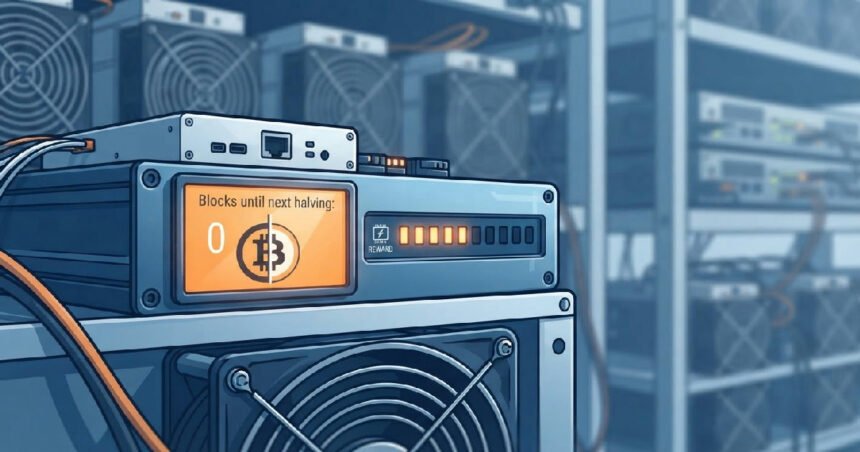
The Bitcoin halving, a fundamental and pre-programmed event embedded in the cryptocurrency’s protocol, significantly influences miner profitability, network security, and its overall supply schedule. This mechanism, hardcoded by its pseudonymous creator Satoshi Nakamoto, systematically reduces the rate at which new bitcoins enter circulation, aiming to control inflation and ensure scarcity.
Occurring roughly every four years, or specifically every 210,000 blocks, the halving event cuts in half the reward miners receive for validating transactions. This periodic reduction has profound implications for the Bitcoin ecosystem, reshaping economic incentives for miners and underpinning its predictable disinflationary nature.
Bitcoin Halving Fundamentals: The Core Mechanism
At its core, the Bitcoin halving represents a scheduled reduction in the block reward, the newly minted bitcoins miners receive for successfully adding a block to the blockchain. This process began with an initial reward of 50 BTC per block, progressively decreasing over time. The most recent halving occurred on April 20, 2024, lowering the block reward from 6.25 BTC to 3.125 BTC per block.
This programmed scarcity serves as a key differentiator for Bitcoin when compared to traditional fiat currencies, whose monetary supplies can be adjusted at will by central authorities. The next halving is estimated around April 2028, which will further reduce the reward to 1.5625 BTC per block.
This cycle will continue until approximately 2140, when the final fractions of Bitcoin are expected to be mined.
- Initial Block Reward: 50 BTC per block (2009-2012)
- Halving Schedule: Occurs every 210,000 blocks
- Approximate Time Between Halvings: Roughly every 4 years
- Current Block Reward (post-April 2024 halving): 3.125 BTC per block
- Next Estimated Block Reward (post-April 2028 halving): 1.5625 BTC per block
- Total Bitcoin Supply Limit: 21 million BTC
- Estimated Year for Last Bitcoin Mined: Around 2140
- Difficulty Adjustment Interval: Every 2,016 blocks (approximately every two weeks)
- Target Block Time: 10 minutes on average
These specific parameters are hardcoded into the Bitcoin protocol, ensuring its predictable issuance schedule. The consistent average block discovery time of 10 minutes is a crucial element of its design.
Economic Ripple Effects: Miner Revenue and Profitability
Miner revenue is derived from two primary sources: the block subsidy, which is the newly minted bitcoins, and transaction fees paid by users. After a Bitcoin halving, the block subsidy component of this revenue is immediately cut in half, presenting a significant challenge to profitability.
This immediate reduction forces miners to re-evaluate their operations and find ways to maintain financial viability. Less efficient miners, especially those with higher operational costs, often face the difficult decision to cease their activities.
Adapting to Reduced Rewards
To offset the decreased block reward, miners typically look for an increase in Bitcoin’s market price, a rise in transaction fees, or improvements in their operational efficiency. These market forces become critical to their continued existence.
Achieving greater efficiency often involves investing in more energy-efficient hardware, such as application-specific integrated circuits (ASICs), or securing lower electricity costs. This constant drive for optimization influences Bitcoin market trends and technological advancements in the mining sector.
Securing the Network: Hash Rate and Difficulty Adjustments
Bitcoin’s network security relies on its Proof-of-Work (PoW) consensus mechanism, where miners compete by solving complex cryptographic puzzles. This collective computational power, known as the hash rate, is vital for securing the blockchain against attacks like a 51% attack.
While a halving can initially lead to a temporary reduction in the overall hash rate as some less efficient miners power down, the network is specifically designed to adapt. This temporary dip does not compromise the long-term security of the system.
Bitcoin’s Adaptive Difficulty
The Bitcoin protocol includes an automatic difficulty adjustment mechanism, which recalibrates the mining difficulty every 2,016 blocks—roughly every two weeks. This crucial feature ensures a consistent average block discovery time of 10 minutes, regardless of fluctuations in the total mining power.
If the hash rate decreases, mining difficulty automatically falls, making it easier for remaining miners to find blocks. Conversely, if the hash rate increases, the difficulty rises. This adaptive mechanism guarantees continued network security and predictable block issuance.
Bitcoin’s Scarcity Model: Supply Dynamics
A core principle of Bitcoin’s architecture is its fixed maximum supply of 21 million coins, a limit immutably encoded into its protocol. The halving mechanism ensures that new bitcoins are introduced into circulation at a progressively decreasing rate, underpinning its disinflationary characteristics.
This predictable issuance schedule sharply contrasts with the elastic supply of many fiat currencies, whose monetary supplies can be expanded at the discretion of central authorities.
Satoshi Nakamoto articulated this philosophy in the Bitcoin whitepaper, stating, ‘The steady addition of a constant amount of new coins is analogous to gold miners expending resources to add gold to circulation. In our case, it is CPU time and electricity that is expended.’
Addressing Key Misconceptions
The Bitcoin halving frequently generates considerable discussion, and with it, several common misconceptions. Two prominent myths often surface regarding its immediate impact on price and the long-term viability of mining.
Price Speculation vs. Reality
One prevalent misconception suggests that a halving guarantees an immediate, sharp increase in Bitcoin’s price. While historical halvings have often been followed by significant price increases over the medium to long term, the market doesn’t necessarily experience an immediate price surge on the halving day itself.
Bitcoin price recovery and overall market movements are influenced by a multitude of factors. These include general demand, broader adoption rates, evolving regulatory landscapes, and prevailing market sentiment. Historical data also indicates that the magnitude of gains in each subsequent cycle has typically been shrinking.
Debunking the Mining “Death Spiral”
Another concern often raised is the notion of a ‘mining death spiral,’ which posits that a halving renders mining unprofitable, leading to reduced network security. While the immediate reduction in the block reward can indeed compel less efficient miners to cease operations, potentially causing a temporary dip in the hash rate, the network is designed to be resilient.
The adaptive difficulty adjustment mechanism serves as a crucial safeguard, automatically making mining easier if the hash rate drops. This ensures that blocks continue to be found at a consistent rate, thereby maintaining the network’s security and operational integrity.
The Road Ahead: Future Implications and Outlook
The ongoing cycle of Bitcoin halvings continues to shape its unique economic model and operational resilience. As block rewards progressively decrease towards zero by the estimated year 2140, transaction fees are expected to constitute an ever-growing share of miner income.
This transition is crucial for the long-term sustainability and security of the network.
The integrity of the Bitcoin protocol, enforced by software like Bitcoin Core, ensures strict adherence to these programmed rules, including the halving schedule and difficulty adjustments. This transparent and predictable monetary policy remains a cornerstone of Bitcoin’s value proposition.
Ultimately, the Bitcoin halving stands as a testament to the cryptocurrency’s innovative design. It effectively balances incentives for miners with a predictable, disinflationary supply schedule. It will continue to be a critical event in the digital asset calendar, influencing market dynamics and reinforcing Bitcoin’s programmed scarcity for years to come.