

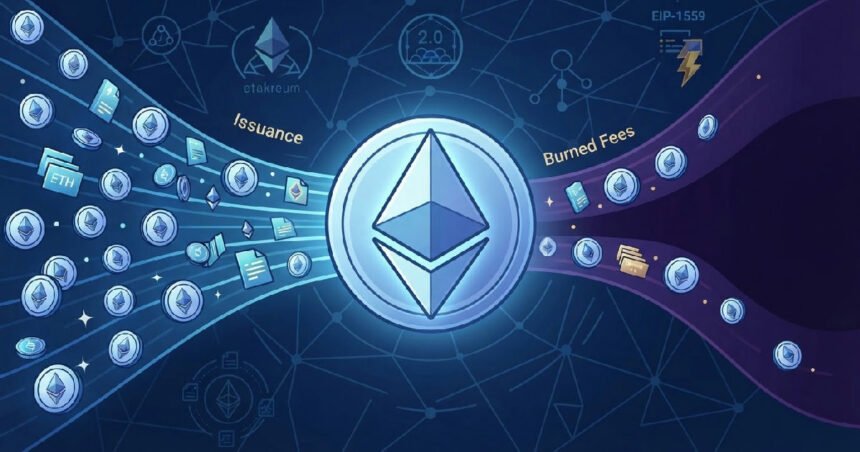
Understanding Ethereum’s supply dynamics today requires examining the core mechanisms governing its Ether (ETH) supply. The network’s current monetary policy is largely defined by its Proof-of-Stake (PoS) consensus mechanism and the EIP-1559 burning process. This combination drastically reduced new ETH issuance and introduced the potential for deflation, shaping Ethereum’s economic model.
This ongoing interplay between newly issued ETH and burned transaction fees continuously dictates whether the network experiences an inflationary or deflationary state. It represents a significant shift in the cryptocurrency’s long-term economic framework.
Ethereum’s supply dynamics and proof-of-stake
The Merge, completed on September 15, 2022, fundamentally transformed Ethereum by transitioning it from a Proof-of-Work (PoW) to a Proof-of-Stake (PoS) consensus mechanism. This complex upgrade seamlessly integrated the original Ethereum Mainnet, which executes transactions, with the Beacon Chain, now responsible for network consensus.
This move was years in the making, with Ethereum co-founder Vitalik Buterin indicating an intention to switch to Proof-of-Stake shortly after the network’s inception in 2015. The Ethereum Foundation, a non-profit organization supporting the ecosystem, estimated this shift dramatically cut the blockchain’s power consumption by 99.95%, making it a far more sustainable platform for private Ethereum applications.
How Ethereum’s monetary policy functions
Ethereum’s supply dynamics are now controlled by two primary forces: the issuance of new ETH to validators and the burning of ETH from transaction fees. Grasping this continuous balance is essential to understanding the network’s present economic model.
This delicate interplay establishes a dynamic equilibrium, where the supply of Ether is not fixed but rather responsive to network activity and security demands. Unlike traditional fixed-supply cryptocurrencies, Ethereum’s model aims for a more adaptable economic framework, one that can theoretically achieve a stable long-term supply or even become deflationary during periods of high usage, thereby reinforcing its value proposition.
Understanding this dual mechanism is paramount for anyone evaluating Ethereum’s economic future, as it directly impacts ETH’s scarcity and, consequently, its potential as a store of value. The transparency of these processes allows for real-time monitoring of supply changes, offering a clear view into the network’s ongoing health and market dynamics for all participants.
New ETH issuance to validators
Under the previous Proof-of-Work system, approximately 13,000 ETH was issued daily to miners as block rewards. An additional 1,600-1,700 ETH per day also went to stakers on the Beacon Chain, bringing the total annualized issuance rate to roughly 4.61%.
Today, issuance from the execution layer (former miner rewards) is zero. New ETH is now exclusively issued to validators on the consensus layer. They earn rewards for proposing and attesting to blocks, which secures network integrity.
Currently, with around 14 million ETH staked, validators receive approximately 1,700 ETH per day. This marks an 88-90% reduction in total new ETH issuance compared to the PoW era. The estimated annualized inflation rate immediately post-Merge was around 0.5%.
To participate as a validator, an individual or entity must stake 32 ETH. These validators then earn newly issued ETH, alongside a share of transaction fees, incentivizing their crucial role in network security.
Burning of transaction fees via EIP-1559
The burning mechanism, introduced with Ethereum Improvement Proposal 1559 (EIP-1559) in August 2021, plays a critical role in managing ETH supply. This upgrade reformed Ethereum’s transaction fee market, establishing a base fee for transactions.
This base fee, paid in ETH, is permanently removed from circulation, or “burned.” The base fee dynamically adjusts, increasing with network demand and decreasing during periods of lower activity, which helps manage network congestion. Users can track the overall burn rate to see its effect on token issuance protocol.
Users can also include an optional “priority fee,” or tip, to encourage validators to process their transactions faster. Unlike the base fee, this tip goes directly to the validator and is not burned, providing an additional incentive for their service.
Net supply balance and deflationary potential
The net change in Ethereum’s overall supply results from the ongoing balance between ETH issued to validators and ETH burned through transaction fees. This dynamic interplay continuously determines whether the cryptocurrency’s supply expands, contracts, or stabilizes.
If the amount of ETH burned exceeds the amount issued, Ethereum enters a deflationary state, meaning its total supply decreases over time. Conversely, if issuance outstrips burning, the supply increases, albeit at a much lower rate than before The Merge.
A critical threshold for this balance is an average gas price of at least 16 gwei. This level is generally required for the amount of ETH burned to offset the approximately 1,700 ETH issued daily to validators, potentially leading to zero or negative net inflation for Ethereum.
Since The Merge, Ethereum has experienced periods of both net deflation and modest inflation. This variability largely depends on network activity and the prevailing transaction fees. Recent upgrades, such as Dencun in March 2024, have impacted this balance by reducing fees for Layer 2 solutions.
This can lead to lower base fees being paid on the mainnet, potentially contributing to periods of supply growth when less ETH is burned.
Realities of Ethereum’s supply: dispelling myths
Despite the clarity offered by The Merge, certain misconceptions about Ethereum’s supply persist. It’s crucial to differentiate these from the underlying realities of the network’s monetary policy. Understanding these nuances better informs investors and users about the asset’s true behavior.
These persistent misconceptions often stem from oversimplified narratives or an incomplete understanding of the complex interactions between staking rewards, transaction fee burning, and broader network activity. The transition to Proof-of-Stake was a massive undertaking, and fully appreciating its long-term economic implications requires moving beyond initial assumptions to a data-driven analysis of actual supply changes.
Moreover, Ethereum’s monetary policy is not a static construct but an evolving one, continuously refined through community proposals and network upgrades. This ongoing development means that understanding the current ‘realities’ is a continuous process, demanding stakeholders remain informed about how factors like Layer 2 scaling solutions or increased staking participation influence the overall supply trajectory.
Not consistently deflationary immediately
One common misconception was that The Merge immediately made Ethereum consistently deflationary. While the upgrade drastically reduced issuance and introduced the *potential* for deflation, Ethereum’s net supply change remains highly dynamic. It’s a direct function of network activity and transaction fees.
Periods of high network usage and elevated base fees can indeed lead to deflationary phases. However, lower network activity can result in modest inflation. Ethereum’s supply has actually increased by over 1 million ETH since The Merge, showing an annual inflation rate of around 0.24% as of March 2026.
This increase is partly due to factors like greater staking participation and reduced Layer 2 fees post-Dencun upgrade, which impacts the burning rate.
The Merge did not directly lower transaction fees
Another prevalent belief was that The Merge directly resulted in lower transaction fees. In reality, The Merge primarily transitioned the network’s consensus mechanism. It did not directly alter network capacity or throughput in a way that would significantly reduce gas fees for users.
Gas fees on Ethereum are predominantly a function of network demand relative to its capacity. While future upgrades are planned for enhancing network capacity and scalability, The Merge itself was not designed to address transaction costs directly. The challenge of high transaction costs remains a focus for ongoing network development.
Navigating Ethereum’s evolving supply landscape
The Ethereum network has undergone a profound transformation with The Merge, fundamentally altering its monetary policy. This shift from Proof-of-Work to Proof-of-Stake established a new framework for ETH issuance and overall supply management.
The dynamic interplay between validator issuance and EIP-1559’s burning mechanism will continue to shape Ethereum’s supply trajectory. While deflationary periods are possible, and have occurred, the network’s long-term supply remains sensitive to both staking participation and on-chain activity levels.
Frequently Asked Questions about Ethereum’s Supply
What is The Merge?
Does EIP-1559 make Ethereum deflationary?
Did The Merge lower transaction fees?
How much ETH is issued daily to validators?
Citations
- Source for Merge date (Placeholder)
- Source for Beacon Chain integration (Placeholder)
- Source for Vitalik Buterin’s involvement (Placeholder)
- Source for Ethereum Foundation’s role (Placeholder)
- Source for power consumption reduction data (Placeholder)