

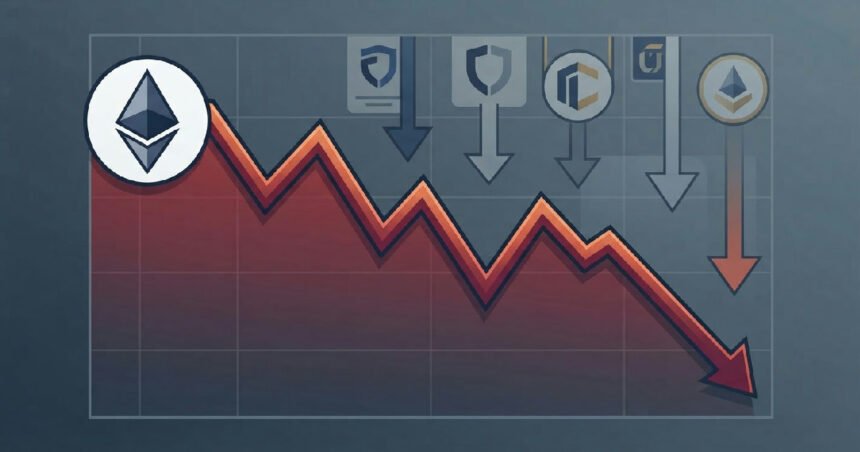
Ethereum (ETH), the world’s second-largest cryptocurrency, saw its value fall significantly on November 5, 2026. The digital asset experienced a 6.93% price drop, reaching $2254 amidst intensified selling pressure. This Ethereum price dips follows a reversal in US spot ETF outflows.
This downturn follows a notable reversal in recent US spot exchange-traded fund (ETF) flows. Market sentiment took a hit as substantial weekly outflows from these institutional investment vehicles weighed on Ethereum’s performance.
Ethereum price dips as spot ETF outflows trigger downturn
The recent dip in Ethereum’s price directly correlates with a shift in sentiment surrounding US spot Ethereum ETFs. These financial products, once hailed as catalysts for broader adoption, are now facing a challenging period.
On November 3, 2026, US spot Ethereum ETFs recorded a net outflow of $85.3 million, equivalent to 37.86K ETH. The iShares Ethereum Trust ETF (ETHA) bore the brunt of this exodus, seeing the largest single outflow of $74.4 million.
Over the previous five trading days, the cumulative net outflows reached a substantial -$507.6 million. The broader trend for the last 30 days paints an even starker picture, with total net outflows hitting -$1.69 billion, or 690.67K ETH.
This period of significant institutional withdrawal has coincided with a notable 16.83% price decline for Ethereum, underscoring the ETFs’ growing influence on market valuation. The sudden change in flow direction has prompted questions about sustained institutional interest.
The rise and reality of Ethereum spot ETFs
Ethereum’s journey to becoming a mainstream investment vehicle has been a long one, marked by key technological advancements and regulatory breakthroughs. Conceived by Vitalik Buterin in late 2013, Ethereum officially launched on July 30, 2015, distinguishing itself from Bitcoin with its smart contract functionality and support for decentralized applications.
The cryptocurrency transitioned to a more energy-efficient proof-of-stake (PoS) consensus mechanism in 2022, an event known as “The Merge.” This move aimed to enhance its sustainability and scalability, drawing further attention from traditional finance.
The US Securities and Exchange Commission (SEC) finally approved rule changes for eight spot Ethereum ETFs on May 23, 2024. Trading for these highly anticipated products commenced on July 23, 2024, involving major issuers like BlackRock, Grayscale, Fidelity, VanEck, and Bitwise.
These spot ETFs directly track Ethereum’s price by holding the actual asset. They offer investors exposure to cryptocurrency movements through conventional brokerage accounts, circumventing the complexities of direct digital asset ownership and management. Understanding Ethereum’s supply dynamics helps contextualize these market shifts.
Bitcoin’s prior ETF experience offers a contrast
The approval of Bitcoin spot ETFs in January 2024 set a significant precedent for the crypto market. That event sparked expectations of a substantial price rally, and indeed, Bitcoin experienced a notable upswing following increased accessibility and liquidity.
In stark contrast, Ethereum’s price reaction after its own spot ETF approval and launch in July 2024 was largely subdued. Despite attracting over $10 billion in assets on its first day, ETH saw little movement, and in some cases, even a slight dip. This difference highlighted that market responses to institutional products are not always uniform.
Institutional money shifts amid outflow dynamics
The current reversal in ETF flows indicates a cautious turn among institutional investors. After a period of initial enthusiasm, the market is now processing sustained withdrawals, creating downward pressure on Ethereum’s price.
Total Assets Under Management (AUM) for Ethereum ETFs still stand at $22.26 billion across 12 funds from eight issuers. These funds collectively hold 5.9 million ETH, representing a significant 4.83% of Ethereum’s circulating supply and 7.86% of its overall market capitalization.
However, the recent trend of outflows demonstrates how quickly sentiment can pivot in the volatile crypto space. While a brief inflow of $53.02 million on November 4, 2026, broke a seven-session outflow streak, it wasn’t enough to counteract the broader bearish movement.
The net outflows over the last month underscore a period of re-evaluation for some institutional players. This shift impacts not only Ethereum but also influences perceptions of the wider cryptocurrency market, especially concerning the stability offered by ETFs. Large movements in Bitcoin and Ethereum ETFs can have broad market implications.
Staking, regulation, and the path forward for ETH ETFs
A significant factor distinguishing Ethereum ETFs from direct ETH ownership is the regulatory stance on staking. Current US spot Ethereum ETFs are precluded from staking the Ether they hold, meaning ETF holders miss out on the 3-4% annual staking yields available to direct holders.
This regulatory constraint means that staking-enabled products face a more intricate review process. Regulators are still debating whether yield generation fundamentally alters the legal character of these investment vehicles. Grayscale, for example, has indicated plans for a “Grayscale Ethereum Staking ETF” (ETHE), where staking rewards would be converted to cash and distributed to shareholders.
The regulatory environment continues to evolve. The SEC issued detailed disclosure guidance on crypto ETPs on July 1, 2025, clarifying how these products should navigate federal securities laws. This guidance covers aspects such as the disclosure of underlying crypto assets and conflicts of interest.
Furthermore, the approval of generic listing standards on September 17, 2025, has streamlined the approval process for crypto ETFs. This framework shortens approval timelines to approximately 75 days for assets traded on a CFTC-regulated Designated Contract Market for at least six months.
This could pave the way for more diverse crypto ETF offerings in the future, including those focused on private Ethereum applications or other altcoins.
What’s next for Ethereum amidst market uncertainty?
Looking ahead, the trajectory for Ethereum and its associated ETFs remains a subject of considerable debate among analysts. Some anticipate a gradual increase in institutional demand, which could eventually stabilize prices and drive long-term growth.
However, others point to the persistent volatility of the cryptocurrency market, coupled with intense fee competition among ETF issuers, as factors that could sustain price fluctuations. Ethereum’s price was around $2,417.10 on November 5, 2026, marking a 4.07% gain over 24 hours but a 10.80% decline over the month.
The prospect of staking ETF approvals represents another potential turning point. The final deadline for early applications for Ethereum ETF staking options is late October 2025, with BlackRock’s application expected to be reviewed by April 2026. An approval could occur as early as Q4 2025, potentially unlocking new yield opportunities for institutional investors and impacting ETH’s valuation.
For now, the market will be closely watching for any sustained shifts in ETF flows and further regulatory clarity. The interplay between traditional financial structures and the inherent dynamism of cryptocurrencies ensures that Ethereum will remain a focal point for investors worldwide.