

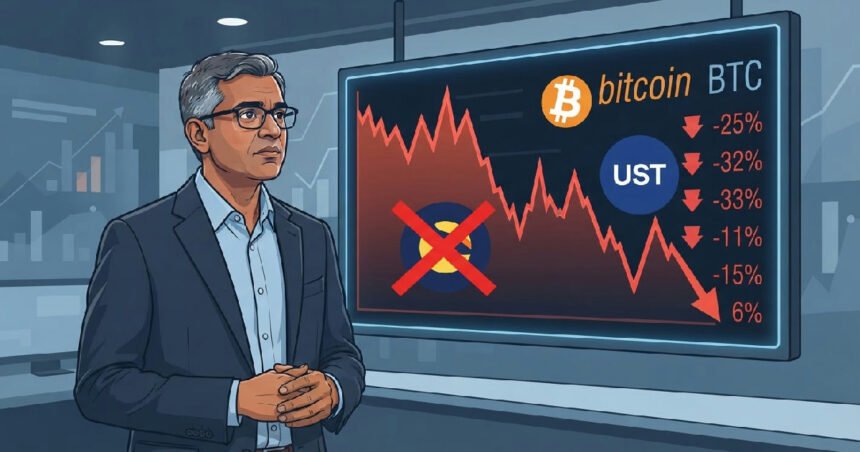
A catastrophic Bitcoin tumble on May 11, 2022, saw the world’s leading cryptocurrency plummet below $28,000, its lowest level since late 2020. The dramatic 10% single-day drop was triggered by the systemic collapse of the TerraUSD (UST) stablecoin, wiping out over $200 billion from the total crypto market in just 24 hours and sending shockwaves through the industry.
The event, which cut Bitcoin’s value by more than half from its November 2021 peak, prompted seasoned investors and analysts to declare that this market crash felt fundamentally different from previous downturns. The sentiment was captured by Luno executive Vijay Ayyar, who noted, “This time actually seems different, in terms of the macro environment, and also the size of the industry.”
The TerraUSD implosion and the Bitcoin tumble
The immediate catalyst for the market-wide panic was the failure of TerraUSD, an algorithmic stablecoin designed to maintain a one-to-one peg with the U.S. dollar. When UST lost its peg and fell to as low as 30 cents, it triggered a death spiral for its sister token, LUNA, and the broader Terra ecosystem.
The Luna Foundation Guard (LFG), a non-profit supporting the network, attempted to defend the peg by selling its vast Bitcoin reserves, estimated to be worth billions.
This desperate sell-off flooded the market with Bitcoin, creating immense downward pressure. “The main reason for the recent crash is due to the Luna Foundation Guard selling their Bitcoin reserves to try and defend the UST peg,” said Marcus Sotiriou, an analyst at GlobalBlock at the time. The contagion spread rapidly, as the ether DeFi plunge demonstrated the panic was not isolated to Bitcoin.
The collapse obliterated an estimated $40 billion in market value from the Terra ecosystem alone. Mike Novogratz, CEO of Galaxy Digital (a firm that had been a vocal supporter of LUNA), described the fallout in a stark letter to shareholders.
“In Luna and UST alone, $40bn of market value was destroyed in a very short amount of time,” he wrote. “The collapse dented confidence in crypto and DeFi.”
The crisis also drew sharp criticism from industry leaders. Changpeng Zhao, CEO of the major exchange Binance, expressed his disappointment with the Terra team’s response to the disaster. Binance was forced to temporarily pause withdrawals of both LUNA and UST tokens, citing network congestion and extreme risk to users as the system unravelled.
‘A full-fledged ass-kicking’: Veterans sound the alarm
While Bitcoin has always been volatile, veteran investors who had weathered multiple bear markets saw the May 2022 crash as a unique and more dangerous event. Novogratz didn’t mince words, calling it “a full-fledged ass-kicking” and predicting it would be “a while before markets turn around.” He stressed that the event would serve as a crucial “test of all projects and people in the space.”
Vijay Ayyar, then VP of Corporate Development at Luno, echoed this sentiment. He pointed out that the crypto industry had never before faced such a severe global macroeconomic crisis while being so large and interconnected.
“We’ve never really been in a situation where the macro has been this bad, in terms of inflation, interest rates, and the war,” he stated, referencing the war in Ukraine and soaring global inflation.
This perfect storm of internal failure and external pressure created a pervasive sense of dread. Alex Miller, CEO of Bitcoin mining firm Foundry, summarized the mood as a “state of fear and uncertainty” that was fuelling intense selling pressure across the board.
For many, the collapse of a top-ten crypto project wasn’t just another dip; it was a fundamental challenge to the perceived stability of decentralized finance.
A perfect storm of macroeconomic pressure
The Terra/LUNA implosion did not happen in a vacuum. It occurred amid a broader risk-off environment as global markets buckled under the weight of rising inflation and aggressive monetary tightening by the U.S. Federal Reserve. The crypto crash mirrored a painful sell-off in technology stocks, with the Nasdaq index also experiencing a steep decline.
Analysts at the time, including Simon Peters of eToro and Noelle Acheson of Genesis Global Trading, noted that the crypto market was being heavily “driven by the wider macroeconomic picture.” Concerns over tightening Bitcoin liquidity were already mounting as investors priced in aggressive interest rate hikes to combat inflation.
In this environment, investors fled assets on the higher end of the risk spectrum, like cryptocurrencies, in favor of perceived safe havens.
The correlation with equities shattered the popular narrative of Bitcoin as an uncorrelated “digital gold” or a hedge against inflation. Instead, it behaved like a high-beta tech stock, amplifying the losses seen in the broader market. This dynamic added another layer of concern for investors who had hoped crypto would offer a refuge from turmoil in traditional finance.
Gauging the fear and forecasting the floor
As prices cratered, market sentiment gauges flashed extreme warning signals. The widely-watched Crypto Fear & Greed Index, which measures investor emotion, plunged into the single digits, indicating “extreme fear.” This level of pessimism, while often a contrarian buy signal in the past, felt more ominous during this crisis due to the systemic nature of the Terra collapse.
The closing price for Bitcoin on May 11, 2022, was $28,763.38, a punishing 7.3% drop for the day. Its market capitalization shrank to approximately $550.87 billion as the total crypto market cap fell below the $1.3 trillion mark for the first time since July 2021. The speed and scale of the value destruction were staggering.
Amid the panic, bleak forecasts became common. Some analysts, including veteran investor Clem Chambers, began to predict that Bitcoin could fall as low as $20,000, with some models even suggesting a wick down toward $15,000. These predictions, which seemed outlandish just weeks prior, suddenly became plausible as key technical support levels were broken one after another.
The aftermath and the search for stability
The May 2022 crash left deep scars on the crypto industry. It not only wiped out billions in retail and institutional wealth but also severely damaged trust in the burgeoning DeFi sector. The failure of an algorithmic stablecoin at such a massive scale immediately put the entire concept under intense scrutiny from global regulators.
In the months that followed, the event became a centerpiece in policy discussions. The collapse served as a stark reminder of how regulatory changes shape market trends, with governments in the U.S., Europe, and Asia accelerating plans for comprehensive stablecoin oversight to prevent a similar catastrophe from impacting the traditional financial system.
For the crypto market itself, the event was a painful but necessary purge. It exposed the vulnerabilities of poorly designed protocols and washed out huge amounts of leverage. As Mike Novogratz noted, it was a brutal test.
The projects and platforms that survived the subsequent “crypto winter” were forced to become more resilient, transparent, and focused on sustainable long-term value, setting the stage for the industry’s next chapter.