

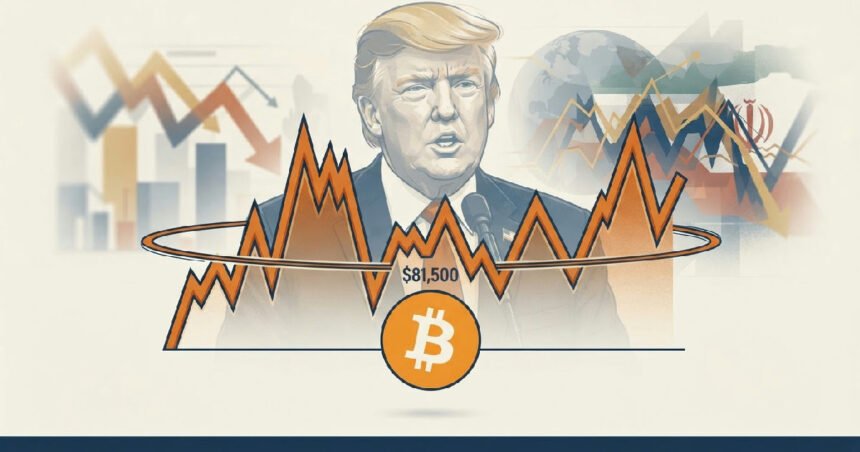
Bitcoin’s price remained precariously close to its critical $81,500 exchange-traded fund (ETF) cost basis on Thursday, October 22, 2026. This occurred even as US President Donald Trump’s renewed warnings about Iran triggered a significant downturn across global stock markets.
At 11:39 AM EDT, Bitcoin (BTC) was trading at $81,551.39, preserving a 2.9% daily loss. The cryptocurrency’s ability to defend this key support level comes amidst geopolitical tensions and notable ETF activity, including recent outflows from US spot Bitcoin ETFs.
Bitcoin’s critical ETF cost basis support
The $81,500 mark represents the average purchase price for Bitcoin held by all US spot ETFs, also known as the Spot ETF Cost Basis. This level acts as a significant liquidity floor. On-chain data analytics platform Glassnode emphasized on October 22, 2026, that Bitcoin’s price must not breach this crucial support.
This critical price point recently transitioned from a strong resistance level during the May 2026 bull run to a foundational support. Bitcoin has now twice successfully defended this $81,500 cost basis. This resilience highlights its growing importance to institutional investors in the volatile cryptocurrency market.
ETF flows and market resilience
Despite Bitcoin’s defense of this key level, the market has seen considerable institutional capital movement. US spot Bitcoin ETFs recorded substantial weekly outflows totaling $678.9 million. An additional $65 million flowed out specifically on Monday, October 19, 2026, indicating continued selling pressure.
Yet, earlier inflows on October 19, led by BlackRock’s iShares Bitcoin Trust (IBIT), brought in $526 million, helping to stabilize prices near $84,000. Vugar Usi Zade, CEO of MEXC, noted that this robust institutional presence has established a stronger structural floor. It effectively anchors the average cost for spot ETFs and custodial services around the $80,000 mark.
Navigating key support and resistance levels
The ability of Bitcoin to hold its ground at the ETF cost basis underscores the importance of technical analysis in the current market. Should the $81,500 support level fail, Glassnode indicates the next significant support could be around $77,600. This level aligns with the True Market Mean Price, suggesting a strong historical average.
In a more pessimistic scenario, where bullish sentiment falters, Glassnode’s metrics identify $74,800 as a robust support level. This figure notably overlaps with the Short-Term Holder Cost Basis, representing the average purchase price for newer market participants. Analysts at Bitfinex Alpha anticipate BTCUSD trading within a narrow range. They forecast it will fluctuate between $81,300 and $84,400 until the Federal Reserve meeting on October 28.
A sustained demand from ETFs coupled with stable leverage metrics would likely support a breakout above $84,400. Conversely, persistent macro headwinds combined with a close below $81,300 would significantly increase the risk. Such a move could push the price towards the October 15 low of $79,821, signaling further downward pressure.
Geopolitical tensions trigger market sell-off
The broader financial markets reacted sharply to comments from US President Donald Trump regarding Iran. Posting on Truth Social, President Trump reiterated the possibility of new military action against Iran. He stated the US was “not negotiating” with the Iranian side, escalating geopolitical concerns.
President Trump also claimed Iran was attempting to influence oil prices before the US midterm elections on November 3, 2026. He accused them of “making up fake hits, mines, and everything else” to drive up costs.
His comments intensified scrutiny on US-Iran relations, especially after Iran’s state television reported attacks on seven oil tankers in the Strait of Hormuz. The incident reportedly occurred overnight on Thursday, following alleged targeting or naval mine strikes.
These remarks sent immediate ripples through global stock markets. The S&P 500 Index was down 1.3% at the open on Thursday, October 22, 2026. The tech-heavy Nasdaq Composite Index experienced an even sharper decline, falling 2.3%.
The technology sell-off was particularly pronounced in the semiconductor sector. Ian Lyngen at BMO Capital Markets observed that “Treasuries have emerged as a primary beneficiary as global risk sentiment has come under pressure.” This flight to safety indicates investor apprehension amid rising geopolitical tensions.
Additionally, Brent oil prices soared to over $112 per barrel, reaching their highest level since May, following an attack in Saudi Arabia that hit the international airport in Dammam. West Texas Intermediate crude oil futures also gained, trading around $98.50 per barrel.
Broader market sentiment and macro pressures
Beyond the immediate geopolitical concerns, the wider economic landscape also influences Bitcoin’s trajectory. The Fear and Greed Index, a measure of market sentiment, currently stands at 68. This indicates a rising sentiment among investors despite the cryptocurrency’s recent price stagnation. This seemingly contradictory reading suggests underlying bullishness, even as short-term price movements remain constrained.
The upcoming Federal Reserve meeting, scheduled for October 27-28, looms large for market participants. Recent September Consumer Price Index (CPI) figures, showing inflation at 3.7%, have revived expectations for further interest rate hikes. Such monetary policy decisions can significantly impact asset prices across the board, including digital assets. Digital asset services, including custody providers, closely monitor these macro trends.
Major corporate entities continue to shape the institutional adoption of Bitcoin. BlackRock’s iShares Bitcoin Trust (IBIT) has consistently led other institutions in renewed Bitcoin accumulation. This ongoing activity by large asset managers reflects a sustained belief in Bitcoin’s long-term value proposition, despite daily price fluctuations. Even Fidelity’s FBTC ETF wallet recently purchased and withdrew 282.63 BTC, valued at $23.08 million, from Binance, showcasing active participation.
Bitcoin’s journey and institutional adoption
Bitcoin’s current position near the $81,500 ETF cost basis is part of its dynamic price history. The cryptocurrency reached its all-time high in early October 2025, climbing to approximately US$126,000. This followed a significant milestone on December 5, 2024, when Bitcoin first broke the US$100,000 barrier, marking a period of rapid ascent.
By early 2026, Bitcoin was trading near US$95,000, illustrating its consistent growth over recent years. The current price action, therefore, represents a pull-back from these peaks, yet it maintains a robust institutional floor.
Firms like Strive have significantly increased their Bitcoin holdings, purchasing 4,045 bitcoins between October 12 and 16, bringing their total to 36,818 BTC. This continued accumulation underscores the long-term strategic investments being made by major players.
While the broader market experienced tech sell-offs, with major cloud providers like Oracle, Alphabet, Microsoft, and Amazon seeing declines, Bitcoin’s resilience around its ETF cost basis highlights its unique market dynamics. Institutional interest, as evidenced by consistent purchases, forms a strong underlying support. This contrasts with traditional equities, which are more susceptible to immediate geopolitical and economic shocks.