

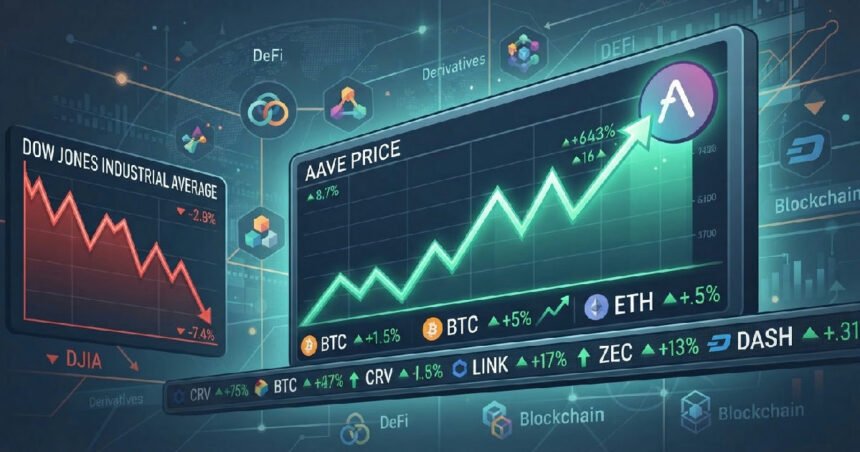
The decentralized finance (DeFi) sector staged a remarkable rally on Tuesday, September 29, 2026, led by a significant Aave price surge that saw the lending protocol’s token climb over 16%. The move defied intense pressure from traditional financial markets, where surging U.S. Treasury yields sent stocks tumbling for a second consecutive day.
While the Dow Jones Industrial Average shed over 300 points, the crypto market demonstrated a surprising resilience. Bitcoin recovered its recent losses to trade at $84,170, and the wider CoinDesk 100 index posted gains.
Aave price surge from Aavenomics upgrade
This divergence highlights a potential decoupling, where digital assets chart their own course independent of macroeconomic headwinds that typically stifle risk assets. The broader crypto rally suggests investor confidence remains robust within the digital asset class.
The primary catalyst for Aave’s standout performance appears to be renewed speculation surrounding a significant protocol upgrade. Aave’s founder, Stani Kulechov, hinted at details for “Aavenomics 3.0,” including the potential introduction of a token burn mechanism. This prospect has captured the market’s attention, sending the AAVE token from approximately $149 to over $175 in a single day.
A token burn permanently removes a portion of the cryptocurrency’s supply from circulation. For investors, this is a bullish signal. By reducing the total number of available tokens, the mechanism can theoretically increase the value of the remaining ones, assuming demand stays constant or grows. The discussion around this deflationary tool is a powerful narrative driving the current price action.
This speculation is compounded by other positive developments within the Aave ecosystem. The protocol has an ongoing buyback program and plans for its ecosystem reserve that support the token’s value. Furthermore, the expansion of Aave’s market for tokenized-equity lending continues to attract interest from sophisticated investors, adding another layer of utility and demand.
DeFi sector shows renewed strength across the board
While Aave was the day’s clear leader, the rally was not an isolated event. The broader DeFi sector showed significant strength, with the CoinDesk DeFi Select Index (DFX) gaining 5.0%.
This marks the second time in a week that DeFi has driven a positive move in the crypto markets, suggesting a revival of interest in the sector after a period where reports pointed to stalled DeFi growth.
Other major DeFi tokens posted impressive gains alongside Aave. Curve DAO Token (CRV) gained 5.2% on September 29, 2026. Chainlink (LINK), a critical oracle network for the DeFi space, surged 14% over 24 hours as futures open interest in the token hit its highest level since late August, pointing to an influx of new long positions.
However, the gains weren’t universal. Privacy-focused tokens notably lagged, with Zcash (ZEC) tumbling 4.1% to $1,422.35 and 8.4% over 24 hours. Dash (DASH) also fell 6.4% to $61.38. This divergence indicates that investors are becoming more selective, pouring capital into specific sectors like DeFi while moving out of others.
Crypto charts its own course amid macroeconomic turmoil
The crypto market’s bullish performance on Tuesday was particularly notable given the bleak backdrop in traditional finance. The 10-year U.S. Treasury yield sat at 5.234%, a level not seen since 2007. Meanwhile, the 30-year yield reached 5.549%, hovering near a high from 2004. These high, relatively safe returns on government debt typically pull capital away from more speculative investments.
This dynamic played out as expected in the stock market. The S&P 500 and Nasdaq Composite fell 0.8% and 0.9% respectively on Monday, with losses continuing into Tuesday’s session. The fact that Bitcoin, Aave, and other digital assets rallied in the face of this pressure is a significant data point for investors.
It suggests the crypto market may be developing its own internal drivers that are strong enough to overcome external macroeconomic forces.
Despite the market’s upward movement, traders continue to analyze market dynamics for signs of overheating. They remain watchful for signals that could indicate a shift from the current momentum, seeking sustained growth without excessive speculation.
New proposals hint at future growth for the Aave protocol
Looking forward, Aave’s governance pipeline contains proposals that could further bolster its position as a DeFi leader. One of the most significant is from Sentora, an institutional DeFi platform. Sentora has proposed running independently curated lending markets on the upcoming Aave V4, with a 50/50 revenue split with the Aave DAO.
If approved, this partnership would see Sentora managing key aspects like collateral selection, risk parameters, and interest rates for its own dedicated markets on the Aave protocol. This could bring a new wave of institutional capital and activity to Aave while providing a substantial new revenue stream for its decentralized autonomous organization (DAO). It’s a model that could create a more robust and diversified ecosystem.
Other governance activity includes a more routine risk proposal presented on September 28, 2026, to adjust borrowing conditions for certain assets. One such change involved a small increase to the borrowing rate for the USDe stablecoin. This kind of proactive risk management is crucial for maintaining the long-term health and stability of a lending protocol, providing further confidence for its users and token holders.
Derivatives data reveals shifting trader sentiment
Deepening the analysis, data from derivatives markets confirms the shift towards a more bullish outlook. While overall futures open interest (OI) has remained relatively flat, key indicators point to a change in trader positioning. How Bitcoin derivatives influence its spot market is a complex but crucial factor in understanding market movements.
For Bitcoin, futures OI slipped slightly, but funding rates have turned positive again after brief negative readings. This suggests that the cost of holding long positions is increasing, a sign of growing bullish demand. Perhaps most tellingly, sentiment among large-scale traders, or “whales,” on the Binance exchange was up from bullish.
The long/short ratio for whale positions reached 1.88, indicating significantly more long positions than short ones.
This bullishness is also reflected in options activity, where traders have been swapping puts for calls. This shift indicates a preference for positions that profit from price increases. For Ethereum, the $3,000 call expiring October 9 is the most traded contract, up from the previous day’s top pick, the $2,850 call expiring October 20.