

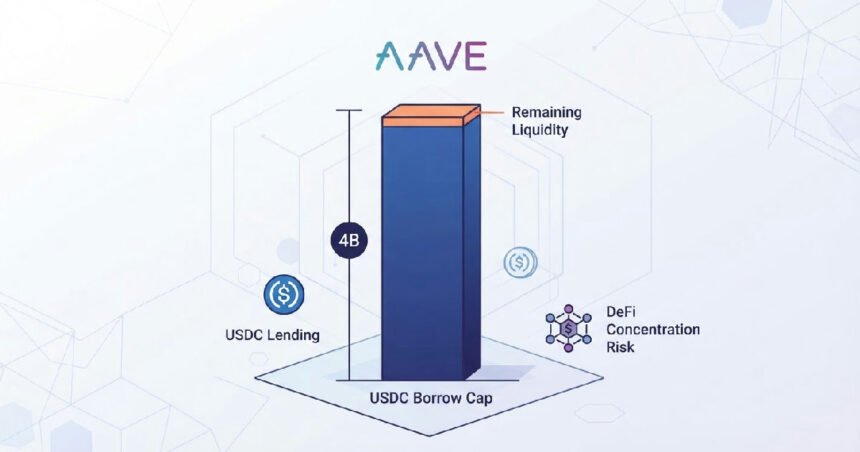
Aave increased its main Ethereum market Aave USDC borrow cap to $4 billion on November 20, a significant boost to borrowing capacity. The decision followed a series of massive deposits from a single, unidentified wallet totaling nearly $1.5 billion, which pushed borrowing demand toward its previous ceiling.
While the cap increase accommodates growing demand, it introduces a scenario where available liquidity for lenders looking to withdraw their funds could become exceptionally tight.
A whale’s arrival prompts Aave USDC borrow cap changes
If total borrowing reaches the new $4 billion limit while total deposits remain near their late November 20 level of $4.19 billion, only about $190 million in USDC would be left in the pool for withdrawals. This represents a significant potential squeeze on short-term liquidity.
The chain of events was set in motion on November 19, when a single wallet, identified by the address 0x176F…a132, made three substantial USDC deposits over roughly 75 minutes. The deposits consisted of 400 million, 350 million, and 738 million USDC, bringing the wallet’s total contribution to just under $1.5 billion. This single entity’s actions had an immediate and profound impact on the market’s metrics.
These deposits pushed the total supply of USDC close to its then-existing deposit limit of $3.5 billion, with risk management firm LlamaRisk reporting that the cap was 99.6% utilized. In response, Aave governance acted swiftly to raise the deposit cap to $5 billion. But that was only half of the equation.
Increased supply naturally enables increased borrowing, a situation that carries its own set of risks for decentralized protocols which can sometimes result in warnings of liquidation risk.
As borrowers took advantage of the new liquidity, total loans surged, approaching 98.5% of the former $2.7 billion borrow cap. This triggered another intervention. On November 20, following a recommendation from LlamaRisk, the protocol executed a transaction at 11:15 UTC to hoist the borrow cap to its current $4 billion level, finalized in Ethereum block 26,455,948.
The mechanics of a potential liquidity crunch
The core of the concern lies in how Aave manages its liquidity pools. Lenders and borrowers draw from the same pot of capital. Withdrawals are paid from the portion of supplied assets that has not been loaned out.
According to a snapshot from Aave Tracker late on November 20, the market held $4.19 billion in USDC deposits and had $3.05 billion in outstanding loans. This left approximately $1.14 billion available for withdrawals.
This “unborrowed” buffer shrinks as new loans are issued. The $190 million figure represents a stress-test scenario, not a current reality. It illustrates what would happen if borrowing demand consumes nearly all the available capital up to the new ceiling without a corresponding increase in new deposits. In this situation, the pool’s utilization rate would jump from its current 72.8% to about 95.5%.
Such a high utilization rate is a critical threshold. According to LlamaRisk, Aave’s interest rate model is designed to sharply increase borrowing costs when utilization exceeds 94%.
This mechanism is intended to be self-correcting; prohibitively high rates discourage new borrowing and incentivize existing borrowers to repay their loans, which in turn frees up capital and replenishes the withdrawal pool. The high yields could also attract new lenders, further boosting liquidity.
Concentration risk in the spotlight
The episode casts a harsh light on the issue of concentration risk within DeFi protocols. By late November 20, the single large depositor held approximately 1.495 billion aEthUSDC, the receipt token representing a claim on the underlying USDC in the pool. This stake amounted to a staggering 35.7% of the entire market.
Crucially, at that time, the whale’s total position was larger than the entire available liquidity in the pool. The depositor’s $1.495 billion claim dwarfed the $1.14 billion in unborrowed USDC. This means the entity could not have withdrawn its entire position at once. A full redemption would have required waiting for other users to repay their loans or for new capital to enter the pool.
This dynamic presents a tangible risk for all lenders in the pool. If the whale were to attempt a large withdrawal—say, $500 million—it would significantly reduce the remaining liquidity available for everyone else. In the hypothetical $4 billion debt scenario, such a withdrawal would be impossible as it would exceed the available $190 million.
The scale of this single position creates a potential bottleneck, where the actions of one participant can dictate the immediate withdrawal capacity for the entire market, a growing concern amid changes in institutional crypto exposure.
Aave’s risk parameters are working as designed
While the low liquidity scenario sounds alarming, the protocol’s reaction demonstrates that its risk management frameworks are functioning as intended. Borrow and supply caps are not arbitrary; they are guardrails designed to prevent unchecked growth from threatening the solvency of the entire system. When market activity pushes against these limits, it triggers a governance process to reassess and adjust them.
The involvement of third-party risk managers like LlamaRisk provides a layer of specialized oversight. Their analysis and public recommendations form the basis for governance decisions, creating a transparent, albeit reactive, process for managing market dynamics. The rapid adjustments to both the supply and borrow caps in response to the whale’s deposit and subsequent borrowing activity show this system in action.
The core defense against a liquidity freeze remains the variable interest rate model. It acts as an algorithmic brake on borrowing and a magnet for new supply. While a temporary liquidity squeeze is possible and can be inconvenient for lenders, the economic incentives are designed to pull the system back toward equilibrium.
This is a common theme across stablecoin protocols, with many seeing rapid growth, such as when the Ethena USDe Avalanche supply recently grew.
Outlook for lenders and the Aave market
Moving forward, the key metrics to watch will be the USDC pool’s utilization rate and the activity of the billion-dollar whale. Lenders in the Aave protocol are now faced with a clearer picture of the trade-offs: potentially higher yields driven by high utilization versus the risk of temporarily delayed withdrawals.
The protocol doesn’t guarantee instant liquidity, and this event serves as a practical reminder of that fact.
Several outcomes are possible. Borrowing could continue to climb toward the $4 billion cap, pushing interest rates higher and testing the resilience of the market. These higher rates may, in turn, attract a wave of new deposits from yield-seeking investors, which would expand the liquidity buffer and alleviate the squeeze.
Conversely, if the large depositor decides to withdraw a significant portion of their funds, it could trigger a short-term crunch, forcing borrowers to repay loans to restore liquidity.
Ultimately, the situation underscores the transparent and fluid nature of DeFi markets. All data is on-chain for users to analyze, and the risks, including concentration and liquidity, are visible to those who look.
Aave has so far navigated the situation by adjusting its parameters, but the market’s stability now depends on the collective actions of its thousands of borrowers and lenders, all under the watchful eye of one very large whale.