

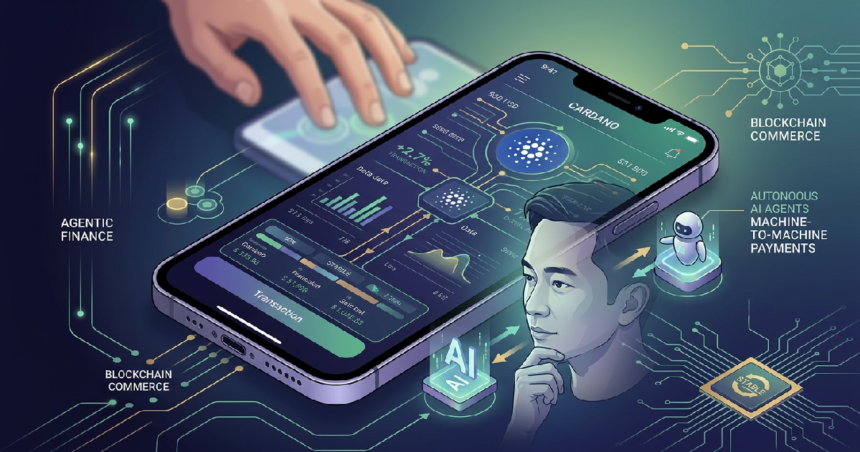
First Digital CEO Vincent Chok has identified a structural shift in how artificial intelligence interacts with financial systems, asserting that crypto is becoming an essential “financial backend” for autonomous AI agents. As firms move away from simple chatbots toward systems that can plan and execute transactions, the limitations of traditional banking are reportedly forcing a transition toward programmable money. This shift into “agentic finance” allows machines to manage funds using stablecoins and blockchain rails, effectively creating a new class of non-human financial users.
The emergence of these autonomous systems comes at a time when traditional financial infrastructure remains ill-equipped for 24/7, high-frequency machine activity. While a human might wait days for a wire transfer to clear, an AI agent operating in a millisecond-driven environment requires instant settlement. This is why stablecoins and decentralized networks are increasingly viewed as functional tools for a machine-driven economy. This evolution highlights a broader shift in digital asset utility as the industry seeks tangible use cases beyond speculation.
The Three-Layer Architecture of Agentic Finance
According to Chok, the development of agentic finance is generally structured across three distinct layers. The first is agentic commerce, which focuses on discovery and decision-making—tasks like an AI scanning the web to find the most cost-effective travel arrangements. The second layer is agentic payments, where the system executes the transaction once a predefined parameter is met. Finally, the asset management layer allows agents to handle portfolios, optimizing for yield and managing risk in real-time.
This delegation of authority does not mean humans are hand-off. Instead, it functions through conditional delegation where users set the boundaries, such as spending limits or specific goals, and the AI operates within those guardrails. Because these agents require global access, they cannot rely on standard banking hours or the geographical restrictions of legacy finance. This necessitates the use of crypto wallets that provide permissionless access to capital at any time.
Industry leaders are already responding to this demand by developing open payments protocols to standardize how agents send and receive money. This is particularly vital for micropayments, where the cost of a traditional credit card transaction would exceed the value of the payment itself. As investors look for long-term utility in the blockchain space, the integration of AI agents provides a concrete scenario for high-throughput networks.
Real-World Applications and Machine-to-Machine Payments
These systems are reportedly gaining ground in B2B environments. AI agents are being used to streamline supply chain management, where they can autonomously pay vendors or settle invoices based on data-driven triggers. This reduces human error and cuts down on administrative overhead. In the retail sector, autonomous commerce is beginning to take hold as agents research and secure subscriptions or products for consumers without manual intervention at every step.
In the crypto-native world, trading agents are perhaps the most mature example of this technology. These systems are widely used for yield optimization and liquidity management across different protocols. This type of activity is driving a surge in on-chain volume that isn’t tied to human sentiment but rather to programmatic logic. This trend mirrors how liquidity surges in other assets are often driven by institutional and automated participation rather than retail hype.
Legal Risks and the Path to Regulatory Clarity
A primary hurdle for widespread adoption remains the risk associated with autonomous agents that might deviate from their intended purpose. If a system is exploited or makes an unintended financial move, the legal questions of authorization and liability become incredibly complex. There is currently no global consensus on how an AI agent is treated under financial law, or who is responsible when an autonomous system executes a transaction that results in a financial loss.
Financial advisors must keep an eye on how regulators approach these autonomous entities. For the machine-driven economy to scale, there needs to be a clear framework that allows developers to build with confidence while ensuring that user funds are protected. Trust is the final barrier. Until there is a standardized way to verify the identity and permissions of an AI agent, many traditional institutions will likely remain on the sidelines.
In the coming months, the industry is expected to watch for specific signals of maturity. The growth of agent-native wallets and the total volume of transactions initiated by non-human users will be key metrics to monitor. If the integration between stablecoins and AI systems continues to deepen, crypto could solidify its role as a primary infrastructure for the next generation of financial services, moving further away from its reputation as a purely speculative tool.