

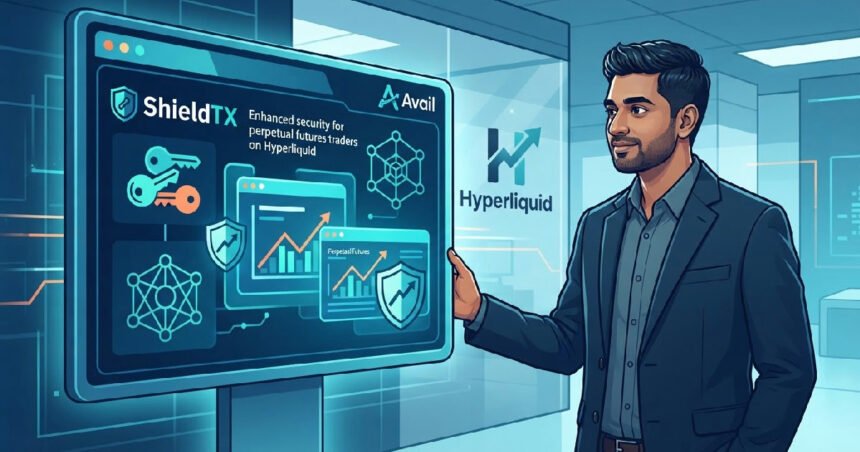
Avail, a blockchain infrastructure project led by Polygon co-founder Anurag Arjun, on October 28, 2026, launched ShieldTX, a privacy tool designed to protect traders on the decentralized exchange Hyperliquid. The service aims to combat the growing problem of copy-trading bots, which exploit the public nature of the blockchain to mimic profitable traders and degrade their execution prices.
The core issue ShieldTX addresses is the financial drain caused by these bots, a phenomenon often called “edge erosion.” According to research conducted by Avail, traders being copied on Hyperliquid faced a median additional cost of 63 basis points (0.63%) per trade. For active, high-volume participants, these losses can accumulate quickly, turning profitable strategies into losing ones.
How Avail launches ShieldTX to obscure on-chain activity
Hyperliquid has seen a surge in activity and interest from serious trading firms, especially with recent developments like the plan for regulated perpetual futures on the platform. This growing institutional presence makes on-chain privacy less of a luxury and more of a necessity for maintaining a competitive edge.
ShieldTX introduces a novel method to break the chain of surveillance used by copy-trading bots. Instead of a trader executing all their positions from a single, publicly visible wallet, ShieldTX creates a fresh, separate Hyperliquid wallet for every single perpetual futures position opened.
The process begins when a user deposits USDC into a secure vault contract on the Arbitrum network, creating a shielded balance. When they decide to place a trade, ShieldTX automatically provisions a new wallet, funds it from the shielded balance, and routes the order to Hyperliquid’s native order book. This ensures traders still benefit from the platform’s existing liquidity and speed.
Once the position is closed, the proceeds are sent back to the user’s private shielded balance. While the individual trades themselves remain visible on Hyperliquid’s public order book, they are disconnected from each other. This makes it incredibly difficult for bots to link different trades to a single profitable trader and preemptively act on their strategies.
This approach stands in contrast to simpler privacy methods. Avail’s analysis found that while 29% of the top 150 Hyperliquid accounts use subaccounts to manage their trading, these wallets can often still be linked on-chain through careful analysis. ShieldTX is designed to defeat this type of advanced surveillance by ensuring no discernible link exists between positions.
The quantifiable cost of copy-trading
The launch of ShieldTX is backed by specific data highlighting the severity of the copy-trading problem. Avail’s research team conducted an extensive analysis of on-chain activity over a 30-day period, examining 332,317 unique wallets that traded on Hyperliquid.
From this vast dataset, the team randomly selected seven traders from the platform’s top 100 performers. For each of these seven traders, they identified 25 wallets that exhibited classic copy-trading behavior. A wallet was flagged as a potential copier if it matched the top trader’s chosen asset and position direction (long or short) within 60 seconds on at least 10 separate occasions during the month.
By comparing the fill prices of the original traders to those of the bots that followed them, Avail calculated the execution cost. The study concluded that copy-trading imposed a median slippage cost of 63 basis points per trade on the targeted traders. For a single $100,000 trade, that translates to a $630 loss directly attributable to bot activity.
While the cost is significant, Avail’s early analysis of ShieldTX’s performance suggests traders using the service may save up to 25 basis points per transaction by mitigating this impact.
The service itself has a clear pricing model, charging 5 basis points of notional value, a fixed fee of $1 to open a position, and around $2 for closes sent to external wallets. This structure makes it most viable for its target audience: professional traders and funds with wallet volumes exceeding $500,000.
Nightshade: The zero-knowledge tech powering the shield
ShieldTX is powered by Nightshade, Avail’s proprietary privacy infrastructure that utilizes zero-knowledge (ZK) proofs. This technology is central to how the service can maintain user privacy while still interacting with a public blockchain like Hyperliquid.
Zero-knowledge proofs are a cryptographic method that allows one party to prove to another that a statement is true, without revealing any information beyond the validity of the statement itself. In the context of ShieldTX, this means the system can verify a user’s ownership of funds and authorize trades without ever exposing their primary wallet or the total balance in their shielded vault.
Nightshade operates as a zero-knowledge application-specific chain with a “commit-first, prove-later” architecture, with final settlement occurring on Arbitrum. This design is part of a broader industry movement toward sophisticated privacy innovations in crypto, which are becoming critical for DeFi to attract more sophisticated financial actors.
“We built Nightshade because privacy is essential infrastructure for onchain markets,” said Anurag Arjun in a statement. “We built ShieldTX for Hyperliquid because traders there have limited privacy and that gap is being exploited by onchain surveillance tools, which costs traders directly.”
A growing trend in DeFi privacy
Avail’s launch is not happening in a vacuum. It joins a growing number of projects aimed at solving the transparency problem inherent in decentralized finance. Other platforms have also recently introduced privacy-enhancing features to protect their users from predatory bot activity and preserve strategic advantages.
For example, perpetuals trading platform Aster launched a dedicated privacy-enabled blockchain for its derivatives exchange earlier in the year. More recently, StarkWare launched OffMarket, a service allowing users of the prediction market Polymarket to trade without publicly linking their positions to their main accounts. These solutions, much like other projects exploring confidential futures products, underscore a market-wide demand for greater discretion.
What sets ShieldTX apart is its model of acting as an overlay on a major, existing exchange. Rather than trying to build a new private ecosystem from scratch and attract liquidity, Avail is bringing the privacy layer to where the traders and volume already are.
It’s a non-custodial solution built for an open ecosystem, as confirmed by Arjun, who noted that Hyperliquid’s core team was not directly involved in the development.
Beta testing and the road ahead
Before its public launch, ShieldTX underwent a significant testing phase with a select group of users. The private beta involved 75 traders, including high-volume individuals, trading desks, and crypto funds.
According to Avail, this beta period generated over $1 million, with one source specifying more than $2.5 million in trading volume, and saw the creation of more than 3,800 single-use wallets, proving the concept at scale.
The founder of one unnamed digital asset fund using the tool noted, “We thought we had sufficient privacy by rotating wallets. We had no idea the wallets had already been linked to us and were being actively copied.” This highlights the sophistication of on-chain surveillance and the need for dedicated tools.
Security remains a paramount concern for any service that interacts with user funds. Avail stated that ShieldTX has undergone multiple internal audits and reviews by external security consultants, with a full, formal audit currently underway. As the service moves from its private beta to a broader invite-code model, this security assurance will be crucial for building trust.
The future for ShieldTX is focused on expanding access to more trading teams and individual professional traders. With special fee discounts offered to stakers of Avail’s native token (AVAIL), the project is building an incentive structure to foster a loyal user base. Ultimately, its success will depend on its ability to win the ongoing technological arms race between on-chain privacy and public surveillance.