

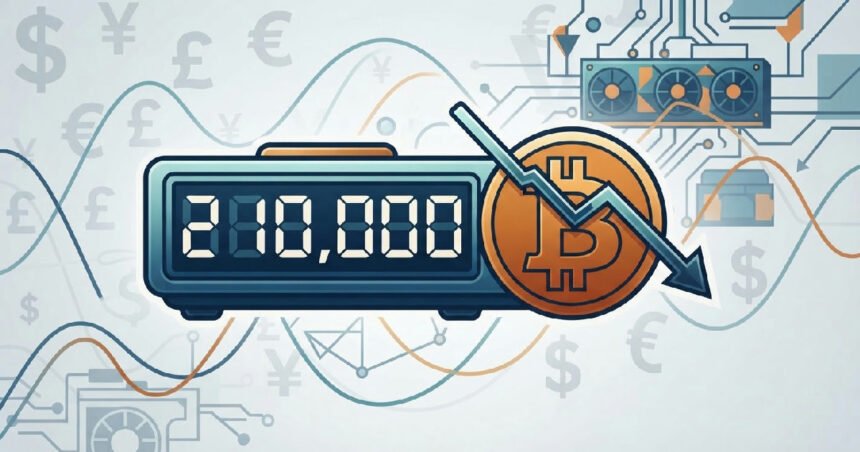
Bitcoin halving events represent a core mechanism within the cryptocurrency’s protocol, systematically reducing the rate at which new Bitcoins enter circulation. These pre-programmed reductions are designed to reinforce scarcity and directly influence the supply-demand dynamics over time, profoundly shaping Bitcoin’s long-term market cycles.
This intrinsic feature, hardcoded by its pseudonymous creator Satoshi Nakamoto, ensures a predictable, disinflationary monetary policy that contrasts sharply with the often-inflationary nature of traditional fiat currencies.
Understanding Bitcoin Halving Events
A Bitcoin halving, sometimes called a “halvening,” is a pre-programmed event that occurs approximately every four years. More precisely, it triggers every 210,000 blocks added to the blockchain. During a halving, the reward miners receive for validating transactions and adding new blocks is automatically cut in half.
This process directly impacts the rate of new Bitcoin creation, effectively slowing its inflation rate. It’s a foundational element for maintaining the cryptocurrency’s capped total supply of 21 million BTC.
What is a Block Reward?
The “block reward” serves as the incentive for miners. This payment, made in newly minted Bitcoins, is awarded to the miner who successfully solves a complex computational puzzle, known as Proof-of-Work, to verify transactions and add a new block to the blockchain.
The mining process involves network participants using specialized computers, or ASICs, to solve cryptographic puzzles. The first miner to find the solution earns the block reward, maintaining the network’s integrity and coin distribution.
The Mechanics of Bitcoin’s Supply Control
The halving mechanism is a crucial design element ensuring Bitcoin’s finite supply. Its fixed schedule means that these events are entirely predictable, occurring consistently every 210,000 blocks mined, which translates to roughly every four years given the average 10-minute block time.
At each halving, the block reward automatically decreases by 50%. This reduction is deeply embedded in Bitcoin’s protocol and would require an overwhelming network consensus to alter, making it practically immutable. This systematic decrease mimics the scarcity model of precious metals like gold, designed to control the total supply and combat inflation.
Historical Block Reward Reductions
- Initial Block Reward (2009): 50 BTC per block
- First Halving (November 2012): Reward reduced to 25 BTC
- Second Halving (July 2016): Reward reduced to 12.5 BTC
- Third Halving (May 2020): Reward reduced to 6.25 BTC
- Fourth Halving (April 2024): Reward reduced to 3.125 BTC
- Fifth Halving (Estimated April 2028): Reward will reduce to 1.5625 BTC
As block rewards diminish over time, transaction fees are expected to become an increasingly significant component of miners’ revenue. This ensures the network remains secure and operational even after all 21 million Bitcoins have been mined, an event estimated to occur around the year 2140.
Satoshi Nakamoto’s Vision for Scarcity
While the term “halving” doesn’t explicitly appear in the original Bitcoin whitepaper, the concept of a controlled, diminishing supply is central to its architectural design. Satoshi Nakamoto, the pseudonymous creator of Bitcoin, integrated this mechanism into the cryptocurrency’s initial source code.
Nakamoto intended this fixed supply and predictable reduction to make Bitcoin inherently resistant to inflation. In an email exchange with Hal Finney, Nakamoto articulated this rationale: “The introduction of new coins means the supply of money increases by the planned amount, which does not necessarily lead to inflation.”
He added, “If the supply does not increase as fast as demand, deflation occurs when the value of coins rises.” This inherent design has made Bitcoin an attractive asset for long-term investors seeking inflation-resistant holdings.
Historical Impact on Market Cycles
Bitcoin halving events are widely considered significant drivers of its long-term market cycles due to their direct and predictable influence on supply. By cutting the rate of new Bitcoin entering the market in half, halvings create a distinct supply shock.
Economically, if demand for Bitcoin remains constant or continues to grow against this reduced supply, the principle of scarcity suggests a potential increase in price. This inherent scarcity is a core pillar of Bitcoin’s value proposition.
Correlation with Bull Runs
Historically, the periods immediately following halving events have often coincided with substantial price increases and prolonged bull markets for Bitcoin. These rallies typically unfold within 12 to 18 months after the halving.
For instance, the first halving in November 2012 preceded a rally that saw Bitcoin’s price surge from approximately $12 to $1,150. Similarly, after the second halving in July 2016, BTC climbed from around $650 to nearly $20,000, illustrating a compelling pattern of price appreciation linked to these supply reductions.
Future Implications and Outlook
The predictable nature of Bitcoin halvings provides a unique insight into its long-term trajectory. As the network approaches its final halving around 2140, with all 21 million Bitcoins expected to be mined, the dynamics of miner incentives will continue to evolve.
At this point, transaction fees will become the sole compensation for Bitcoin mining, underscoring the importance of robust network usage and consistent transaction volumes. This shift is crucial for ensuring the network’s continued security and decentralization.
The upcoming fifth halving, estimated for April 2028, will further reduce the block reward to 1.5625 BTC. Each such event reinforces Bitcoin’s fundamental design as a disinflationary asset, solidifying its role within the broader digital asset landscape.