

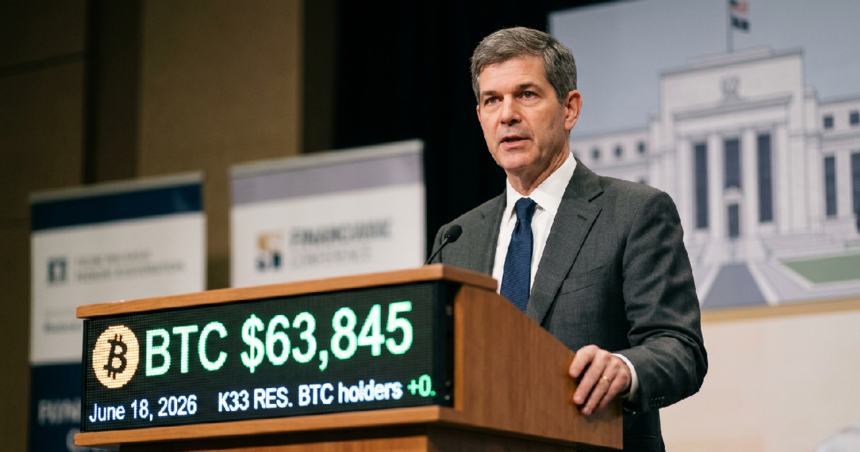
Bitcoin (BTC) dropped below the $64,000 threshold on June 18, 2026, as the market reacted to a hawkish policy stance from the U.S. Federal Reserve. The cryptocurrency fell nearly 4% from a previous level of approximately $66,400, or a June 17 high of $66,315. During early trading on June 18, Bitcoin reached an intraday low of $63,683 before stabilizing near $64,176 by press time.
The Federal Open Market Committee (FOMC) concluded its June 17 meeting by deciding to keep the federal funds rate steady at 3.50%–3.75%. Although the decision to hold rates was expected, the committee adopted a hawkish outlook under the leadership of the new U.S. Federal Reserve Chair Kevin Warsh.
The updated policy statement notably removed previous language that had suggested possible rate cuts later in the year.
Market sentiment shifted rapidly as the Fed’s “dot plot” projections revealed a more aggressive interest rate trajectory. Nine out of 18 officials now project at least one more rate hike this year, while eight project no change. This represents a significant pivot from March, when 12 out of 19 officials had forecast a rate cut.
Consequently, Bitcoin faces a sharp correction risk as expectations for looser monetary policy evaporate.
Federal Reserve signals inject uncertainty into markets
Chair Kevin Warsh signaled a departure from traditional forward guidance during the meeting, a move that has injected fresh uncertainty into the global policy outlook. Policymakers also raised their inflation forecasts, with the PCE inflation estimate jumping to 3.6% from the previous estimate of 2.7%. Core PCE expectations rose to 3.3% from 2.7%.
The Fed’s outlook for economic growth was also revised downward. Real GDP growth at the end of 2026 is now projected to reach 2.2%, down from the 2.4% estimated in March. This combination of higher inflation and slower growth typically weighs on risk assets, as investors recalibrate the cost of capital in a “higher for longer” environment.
According to the CME Group’s FedWatch Tool, the probability of the Fed hiking rates at least once by year-end rose to 84.2%, up from 59.5% just a day prior. Meanwhile, the probability of a rate cut has fallen to 0%. This shift pushed the yield on the 2-year U.S. Treasury note to a 13-month high of 4.21% during intraday trading.
Broader crypto market retreats as gold rebounds
The downturn was felt across the digital asset sector as high interest rate expectations cooled appetite for tokens. Ethereum (ETH) fell 2.51% to trade near $1,746, while Ripple (XRP) and Solana (SOL) both recorded drops of approximately 3%. The GMCI 30 index, which tracks thirty large-cap cryptocurrencies, fell about 2.6% on June 18.
While Bitcoin struggled, gold experienced a strong rebound, climbing back above $4,300 after a brief dip. This highlight’s gold’s traditional appeal as a safe-haven asset during times of macroeconomic pivot. In contrast, Bitcoin holds support near $64,000 but remains vulnerable to fluctuations in the U.S. Treasury market.
Long term holder accumulation reaches all time high
Despite the immediate price volatility, on-chain data suggests a period of “on-chain repair” characterized by high levels of illiquidity. A report from K33 Research shows that a record 79% of Bitcoin’s circulating supply is now held by long-term holders. This all-time high suggests that veteran participants are continuing to accumulate despite the hawkish Fed.
Furthermore, the reactivation of coins aged two years or more has been exceptionally low in 2026. Only 218,421 BTC had been reactivated by June 6, representing a small fraction of the 1.18 million BTC reactivated by the same point in 2024.
Head of Research at K33 Vetle Lunde noted that this pattern historically appears as Bitcoin approaches a cycle bottom, though he cautioned a final leg lower often precedes a full recovery.
Critical support and resistance zones for Bitcoin
Bitcoin is currently testing key support near $64,000. Analysts suggest that a failure to hold this level could trigger a move toward the $61,000 to $62,000 range. The price is effectively trapped between major support near $60,000 and strong resistance around $68,000, leaving the market in a state of high tension.
Traders are keeping a close eye on technical indicators for a volatility spike signal as the range narrows. If Treasury yields continue to climb, the pressure on the $60,000 support floor may intensify. For now, the “wait-and-see” approach adopted by many institutional participants remains the dominant market theme.
The coming weeks will reveal if the record accumulation by long-term holders is enough to offset the bearish pressure from the Fed’s dot plot. With the median forecast for the year-end benchmark rate rising to 3.8%, the path forward for Bitcoin remains closely linked to the U.S. Dollar’s strength. Investors are advised to watch the $64,000 level as the primary pivot for near-term price action.