

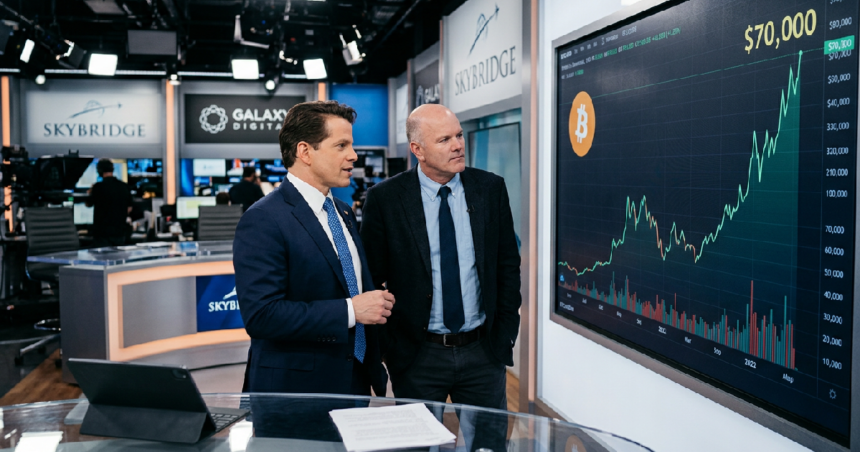
Founder Anthony Scaramucci and CEO Mike Novogratz announced on June 13, 2026, that Bitcoin could reclaim the $70,000 price level by the end of July. Speaking during the “All Things Markets” episode, the two prominent investors cited shifting market sentiment and potential legislative breakthroughs as the primary drivers for a mid-summer recovery.
While Anthony Scaramucci of SkyBridge Capital believes negative sentiment has left the market “burnt out,” Mike Novogratz of Galaxy Digital placed a 70% probability on the target, specifically tied to the advancement of the CLARITY Act.
The prediction comes at a time of relative stability for the digital asset, which recently traded near $69,084. Anthony Scaramucci argued that the current pessimism in the market is actually a contrarian indicator, suggesting that even a small amount of “incremental buying” would be enough to push the price through the psychological resistance at $70,000.
This outlook reflects a belief that the market has already priced in most bearish news, leaving the path of least resistance to the upside.
Mike Novogratz provided a more data-driven justification, linking the fate of the cryptocurrency to the ballooning U.S. national debt. With the country facing approximately $40 trillion in obligations, the CEO of Galaxy Digital argued that policymakers are effectively forced to “inflate it away.”
He suggested that a steady inflation rate of 3% to 4% is necessary to reduce the real value of that debt, a macroeconomic backdrop that historically favors hard assets like Bitcoin.
Regulatory catalysts and the impact of the CLARITY Act
A central pillar of the bullish outlook is the Potential passage of the CLARITY Act, a piece of legislation Mike Novogratz has been actively championing on Capitol Hill. He noted that the market will likely know the direction of the bill by July 10th.
If the act moves forward, it would provide the legal framework many institutional players have been waiting for, potentially triggering a significant inflow of capital. This legislation is often viewed as a companion to moves where the CFTC is ready to oversee crypto market participants more formally.
However, the transition to a regulated environment is not without its hurdles. The legislative process is notoriously slow, and Anthony Scaramucci noted that “older money” still tends to favor traditional hedges like silver or gold.
Despite this generational divide, he remains optimistic about the bill’s prospects, citing data from trading platform Kalshi that places the odds of the CLARITY Act passing before 2027 at roughly 70%.
Mike Novogratz warned that while 3% inflation might be the goal for debt management, there is a tail risk of the situation spiraling. If public trust in the dollar erodes further, he cautioned that inflation could reach extreme levels of 14% or even 40%. In such a volatile scenario, Bitcoin’s role as a “belief system” and digital gold becomes even more critical for wealth preservation.
Market cycles and institutional influence on price
Looking beyond the immediate July target, Anthony Scaramucci expects a more sustained bull run to begin in the fourth quarter of 2026. This timeline aligns with the traditional four-year halving cycle, although he admitted that the record-high participation of institutional investors and Morgan Stanley expanding Bitcoin access has changed the old rules.
These spot ETF inflows have “somewhat suppressed” the volatility of the cycle without erasing it entirely.
The SkyBridge Capital founder currently maintains a price target of $150,000 for the current cycle. He frequently compares the asset to gold, suggesting that if Bitcoin reaches gold’s $30 trillion market capitalization over the next 15 years, the price per coin could hit $1.5 million.
He encourages investors to maintain a minimum four-year time horizon to weather the 40% to 50% technical corrections that typically occur halfway through a halving period.
Macroeconomic debt and the hard asset thesis
The argument for a $70,000 Bitcoin price is increasingly an argument against the long-term stability of sovereign debt. Mike Novogratz was blunt in his assessment, stating that the U.S. cannot simply “grow out” of its $40 trillion debt hole.
He believes the “period, end of story” reality is that currency debasement is the only viable political path forward, making fixed-supply assets the logical beneficiary. This trend has seen some Bitcoin hold steady even when broader markets show signs of hesitation.
While Anthony Scaramucci focuses on the sentiment of the average trader, Mike Novogratz is focused on the “grind” toward higher values. Earlier in 2026, he predicted that Bitcoin would face significant resistance around the $80,000 mark.
He has also shifted his view on the four-year cycle, arguing that as the asset matures and the infrastructure strengthens, the rigid halving-based framework may eventually become obsolete as a price predictor.
The coming weeks will prove pivotal for these predictions. If the July 10th deadline for legislative clarity passes without progress, the “70/30” odds for a $70,000 breakout may shift. For now, both investors appear aligned in the belief that the combination of oversold sentiment and a deepening national debt crisis provides a strong tailwind for the leading cryptocurrency as summer progresses.