

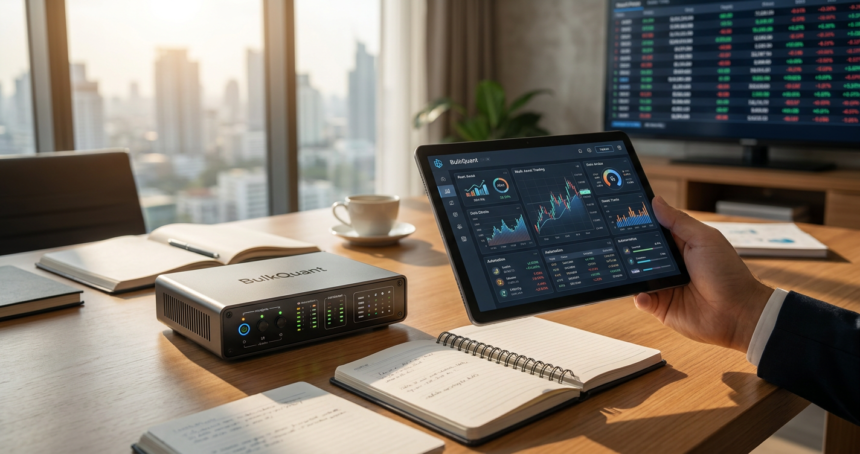
The London-based quantitative firm BulkQuant officially introduced its new multi-asset trading framework on June 16, 2026, marking a significant shift in how retail investors manage portfolios across cryptocurrency, forex, and stock markets.
The platform’s automated AI trading bot replaces complex, code-heavy setups with a managed, no-code workflow designed to help traders navigate a fragmented global financial system. By integrating expert oversight with AI-assisted market monitoring, the firm aims to capture a growing demographic of multi-asset traders who are currently overwhelmed by twenty-four-hour market cycles.
The rise of automated trading in 2026 stems from a “tug-of-war” for liquidity, where high-performing AI stocks are frequently pulling capital away from digital asset markets.
Simplifying complex workflows for multi-asset retail traders
Traders no longer operate in silos; a move in Nasdaq futures often precedes a shift in Bitcoin sentiment, while central bank inflation data can trigger immediate volatility in both currency pairs and equities. This interconnectedness has made manual monitoring nearly impossible for individual retail traders who lack the infrastructure of professional strategy desks.
BulkQuant’s recent expansion follows a series of strategic launches, including its initial AI-powered Quant Trading Platform on May 13 and a specialized U.S. stock day trading infrastructure on June 17. The platform addresses the “multi-screen problem,” a phenomenon where investors are forced to manage attention across conflicting data streams.
Rather than simply executing trades faster, the bot serves as a centralized decision-making hub that helps clarify processes before capital is committed to a trade.
One of the primary barriers to entry for automated trading has historically been the technical requirement of coding or deep parameter configuration. BulkQuant bypasses this by offering a guided route that appeals to those who want the benefits of automation without becoming infrastructure managers. This approach is particularly relevant for the com/cardano-price-prediction-2026-2032-ada-recovery-analysis/”>Cardano price outlook, as investors in ADA and other altcoins increasingly look for tools that can handle both the 24/7 crypto cycle and traditional market hours.
The platform’s design focuses on three core areas to reduce the burden on the user:
- Managed AI systems that combine machine learning with internal expert oversight.
- No-code interfaces that allow users to review automated strategies without writing scripts.
- Integrated risk control settings that provide realistic explanations of potential market downsides.
Managing the always-on pressure of crypto markets
In 2026, cryptocurrency serves as the “always-on” risk layer for the global economy. Because these markets never close, they often act as early warning signals for broader speculative sentiment. A trader might be sleeping when a liquidity shock hits Ethereum, which then impacts technology stocks at the Monday morning opening bell.
BulkQuant’s bot provides continuous coverage, ensuring that a volatility spike does not go unnoticed during off-hours.
This constant presence is vital because crypto volatility can move independently of macro trends when exchange-related news or regulatory headlines break. By automating the monitoring process, traders can set specific execution rules that trigger based on these sudden sentiment shifts, rather than having to remain glued to a screen.
The goal is to turn the trading day into a structured review process rather than a constant reaction loop.
Why the managed approach is gaining momentum over DIY bots
While DIY bot builders offer deep customization for quant professionals, the average retail trader in 2026 often finds too many setup decisions to be a liability. Choosing indicators, adjusting parameters, and manually connecting exchange APIs can lead to “settings fatigue,” which frequently results in errors.
BulkQuant has positioned itself as a managed alternative, where the platform handles the heavy lifting of execution logic and data monitoring.
The distinction between a “bot builder” and a “managed workflow” is critical. Multi-asset traders care less about extreme technical control and more about whether a tool can fit into a broader morning routine that includes checking ETF flows and central bank speeches.
This shift reflects a maturing market where utility and ease of use are becoming more valuable than raw complexity. As the utility of digital assets becomes the primary driver of value, tools that simplify these interactions are seeing higher adoption rates.
The role of expert oversight in AI-driven systems
Unlike fully autonomous “black box” algorithms, the BulkQuant model emphasizes AI systems combined with human oversight. This hybrid approach is intended to build trust with users who remain skeptical of letting a machine handle their entire portfolio. In a market where unexpected geopolitical events can override technical patterns, having an expert layer serves as a safety valve against extreme algorithmic failures.
This structure helps users understand “what” is being automated and “why” certain trades are occurring. Transparency in automation has become a focal point for regulators and traders alike in 2026. By providing a clearer way to inspect automated decisions, the platform aims to reduce the emotional friction typically associated with high-frequency or multi-market trading strategies.
Future outlook for automated trading infrastructure
Looking ahead to the second half of 2026, the demand for cross-market automation is expected to grow as regional liquidity continues to fragment. With the expansion of AI-assisted platforms into niche areas like U.S.
stock day trading and specialized forex pairs, traders are increasingly looking for a “single pane of glass” through which to view their entire financial footprint. BulkQuant’s move to integrate these disparate asset classes into one no-code environment sets a precedent for the next generation of retail tools.
The success of these platforms will ultimately depend on their ability to maintain performance while keeping the user experience simple. As retail hunger for automation persists, the competition between traditional brokerages and AI-native platforms will likely intensify. For now, the focus remains on reducing the mental overhead of trading in a world where every market is connected and none of them ever truly sleep.