

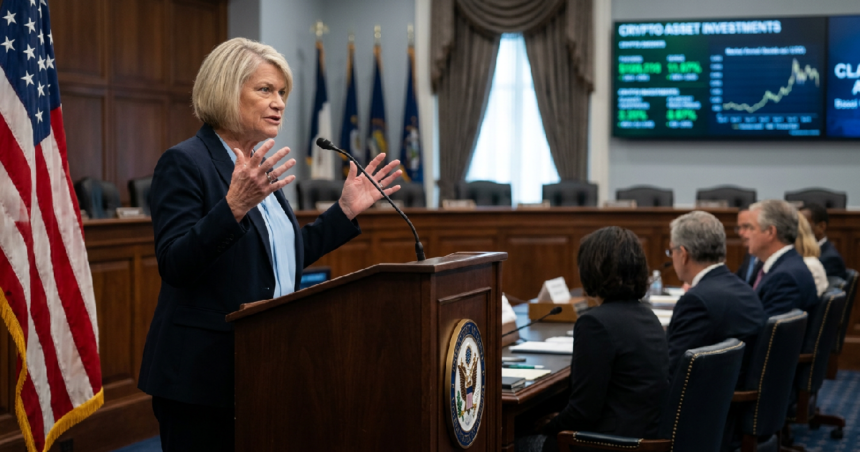
A group of six Republican senators, led by Senator Cynthia Lummis, has formally pressured top U.S. banking regulators to overhaul capital standards for digital assets.
According to a statement released Thursday, June 4, 2026, the lawmakers sent a letter last week to Federal Reserve Vice Chair for Supervision Michelle Bowman, Federal Deposit Insurance Corporation (FDIC) Chair Travis Hill, and Comptroller of the Currency Jonathan Gould, urging them to provide clearer guidance on how banks must hold capital against crypto exposures.
The request arrives as the three regulators are scheduled to testify before the House Financial Services Committee on Thursday.
The Republican senators — including Dan Sullivan, Bill Hagerty, Bernie Moreno, Ted Budd, and Jon Husted — targeted international standards developed by the Basel Committee on Bank Supervision. They criticized a specific 1,250% risk weight currently assigned to certain digital assets.
Because this weight is multiplied by an 8% minimum capital ratio, it creates an effective capital requirement equal to 100% of the exposure. This means banks must essentially hold a dollar of capital for every dollar of digital assets on their books.
The lawmakers argue that these punitive costs prevent American banks from participating meaningfully in the digital asset market. They are pushing for a “technology-neutral” approach, stating in the letter that “capital treatment should reflect the risk characteristics of the underlying asset, not the technology used to record ownership.” This demand comes as the com/crypto-market-forecast-2026-narrowing-window-analysis/”>crypto market window closes and utility becomes the primary driver of value in 2026.
Pushing for technology-neutral crypto capital standards
The senators pointed to a joint statement issued in March by the Fed, FDIC, and the Office of the Comptroller of the Currency (OCC), which concluded that tokenized securities should receive the same capital treatment as traditional ones. The letter argues this principle should be applied consistently across other digital asset classes.
By maintaining the 1,250% risk weight, regulators are effectively disadvantaging bank participation based solely on the underlying ledger technology rather than the financial risk itself.
This regulatory friction is seen by some as a hurdle for institutional adoption. When banks are sidelined by high capital costs, it can lead to periods of institutional pullback, leaving the market’s infrastructure less stable. The senators believe a more balanced framework would allow banks to manage digital asset risks without being economically penalized for using blockchain systems.
The role of the CLARITY Act in banking reform
The push for new capital rules is closely tied to the Digital Asset Market Clarity Act of 2025, also known as the CLARITY Act. This legislation advanced through the Senate Banking Committee on May 14, 2026, with a 15-9 vote.
The bill seeks to define a substantial portion of digital assets as commodities, shifting much of the oversight from the SEC to the Commodity Futures Trading Commission (CFTC).
Senator Cynthia Lummis has been a vocal defender of the bill, recently dismissing criticisms from JPMorgan Chase CEO Jamie Dimon regarding its safety standards. Lummis argued that anti-money laundering and Bank Secrecy Act requirements are already embedded in the legislation. She further noted that “without the CLARITY Act, when a digital asset exchange goes bankrupt, customers do not have guaranteed rights to their assets.”
Bipartisan momentum and regulatory testimony
While the letter to regulators was a Republican initiative, the CLARITY Act itself has seen some bipartisan support. Democratic Senators Ruben Gallego and Angela Alsobrooks voted in favor of the bill during the committee phase. However, opposition remains significant, particularly from Senator Elizabeth Warren, who has warned the bill could create a “tokenization loophole” and undermine investor protections established nearly a century ago.
Amendments to the act have already passed, including a provision from Senator Mike Rounds for an AI regulatory sandbox and an amendment from Senator Dave McCormick regarding portfolio margin rules. As com/cftc-michael-gillick-crypto-market-oversight-claim-2026/”>the CFTC prepares for market oversight, the pressure is on the Federal Reserve and FDIC to align their capital rules with this shifting legislative landscape. Senator Lummis has signaled she hopes for a full Senate floor vote before the August recess.
The hearing on Thursday will likely force Vice Chair Bowman, Chair Hill, and Comptroller Gould to address whether they will reconsider the Basel Committee’s rigid standards. U.S. Treasury Secretary Scott Bessent has been pushing for the CLARITY Act to pass this summer, adding further weight to the senators’ demands.
If regulators move toward a technology-neutral stance, it could significantly lower the barrier for traditional financial institutions to enter the crypto ecosystem.