

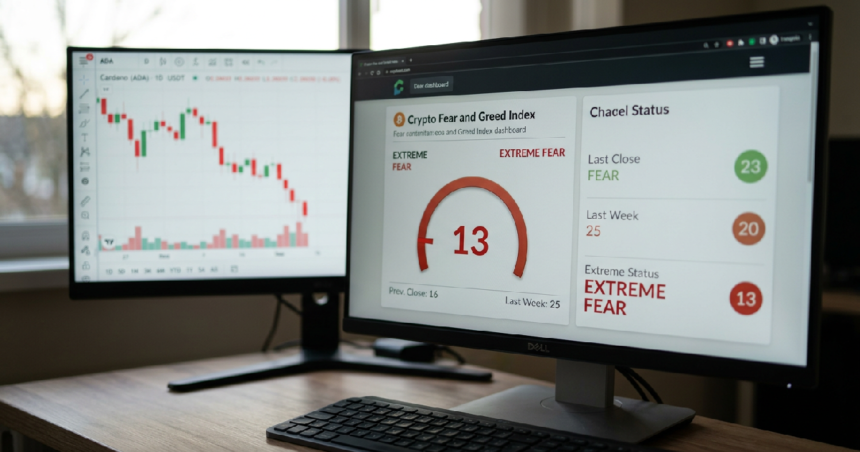
The Crypto Fear and Greed Index collapsed to a reading of 13 on June 8, 2026, plunging the digital asset market into a state of “extreme fear” as major tokens hit multi-year lows. This specific sentiment level, tracked by Alternative.
me, has historically served as a reliable indicator for market bottoms, having previously signaled significant recovery phases in both April 2025 and February 2026. The current crash in sentiment comes as Bitcoin struggles to maintain the $60,000 level and altcoins like Cardano (ADA) sink to prices not seen in six years.
Investor panic has intensified following a 22% decline for Bitcoin (BTC) in the first half of 2026, while Ethereum (ETH) has suffered even sharper losses, shedding nearly 29% in the first quarter alone.
The index, which scales sentiment from 0 to 100, uses a mix of volatility, market momentum, and social media activity to gauge the emotional temperature of the industry. At a reading of 13, the market is currently reflecting deep pessimism and widespread capitulation, often the final stage before a trend reversal.
Historically, these moments of maximum despair have provided the most lucrative entry points for patient buyers. During previous instances this cycle in 2025 and earlier this year, the “extreme fear” zone preceded sharp bounces as selling pressure exhausted itself.
However, the current environment faces unique headwinds, including sustained outflows from spot Bitcoin ETFs and a broader lack of liquidity that has left many tokens vulnerable to aggressive downside moves.
Extreme fear readings signal potential accumulation zones for Cardano
For holders of Cardano (ADA), the current sentiment reading of 13 arrives at a particularly painful juncture. The token is currently trading at six-year lows, a level that has tested the resolve of even the most dedicated “ADA Gang” members. While the price action is discouraging, com/cardano-price-prediction-2026-2032-ada-recovery-analysis/”>Cardano price outlook data suggests that these structural lows often align with the sentiment extremes currently flashing on the index.
The Crypto Fear and Greed Index essentially acts as a contrarian tool. When the crowd is terrified, it usually means that the “weak hands” have already exited their positions. This leaves the market in the hands of long-term accumulators. The logic is mechanical: by the time fear hits 13, the majority of the selling that could happen has already materialized.
How the Fear and Greed Index quantifies market panic
The index is not just a vibes-based guess; it is a weighted composite of several data streams. Volatility accounts for 25% of the score, comparing current price swings against 30-day and 90-day averages. When prices drop rapidly and unpredictably, this metric spikes, dragging the overall index further into the “fear” territory.
Traders often see this as a sign that a volatility spike is reaching its crescendo regardless of the underlying fundamentals.
Other factors include market volume (25%) and social media engagement (15%). On platforms like X, the frequency of bearish hashtags and panic-driven posts is currently at a cycle high. When everyone on social media is convinced that prices are going to zero, the index interprets this as an emotional extreme that is typically unsustainable in the long run.
The specific metrics driving the June 2026 collapse
- Bitcoin Dominance (10%): As investors flee altcoins for the perceived safety of BTC, Bitcoin’s market share rises, which the index treats as a fear signal.
- Google Trends Data (10%): Searches for “crypto crash” and “sell bitcoin” have surged in the first week of June.
- ETF Outflows: Institutional exit from spot products has created a constant overhead supply that retail buyers have struggled to absorb.
Historical precedents show extreme fear is not a precise timing tool
While a reading of 13 has marked bottoms in the past, it does not guarantee an immediate move higher. In June 2022, the index sat below 15 for weeks while Bitcoin hovered around $20,000. It took several more months and the collapse of the FTX exchange before the true cyclical bottom was found.
This suggests that while we are in a “value zone,” we may not have reached the “timing point.”
The danger is that sentiment sometimes stays “extreme” for longer than investors can remain solvent. If the current fear correctly prices in a deteriorating macroeconomic environment, then the index is simply reflecting reality rather than an emotional overreaction. Investors should note that Ether enters rare accumulation phase territory during these times, but the path to recovery is rarely a straight line.
Market momentum and the role of institutional Bitcoin ETF outflows
A major difference in 2026 compared to prior cycles is the influence of institutional products. The continued outflows from Bitcoin ETFs have provided a steady drumbeat of selling pressure that overrides traditional retail sentiment.
These professional desks operate on different timeframes and risk mandates than the average individual trader, meaning they may continue to sell even when the Fear and Greed Index suggests the market is oversold.
Until these outflows stabilize, the sentiment reading may linger in the low teens. Analysts are watching the $58,000 to $60,000 range for Bitcoin as the final line of defense. If that psychological support breaks, the index could potentially drop into single digits, a rare occurrence that usually only happens during “black swan” events like the Terra-Luna collapse or the 2020 pandemic crash.
Future outlook for Cardano and the broader crypto market
Looking ahead to the remainder of June, the question is whether the “extreme fear” reading will once again act as the floor. For Cardano (ADA), the six-year low represents a significant technical milestone. If the broader market begins to stabilize, ADA could see a relief rally as shorts are forced to cover their positions.
However, the lack of immediate catalysts in the ecosystem remains a concern for those looking for a rapid V-shaped recovery.
The contrarian play remains the primary strategy for those watching the index. As the saying goes, “buy when there is blood in the streets.” With a score of 13, the streets are certainly red.
Whether this proves to be the definitive bottom or just a pause before another leg down depends heavily on the stabilization of Bitcoin ETF flows and the broader appetite for risk in a tightening global economy.