

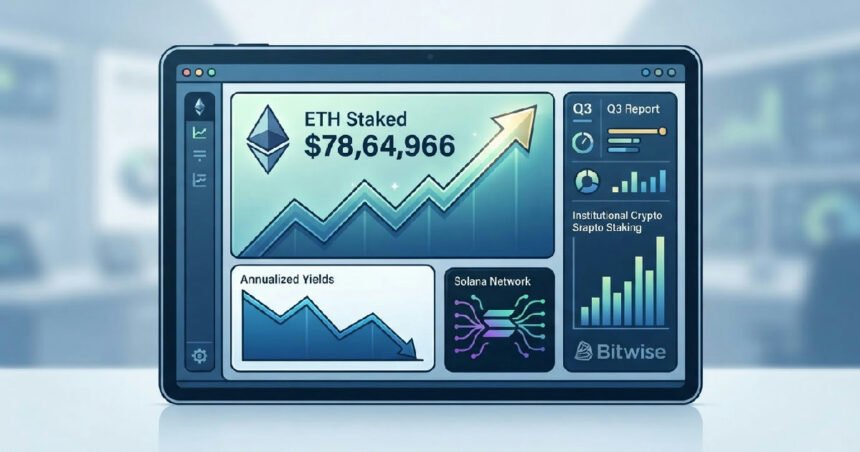
Ethereum staking hit an unprecedented high in the third quarter of 2026, with over 43.8 million ETH now locked into the network. Despite this surge in participation, investors experienced a notable dip in average annualized yields, according to Bitwise’s latest “The Bitwise Staking Report, Q3 2026,” published on October 20, 2026.
The report also highlights significant growth in Solana’s network activity and staking figures, though its yields also saw a slight reduction.
Record Ethereum Staking Amid Yield Compression
The record staking levels on Ethereum represent nearly 36% of its total supply, underscoring continued investor confidence in the blockchain’s proof-of-stake mechanism. But this increased engagement inevitably led to a dilution of rewards, a key trend identified by Bitwise researchers.
The third quarter of 2026 marked a significant milestone for Ethereum, recording net staking inflows of just under 2 million ETH. This period extends a streak of positive flows to six consecutive quarters, demonstrating sustained interest in securing the network.
However, the influx of staked assets compressed the average annualized staking yield to 2.63% in Q3, a decline from 2.81% in the prior quarter. This phenomenon is largely a function of how proof-of-stake rewards are distributed: as more Ether is staked, the fixed pool of rewards is spread across a larger number of participants.
Institutional Capital Fuels Staking Growth
Institutional interest continues to be a primary catalyst for the escalating Ethereum network adoption. Bitwise specifically highlighted Bitmine, a prominent Ethereum treasury company, which dramatically scaled its staking operations. Bitmine, led by Tom Lee, boosted its staked ETH by over 1,000%, moving from 410,000 ETH in December 2025 to an impressive 5.07 million ETH by September 27, 2026.
These institutional movements reflect a broader acceptance and integration of Ethereum within traditional finance. While the yields might be shrinking, the sheer volume of capital entering the staking ecosystem suggests a long-term strategic commitment rather than short-term yield chasing.
Impact of Pectra Upgrade on Validators
The dynamics of Ethereum’s validator ecosystem also saw notable shifts during Q3. The total number of validators dipped from approximately 1.1 million to 881,000 towards the end of September. This reduction, however, doesn’t signal a weakening of the network.
It’s primarily attributed to operators consolidating their stakes under the Pectra upgrade. This significant protocol enhancement allows opted-in validators to earn rewards on up to 2,048 ETH, a substantial increase from the previous 32 ETH limit, streamlining operations for larger stakers.
Shifting Revenue Streams and Network Efficiency
Beyond staking rewards, Ethereum’s network revenue experienced a contraction, falling to roughly $40.6 million in Q3 2026 from $63 million in Q2. This decrease indicates a cooler period for transaction activity and demand for block space.
The composition of staking rewards also reveals a critical dependency: over 96% of Ethereum’s staking yield originated from newly issued ETH. The remaining portion derived from transaction tips and Maximal Extractable Value (MEV), highlighting that base issuance remains the dominant reward mechanism.
The network continues to evolve, with ongoing improvements aimed at enhancing its overall efficiency. Discussions around Ethereum Merge security and subsequent upgrades underscore the platform’s commitment to robustness and scalability, even as revenue fluctuates.
Solana Witnesses Surging Activity and Transaction Fees
While Ethereum grappled with yield compression, Solana recorded its own impressive staking milestones, with 440.5 million SOL actively staked by the end of Q3 2026. This figure represents 69% of Solana’s total supply, indicating strong participation within its community.
Solana’s gross staking yield also declined, reaching 5.99% in Q3 from 6.38% in the previous quarter. Like Ethereum, around 90% of these returns were funded by newly issued tokens, reflecting a similar reliance on inflation for rewards.
Transaction Volume and Memecoin Mania
The Solana network processed an astounding 14.2 billion transactions during Q3, a 45% increase from the second quarter. Average transaction costs remained largely flat, suggesting the network efficiently absorbed the surge in demand.
Transaction fee revenue jumped by 49% to $76 million, primarily fueled by a boom in memecoin trading. This speculative fervor demonstrates Solana’s capacity to handle high-throughput, low-cost transactions, attracting a diverse range of users and applications.
Additionally, tokenized equities trading volume on Solana climbed by 45% to exceed $6.9 billion, showcasing expanding use cases for the blockchain. This growth points to Solana’s emerging role in traditional financial markets, attracting users interested in Solana asset valuation beyond pure cryptocurrency speculation.
Validator Dynamics and Future Prospects
Despite the heightened activity, Solana’s validator count saw a slight reduction, decreasing from 696 to 659. This decline, attributed to cost pressures, means the network now has roughly 30% fewer validators than a year prior. Maintaining a decentralized and robust validator set remains a key challenge for the network.
The Bitwise report generally suggests a positive outlook for proof-of-stake networks. It highlights their increasing capabilities and the expanding range of assets and services built upon them.
The third quarter of 2026 notably saw a major market upturn and the continued emergence of innovative sectors like tokenized stocks, perpetuals, and cross-chain settlement solutions, with new entrants like Robinhood Chain generating significant fees in their inaugural quarter.
Both Ethereum and Solana have made strides in becoming more cost-effective to use compared to a year ago, a deliberate outcome of their design improvements. While staking yields face pressure from increased participation, the underlying networks are demonstrating resilience and growth across various metrics.