

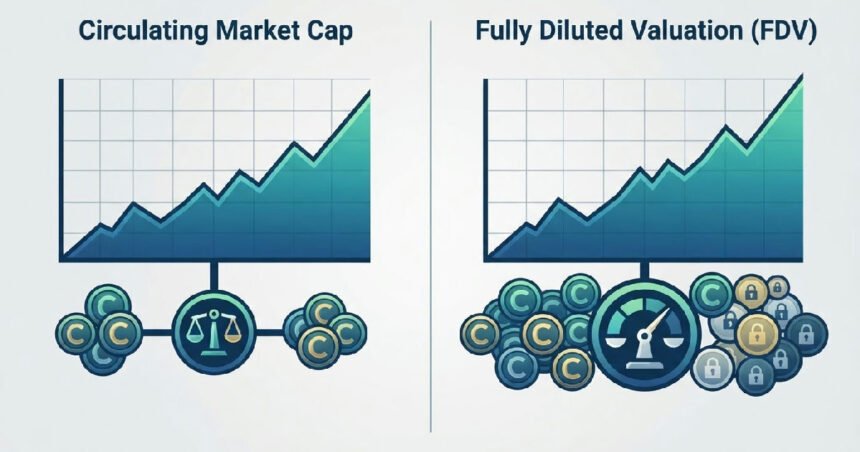
Assessing the true value and future potential of altcoins requires understanding key metrics like Fully Diluted Valuation (FDV) and circulating market cap. While both metrics offer insights into a cryptocurrency project’s worth, they provide fundamentally different perspectives on its current standing and long-term outlook. Navigating these distinctions is crucial for making informed investment decisions in the volatile digital asset market.
Circulating Market Cap: What It Represents
Circulating market cap, frequently shortened to market cap, represents the total value of a cryptocurrency based on the tokens currently available and actively traded. It provides a real-time snapshot of how the market values the entire network at any given moment. This metric is a cornerstone for comparing the relative size of different digital assets.
This real-time snapshot reflects the immediate supply and demand dynamics in the market, influenced by current trading activity and investor sentiment. It provides a quick and easily digestible measure for investors to gauge the present economic scale and liquidity of an asset within the broader crypto ecosystem.
The dynamic nature of market cap means it is constantly fluctuating with price movements and changes in the circulating supply.
Despite its simplicity, market cap serves as a primary filter for many investors, offering an initial indication of a project’s prominence and perceived stability. It allows for broad comparisons across thousands of cryptocurrencies, helping to categorize them and inform early investment considerations, even as deeper analysis is always warranted.
Definition and Calculation
This market cap is calculated by multiplying the circulating supply by the current price per token. Circulating supply is the closest estimate of tokens publicly available and actively trading. It specifically excludes tokens that are locked, reserved, held in restricted smart contracts, or not yet released into the broader market.
Significance for Investors
Market cap is the primary tool data aggregators use to rank cryptocurrencies, helping investors gauge an asset’s overall standing. It assists in risk assessment, as cryptocurrencies are often grouped by market cap into categories like large-cap or small-cap, each with distinct risk-reward profiles. Projects with higher market caps generally tend to exhibit greater liquidity and are less susceptible to sudden price manipulations.
It’s important to note that market cap does not reflect the total capital invested in an asset. Instead, it applies the last traded price to all circulating tokens. A single substantial trade can shift the price and market cap significantly, without a proportional inflow of new capital.
Fully Diluted Valuation (FDV): Projecting Future Value
Fully Diluted Valuation (FDV) offers a forward-looking perspective, estimating a cryptocurrency’s total market value if every token in its maximum or total supply were in circulation. This theoretical projection anticipates the cryptocurrency’s market cap once all tokens have been released, providing insight into potential future value.
By considering all tokens, FDV provides a glimpse into the ultimate scale a project could achieve if its entire token supply were to trade at the current market price. This long-term outlook is crucial for investors who are evaluating the intrinsic value and sustainability of a project beyond its immediate market performance, especially for those with a multi-year investment horizon.
This metric compels investors to assess the full tokenomics, including vesting schedules and planned releases, which can significantly impact an asset’s price over time. Understanding FDV helps to mitigate the surprise of future supply shocks and positions investors to make more informed decisions about a project’s true long-term potential and inherent dilution risks.
Definition and Calculation
FDV is calculated by multiplying the total supply (or maximum supply) by the current price per token. Total supply includes all tokens ever created, even those locked for team allocations, vesting schedules, or future use, minus any tokens that have been permanently burned. Maximum supply represents the absolute highest number of tokens that will ever exist for a given cryptocurrency.
Implications for Dilution Risk
A significant divergence between a project’s circulating market cap and its FDV signals that many tokens remain locked or unreleased. As these tokens eventually enter circulation, they can exert selling pressure and dilute the price if market demand does not increase commensurately. This makes FDV a critical metric for assessing the impact of altcoin token unlocks and their potential market effects.
FDV is particularly valuable when evaluating early-stage projects. Many launch with a small fraction of their total supply initially circulating. A high FDV coupled with a low circulating supply often indicates substantial future token releases, pointing to potential inflationary risks. It also allows for a more equitable comparison between projects, irrespective of their varied token release schedules.
Critical Differences: Market Cap vs. FDV
The fundamental distinction between circulating market cap and FDV lies in the supply figure used for their calculation. Market cap relies on the actively traded circulating supply, while FDV accounts for the entire total or maximum supply. This difference creates varying insights into a project’s valuation.
While market cap provides a snapshot of “what is” — the immediate value based on currently available tokens — FDV projects “what could be,” illustrating the theoretical maximum valuation. This contrast highlights the difference between an asset’s present market reality and its ultimate potential or risk profile, especially as more tokens are released into the ecosystem.
Ultimately, ignoring one metric in favor of the other can lead to an incomplete or misleading understanding of a project’s true economic standing. Both metrics, despite their differing focuses, offer complementary pieces of the valuation puzzle, crucial for any comprehensive analysis of an altcoin’s financial health and long-term viability.
Supply Metrics: The Core Distinction
Circulating market cap reflects the current value based on tokens actively accessible to the public. Conversely, FDV offers a theoretical future value, assuming all tokens that could ever exist are in circulation at today’s price. This theoretical nature means FDV doesn’t account for potential price fluctuations as new tokens enter the market.
Understanding the evolution of altcoin market cap and its underlying supply dynamics helps investors anticipate market movements. The market price of a cryptocurrency is constantly influenced by supply and demand, project developments, and broader economic trends, making FDV a projection rather than a certainty.
Early-Stage Project Assessment
For nascent altcoin projects, FDV can expose potential long-term dilution that a high circulating market cap might initially mask. An investor might see a project with a modest market cap and a low token price as undervalued.
But if its FDV is exceptionally high due to a massive future supply, the potential for significant dilution upon token unlocks becomes clear. This insight is vital for those looking to identify promising altcoin projects in their early phases.
Integrating Both Metrics for Altcoin Analysis
Savvy altcoin investors rarely rely on just one metric. Instead, they integrate both circulating market cap and FDV for a more holistic view of a project’s valuation. This dual approach helps uncover risks and opportunities that a sole focus on either metric might miss.
By comparing the circulating market cap against the FDV, investors can identify potential discrepancies. A large gap often signals significant future token releases, prompting a deeper dive into the tokenomics and vesting schedules to understand the potential for price dilution or significant supply-side pressure down the line.
This combined analysis provides a strategic advantage, allowing investors to anticipate future market dynamics and make more informed decisions. It helps in distinguishing between projects that appear undervalued based on current circulating supply and those that truly offer long-term growth potential once all tokens are in circulation.
Assessing True Value and Potential
When analyzing an altcoin, consider the current market cap to understand its present standing and market perception. Simultaneously, examine the FDV to grasp the project’s fully realized valuation and the potential for future supply shocks. A project with a low market cap but an extremely high FDV warrants deeper investigation into its tokenomics and release schedule.
Beyond Simple Comparisons
While market cap helps compare the current size of projects, FDV enables a more apples-to-apples comparison of ultimate potential, regardless of current token release schedules. Both metrics are essential tools in an investor’s toolkit for navigating the complex and dynamic altcoin market. A balanced perspective, considering both current reality and future possibilities, generally leads to more robust analysis.
Frequently Asked Questions
- What is the main difference between circulating market cap and FDV?
- The main difference lies in the supply used for calculation. Circulating market cap uses the tokens currently available and actively traded, while FDV uses the total or maximum supply, including tokens not yet released.
- Why is FDV important for altcoin investors?
- FDV is crucial because it provides a forward-looking perspective on a project’s potential future value and helps assess the risk of dilution from future token releases. It offers a more complete picture of a project’s long-term tokenomics.
- Can an altcoin’s market cap exceed its FDV?
- No, an altcoin’s circulating market cap cannot exceed its FDV. FDV represents the maximum theoretical market cap if all tokens were in circulation, so the circulating market cap will always be equal to or less than the FDV.
- How does a high FDV relative to market cap impact an altcoin?
- A high FDV relative to market cap suggests that a significant portion of tokens is yet to be released. This indicates a potential for future supply-side selling pressure and price dilution if demand does not grow proportionally with the increasing supply.