

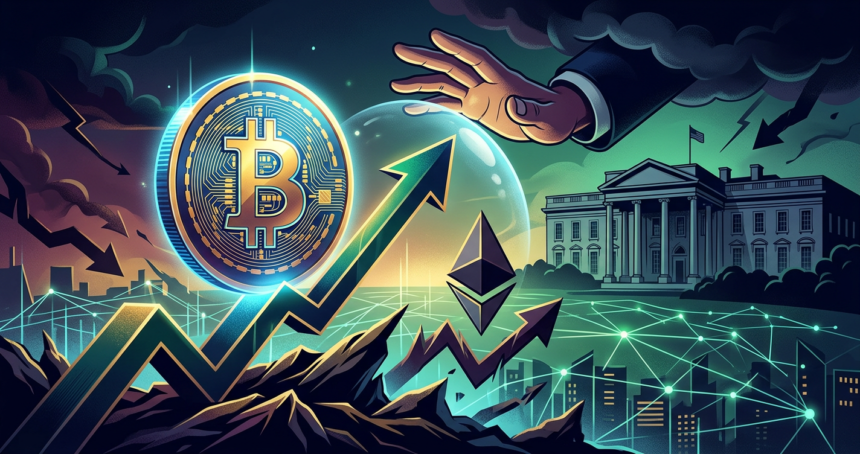
Geopolitical tensions in the Middle East have once again become the primary driver for digital asset markets, as traders react to the evolving situation between Iran and its regional adversaries. Bitcoin and major altcoins have spent the last 48 hours mirroring the headlines coming out of Washington and Tehran, illustrating the sector’s complicated relationship with “safe haven” narratives.
For much of early 2026, the crypto market had been focused on internal shifts, such as changing institutional investment goals. However, the threat of an escalated conflict has forced a pivot back to macro-risk management. When reports first emerged of potential strikes, Bitcoin prices dipped sharply as leverage was wiped out, only to recover partially when the White House indicated a preference for a measured, non-military response.
The White House Pause and Bitcoin’s Brief Relief
Bitcoin has frequently been touted as “digital gold,” a hedge against the failures of traditional fiat systems and geopolitical instability. Yet, the price action seen this week suggests it behaves more like a high-beta risk asset during the initial minutes of a crisis. As news of the tension broke, liquidations spiked across major exchanges, dragging the original cryptocurrency lower.
The tide turned slightly when reports surfaced that the White House decided to pause or delay a direct response to recent Iranian provocations. This breathing room allowed BTC to edge higher, reclaiming lost ground as the immediate fear of a third world war dissipated. It’s a pattern we’ve seen before: the initial “shock” causes a sell-off to cash, followed by a “flight to quality” once the dust settles and investors look for assets outside the reach of any single central bank.
And yet, the recovery remains fragile. Unlike previous bull runs where every dip was aggressively bought, the current climate is wary. Institutional desks are keeping a close eye on the headlines, ready to hit the sell button if the diplomatic situation deteriorates further.
Ethereum and Altcoins Face a Disconnected Reality
While Bitcoin showed some resilience during the diplomatic lull, the rest of the market has not fared as well. Ethereum and XRP have struggled to maintain momentum, revealing a growing divergence in how the market values different tiers of digital assets.
Ethereum, in particular, is navigating its own set of challenges. While some analysts believe Ether is entering a generational buy zone, the immediate price action has been sluggish. The transition toward scaling and AI security needs has kept long-term believers interested, but it hasn’t provided the immediate shield against geopolitical volatility that BTC occasionally offers.
XRP has also found itself caught in the crossfire. Beyond the Middle East tensions, the broader regulatory environment continues to weigh on the asset. With the SEC targeting various tokens in a security status sweep, XRP investors are juggling both war fears and legal uncertainty. This “double whammy” has left XRP trading with high volatility but little upward direction, as the market remains skeptical of the more ambitious long-term price targets often cited by enthusiasts.
Why Crypto Responds Differently to Modern War
The reaction of crypto to the Iran crisis highlights a fundamental shift in market structure. A few years ago, crypto was mostly retail-driven and susceptible to “diamond hands” idealism. Today, the dominance of institutional players means Bitcoin often trades in lockstep with the S&P 500 and Nasdaq futures during the early hours of a global conflict.
When war looks likely, institutional algorithms sell everything that isn’t cash or short-term Treasuries. This is why we see Bitcoin slide alongside tech stocks at the first sign of a missile launch. It is only when the “fog of war” clears that the narrative of Bitcoin as a censorship-resistant store of value begins to attract buyers again.
So, we are seeing a two-stage process:
- The Panic Phase: Correlation with risk assets hits 1.0. Everything is sold to cover margins and move to the sidelines.
- The Sovereignty Phase: If the conflict appears likely to cause long-term currency debasement or bank freezes, capital begins to flow back into BTC and, to a lesser extent, ETH.
The Role of Stablecoins and Capital Flight
One overlooked aspect of the current tension is the movement of stablecoins. In regions directly affected by conflict or sanctions, USDT and USDC often trade at a premium. Investors in the Middle East have increasingly used these assets as a bridge to move capital out of local currencies that might be devalued by war.
But even this “safe” corner of the market is changing. Recent legislation like the New Clarity Act has restricted how yield can be generated on these assets, potentially affecting liquidity during times of crisis. If investors can’t earn interest on their “parked” capital, they may be faster to move back into volatile assets or exit the ecosystem entirely once the immediate threat passes.
Looking Ahead to the Next Escalation
The market is currently in a “wait and see” mode. If the 2026 geopolitical climate remains this volatile, we should expect Bitcoin to continue its role as a high-frequency barometer for global peace. For XRP and Ethereum, the path is more difficult, as they must prove their utility and “store of value” status while simultaneously fighting off regulatory headwinds and a bearish divergence from the market leader.
For now, the chart isn’t being drawn by developers or “whales”—it’s being drawn by diplomats in D.C. and generals in the Middle East.
Frequently Asked Questions
Does Bitcoin actually work as a hedge against war?
The answer is “yes and no.” In the very short term, Bitcoin usually drops because it’s a liquid asset that people can sell quickly for cash. However, over weeks or months of sustained conflict, it has historically performed well as people look for ways to protect their wealth from government seizure or currency collapse.
Why did Ethereum drop more than Bitcoin during the headlines?
In times of extreme uncertainty, investors tend to “flight to quality,” which in the crypto world means Bitcoin. Ethereum is seen as a technology platform, and when war is on the horizon, people care less about decentralized apps and more about basic wealth preservation. This is why ETH often underperforms BTC during geopolitical spikes.
What happens if Iran sanctions affect the local mining industry?
Iran has historically been a notable hub for Bitcoin mining. If a conflict leads to infrastructure damage or stricter energy rationing, the global hashrate might take a small hit. However, because Bitcoin mining is now so distributed across the U.S., Central Asia, and Africa, it’s unlikely to cause a network failure, though it could lead to temporary price volatility.