

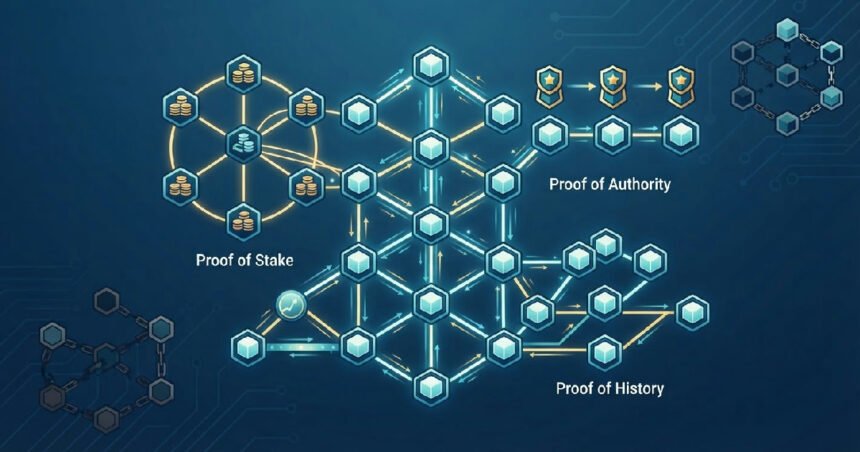
Novel consensus mechanisms are fundamentally reshaping the cryptocurrency landscape, providing essential infrastructure for the expansion of altcoin projects. These innovative protocols address critical limitations inherent in earlier systems, most notably Proof of Work (PoW), by delivering significant enhancements in scalability, energy efficiency, security, and decentralization.
This evolution allows altcoins to support a broader array of applications, achieve faster transaction speeds, and reduce operational costs, thereby accelerating their adoption and continued development.
Understanding Novel Consensus Mechanisms
The journey of any altcoin project heavily relies on its underlying technological framework. Understanding these foundational elements is key to comprehending the broader market. Investors often look at the technical architecture when navigating altcoin developmental roadmap phases, as robust consensus mechanisms are vital for long-term viability and success.
To grasp the impact of these innovations, it’s essential to clarify some fundamental terms. A consensus mechanism is a fault-tolerant protocol used in distributed computer systems and blockchain networks. Its primary purpose is to achieve agreement on a single data value or the network’s state among multiple participants, operating without a central authority.
An altcoin, a portmanteau of “alternative coin,” refers to any cryptocurrency other than Bitcoin. These digital assets leverage various technologies to carve out unique market positions. Meanwhile, a blockchain is a type of distributed ledger database that maintains a continuously growing list of transaction records, ordered into blocks, enabling secure information sharing.
Finally, Distributed Ledger Technology (DLT) is a digital record of ownership that distinguishes itself from traditional databases by lacking a central administrator or storage. Instead, the ledger is replicated across numerous nodes within a peer-to-peer network.
Overcoming Blockchain’s Foundational Challenges
Novel consensus mechanisms are pivotal for altcoin growth because they offer practical solutions to the “blockchain trilemma.” This persistent challenge involves simultaneously optimizing for decentralization, security, and scalability within a single network. Traditional systems often sacrifice one for the sake of the others.
Many newer mechanisms significantly boost scalability, enabling higher transaction throughput and faster finality compared to older PoW systems. This makes altcoins suitable for applications demanding high transaction volumes. They also deliver vastly improved energy efficiency, with mechanisms like Proof of Stake drastically cutting energy consumption by eliminating intensive computational mining.
In terms of security, these mechanisms introduce diverse economic incentives or identity-based validations to prevent malicious behavior. Some also strive to enhance decentralization by lowering entry barriers for validators or distributing validation power more widely. This all contributes to cost reduction through lower energy use and greater efficiency, translating to reduced transaction fees for users.
The Evolution of Proof of Stake (PoS) and Its Variants
Proof of Stake (PoS) represents a significant paradigm shift in how blockchain networks achieve consensus. Unlike PoW, PoS selects validators to propose and verify new blocks based on the amount of cryptocurrency they “stake”—lock up as collateral—rather than computational power. This method fundamentally changes the economics of network participation.
This fundamental change brings several immediate benefits. By removing the need for energy-intensive mining rigs, PoS drastically improves environmental sustainability and lowers the barrier to entry for network participation. This shift democratizes validation, allowing a wider range of users to contribute to network security without needing specialized hardware, thereby fostering greater decentralization potential and reducing operational overheads for the network itself.
The innovation of PoS extends beyond its core mechanism, spawning a diverse ecosystem of variants designed to optimize for different network priorities. These adaptations demonstrate the flexibility of the staking model, allowing projects to fine-tune aspects like transaction speed, validator count, and governance structures.
This continuous evolution has made PoS a versatile foundation for a multitude of altcoins aiming to solve specific real-world problems with bespoke blockchain solutions, contributing to altcoin project sustainability.
Proof of Stake in Practice
In a PoS system, participants stake a predefined amount of the network’s native cryptocurrency into a smart contract. The protocol then pseudo-randomly selects a validator to propose the next block, with selection often influenced by the staked amount and duration. Once a validator proposes a block, other validators verify its correctness.
Honest validators earn rewards, typically in the form of network tokens, while malicious actors risk losing part or all of their staked funds through a process called “slashing.” Ethereum, for example, transitioned from PoW to PoS in 2022. This shift drastically reduced its energy usage by over 99%, showcasing the mechanism’s efficiency. Cardano also utilizes PoS, illustrating its widespread adoption among major altcoins.
Ethereum’s PoS structure requires a minimum stake of 32 ETH to run a validator. Time is organized into 12-second slots and 32-slot epochs, with one validator randomly selected per slot. This design significantly lowers hardware requirements and increases scalability.
As ethereum.org notes, “Proof-of-stake is a way to prove that validators have put something of value into the network that can be destroyed if they act dishonestly.”
Delegated Proof of Stake (DPoS)
Delegated Proof of Stake (DPoS) is an influential variation of PoS. Here, token holders use their staked tokens to vote for a select group of “delegates” or “witnesses” to validate transactions. These elected delegates, typically numbering between 21 and 100, are then responsible for proposing and validating blocks.
This structure enables faster transaction speeds and higher throughput due to a smaller, fixed set of validators, making it energy-efficient.
However, DPoS introduces a trade-off. While efficient, it can lead to a higher degree of centralization compared to pure PoS. Power becomes concentrated among fewer validators, though delegates who act maliciously can be voted out by the community.
Specialized Consensus: Proof of Authority (PoA) and Proof of History (PoH)
Beyond PoS, other novel mechanisms cater to specific use cases or enhance existing systems. Proof of Authority (PoA) is a reputation-based consensus mechanism where validators are pre-approved based on verified identity. It bypasses the need for staked coins or computing power, making it ideal for private chains, testnets, and enterprise solutions.
These specialized approaches highlight the trade-offs inherent in blockchain design. PoA, for instance, sacrifices a degree of public decentralization for enhanced speed and controlled environments, which is crucial for regulated industries or internal corporate applications where known entities are preferred. PoH, conversely, doesn’t achieve consensus alone but revolutionizes how events are ordered and timestamped, thereby dramatically boosting the efficiency and scalability of accompanying consensus algorithms.
The emergence of such tailored mechanisms underscores a broader trend in blockchain development: the move away from a one-size-fits-all approach.
By innovating beyond general-purpose solutions, altcoins can leverage consensus designs that perfectly align with their specific operational demands, whether that involves high throughput for DeFi, verifiable identity for supply chains, or rapid transaction finality for gaming. This customization is key to unlocking new applications and expanding the overall utility of blockchain technology.
Proof of Authority in Enterprise Environments
PoA requires validators to disclose their real-world identity and meet strict approval requirements. A small, fixed group of pre-approved validators takes turns producing and confirming new blocks, often in a round-robin fashion. Validators stake their reputation, providing a strong incentive for honest behavior. Any malicious actions would damage their public identity and could lead to removal from the network.
This mechanism offers high transaction processing speeds, significant throughput, and energy efficiency because it avoids competitive mining or large staking demands. While less decentralized than PoW or PoS due to its reliance on a centralized group of trusted authorities, PoA is highly suitable for enterprise blockchain use cases where identity and trust are already established.
Proof of History (PoH) and Solana’s Innovation
Proof of History (PoH) is not a standalone consensus mechanism but a cryptographic clock designed to create a verifiable record of time and order between events. It functions as a tamper-proof sequence of timestamps on the blockchain, complementing other consensus algorithms. Solana prominently utilizes PoH alongside Proof of Stake and Tower BFT, a PoS-optimized Byzantine Fault Tolerant consensus algorithm.
PoH uses a Verifiable Delay Function (VDF), a sequential pre-image resistant hash function (SHA-256), where each output becomes the input for the next iteration. This continuous hashing creates a chain of hashes, proving that a specific amount of time has elapsed.
This process allows validators to agree on transaction order and timing without constant communication, acting as a consistent global timestamp. Solana targets 160 ticks per second, allowing for immense transaction throughput—up to 65,000 transactions per second—and sub-second finality. This efficiency is a key reason for the platform’s rapid adoption.
Market Impact and Future Trajectories for Altcoins
The proliferation of novel consensus mechanisms is a critical driver for the broader altcoin market, enabling these projects to move beyond the limitations of early blockchain designs. By addressing scalability, efficiency, and decentralization, these innovations allow altcoins to support more complex and high-demand applications, from decentralized finance (DeFi) to gaming and enterprise solutions.
The reduced operational costs and faster transaction times make these networks more attractive for both developers and end-users, fostering wider adoption and navigating digital asset compliance challenges.
As the blockchain space continues to mature, we can expect further innovations in consensus mechanisms. These advancements will likely focus on enhanced interoperability, greater energy efficiency, and more robust security features.
The ongoing evolution ensures that altcoin projects can adapt to growing demands and evolving technological landscapes, solidifying their role in the future of digital finance and beyond. This continuous innovation is vital for the long-term sustainability and utility of the entire crypto ecosystem.
Frequently Asked Questions
- What is the blockchain trilemma?
- The blockchain trilemma refers to the challenge of achieving optimal decentralization, security, and scalability simultaneously in a blockchain network. Often, improvements in one area come at the expense of another.
- How do novel consensus mechanisms improve scalability?
- Many novel mechanisms, such as various forms of Proof of Stake, enable higher transaction throughput and faster transaction finality by changing how blocks are validated, often reducing the computational work or the number of participants required for consensus compared to Proof of Work.
- What is the main difference between Proof of Work (PoW) and Proof of Stake (PoS)?
- In PoW, validators (miners) compete to solve complex cryptographic puzzles to add new blocks, requiring significant computational power. In PoS, validators are selected to create new blocks based on the amount of cryptocurrency they have “staked” (locked up) as collateral, making it far more energy-efficient.
- Can Proof of History (PoH) operate as a standalone consensus mechanism?
- No, Proof of History (PoH) is not a standalone consensus mechanism. It functions as a cryptographic clock that creates a verifiable record of time and order between events, which then complements other consensus algorithms like Proof of Stake and Byzantine Fault Tolerance, as seen in Solana.
- Why are novel consensus mechanisms important for altcoins?
- They allow altcoins to overcome limitations of older blockchain designs, offering better scalability, energy efficiency, and sometimes enhanced decentralization or specialized features. This enables altcoins to support a wider range of applications and achieve faster adoption.