

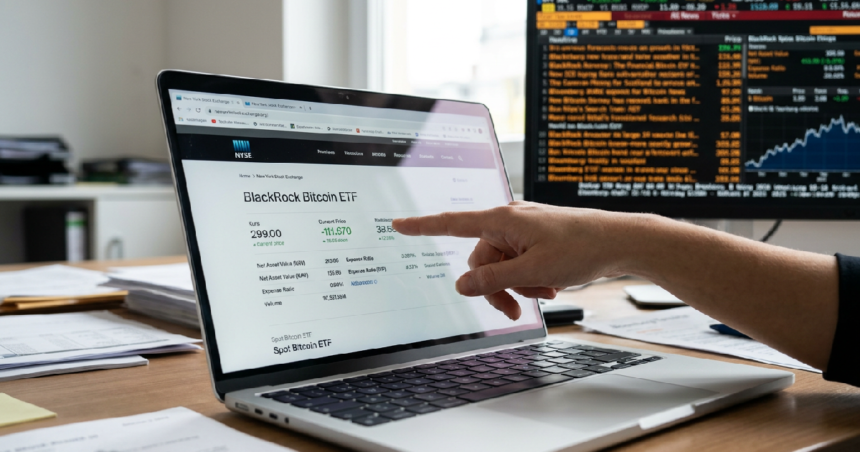
Investors can monitor How to Track Bitcoin ETF Prices (Kurs) by utilizing real-time brokerage accounts, major financial news platforms like Bloomberg and Reuters, or the official websites of fund issuers such as BlackRock and Fidelity.
Unlike the underlying cryptocurrency which trades 24/7, these exchange-traded funds (ETFs) operate within traditional market hours on regulated exchanges like the New York Stock Exchange (NYSE), Nasdaq, and Cboe BZX. The U.S.
Securities and Exchange Commission (SEC) first paved the way for this institutional access by approving the first spot Bitcoin ETFs in January 2024.
The term “Kurs” is a German financial expression that translates to “price” or “rate,” describing the market value of a security at a specific time. Because Bitcoin ETFs serve as a bridge between digital assets and traditional finance, understanding their pricing requires distinguishing between the intraday market price and the Net Asset Value (NAV).
The NAV reflects the end-of-day intrinsic value of the fund’s holdings, calculated once daily after the markets close.
Tracking these assets involves more than watching a ticker symbol; it requires an understanding of the mechanical role of Authorized Participants (APs). These financial institutions manage the creation and redemption of shares to keep the ETF’s market price aligned with the value of the underlying Bitcoin.
This structural oversight is a key component of what is a spot Bitcoin ETF and how it works in the current market.
Authoritative data sources for Bitcoin ETF Kurs tracking
A primary brokerage account remains the most direct way to view the market price of a Bitcoin ETF in real-time or near real-time during exchange hours. If you hold shares in a fund, your personal dashboard will reflect the current bid and ask prices. Monitoring these figures is essential for identifying the bid-ask spread—the difference between the highest buyer bid and the lowest seller ask.
Global financial data platforms such as Yahoo! Finance, Google Finance, and TradingView provide live quotes and historical charts for these funds. These outlets identify ETFs by their unique ticker symbols, such as IBIT for the iShares Bitcoin Trust or FBTC for the Fidelity Wise Origin Bitcoin Fund. Reliable data is particularly important when Bitcoin analysts signal potential breakout trends that might influence institutional fund flows.
Official issuer websites and specialized fund trackers
For the most detailed performance data, investors often turn to the official websites of the ETF providers. Companies like Invesco (Invesco Galaxy Bitcoin ETF) and Bitwise (Bitwise Bitcoin ETF) publish daily data regarding holdings, performance metrics, and the official NAV. These sources provide the baseline for assessing whether an ETF is trading at a premium or a discount relative to its underlying assets.
Specialized trackers such as CoinMarketCap, The Block, and Bitbo have developed dashboards dedicated to the sector. These tools consolidate data from multiple ETFs into a single view, showing assets under management (AUM), trading volumes, and expense ratios. High trading volume typically indicates better liquidity, making it easier for investors to enter or exit positions without causing significant price shifts.
Mechanical differences between ETF prices and spot Bitcoin
Those learning How to Track Bitcoin ETF Prices (Kurs) must account for the fact that market prices are driven by exchange supply and demand, not just the price of Bitcoin. This can lead to small deviations where the ETF trades slightly above or below its NAV. Professional market makers and Authorized Participants arbitrage these differences to maintain price stability throughout the trading day.
While spot ETFs hold actual Bitcoin directly, Bitcoin futures ETFs invest in contracts to buy or sell the asset at a later date. This difference in structure means futures-based funds may experience performance variations due to market conditions like contango. Investors often monitor these developments as part of a broader strategy, sometimes alongside tools like an integrated Bitcoin and gold account to diversify their exposure.
Trading hours and liquidity factors
A critical distinction in tracking “Kurs” is the limitation of traditional trading hours. While Bitcoin itself never stops trading, ETFs are generally restricted to the 9:30 AM to 4:00 PM EST window on U.S. exchanges. Any price movement in the underlying cryptocurrency that occurs overnight or on weekends will not be reflected in the ETF’s market price until the exchange reopens the following business day.
Liquidity varies significantly between different fund products. Larger funds, such as the Grayscale Bitcoin Trust (GBTC), often enjoy higher trading volumes which can lead to tighter bid-ask spreads. Conversely, smaller or newer funds might have wider spreads, which investors must factor in as an additional cost of trading beyond the standard brokerage commissions.
Evaluating expense ratios and fund management costs
Long-term investors must look beyond the daily price to the expense ratio, which is an annual fee charged as a percentage of the fund’s assets. In the United States, the average expense ratio for Bitcoin ETFs is approximately 0.79%. This cost covers the management and administrative expenses incurred by the fund provider in securing and holding the underlying assets.
Significant variations exist between providers in the competitive ETF market. For instance, the Grayscale Bitcoin Mini Trust offers an expense ratio as low as 0.15%, standing in contrast to the broader market average. Comparing these ratios across different “Bitcoin ETF Trackers” is a standard part of the due diligence process for any investor looking to maximize their net returns over time.
Finally, tracking daily fund flows—the amount of capital moving in or out of a fund—can provide insights into market sentiment. Consistent inflows often suggest growing institutional interest, while significant outflows may signal a period of profit-taking or a shift in risk appetite. These metrics, combined with the daily Kurs, offer a comprehensive view of how Bitcoin ETFs are performing within the wider financial ecosystem.