

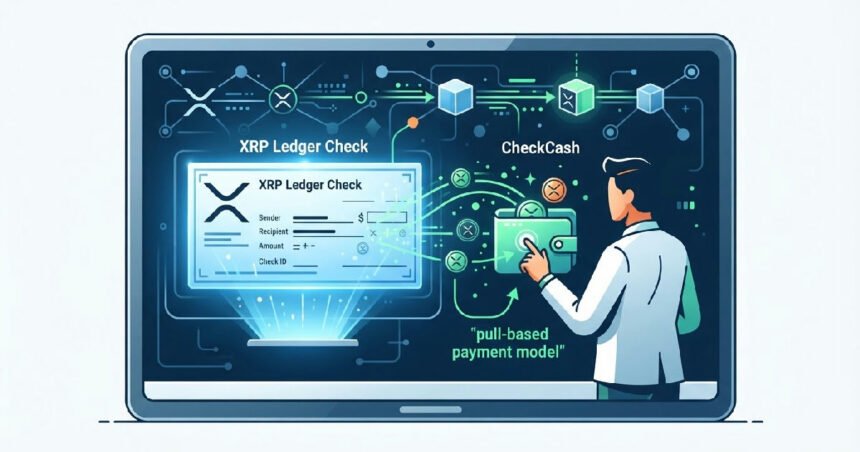
XRP Ledger Checks represent a distinctive feature on the XRP Ledger (XRPL), offering a mechanism for deferred payments that mirrors traditional paper checks within the digital realm. Unlike other blockchain payment methods, these checks do not immediately reserve or lock funds, allowing for greater flexibility in digital value exchange.
This innovative approach means that funds only transfer when a recipient “cashes” the check, providing a pull-based payment model on a decentralized public blockchain. It’s a strategic design choice that distinguishes XRPL Checks from typical escrow or payment channels, where funds are often held in advance.
Understanding XRP Ledger Checks on the XRPL
The XRP Ledger (XRPL) is an open-source, decentralized blockchain known for its swift, low-cost, and scalable digital asset transactions. It employs a unique federated consensus mechanism, enabling transaction settlements in just three to five seconds. This robust infrastructure forms the foundation for various functionalities, including the Check feature.
An XRP Ledger Check is essentially a deferred payment object on the network. It grants a sender the ability to authorize a future payment to a specified recipient, with the actual transfer of value initiated by the recipient at their convenience. This effectively digitizes the concept of a bank draft or a personal check.
The Lifecycle of an XRP Ledger Check
XRP Ledger Checks proceed through a well-defined lifecycle, starting from their creation and potentially ending with either their cashing or cancellation. Each step ensures transparency and control for both the sender and the recipient within the decentralized environment.
Creating a Check
The process begins when a sender initiates a CheckCreate transaction. This transaction specifies the recipient’s address and can include an optional expiration date, after which the check becomes invalid. Crucially, it also defines the maximum amount that can be debited from the sender’s account.
Upon successful processing of the CheckCreate transaction, the XRP Ledger generates a unique Check object. This object is then recorded on the ledger, establishing the potential future payment without yet moving any funds from the sender’s balance.
Cashing and Redeeming Funds
To redeem the authorized funds, the recipient must submit a CheckCash transaction. They have two primary options for cashing: specifying an exact amount up to the check’s maximum value, or setting a minimum amount and letting the ledger transfer as much as possible up to the maximum.
If the sender possesses insufficient funds at the moment the check is cashed, the transaction will fail. However, the recipient retains the ability to retry the transaction until the check’s specified expiration date. A successful CheckCash operation facilitates the fund transfer and automatically removes the Check object from the ledger.
Cancelling an Existing Check
Before its expiration, either the sender or the recipient can cancel a Check object using a CheckCancel transaction. If a check expires without being cashed, it can no longer be redeemed, though the object itself persists on the ledger.
In such cases, any party can submit a CheckCancel transaction to formally remove the expired Check object. This ensures the ledger remains clean and efficient by eliminating outdated payment authorizations. Ultimately, the Check object is destroyed once it is either successfully cashed or formally cancelled.
Key Distinctions and Benefits for Users
The core advantage of XRP Ledger Checks lies in their “pull-based” payment mechanism. Unlike traditional escrow services or payment channels that require funds to be set aside or locked, XRPL Checks keep the sender’s funds available until the recipient decides to cash them.
This design provides significant flexibility, particularly for recurring payments or situations where the exact payment timing is uncertain. It also means that senders retain control over their assets for longer, only relinquishing them upon the recipient’s action. Ripple, a key contributor to the XRP Ledger’s development, highlights this deferred nature as a central benefit.
Moreover, the XRPL ecosystem continues to evolve its terminology for clarity. XRPL Labs, responsible for the XUMM wallet, has moved away from using “IOU” for issued tokens, preferring “issued currencies” or “tokens.” This shift aims to prevent misunderstandings about optimal ledger use, particularly concerning gateways and financial institutions, despite the historical use of IOU for debt representation.
This clarification helps differentiate these asset-backed tokens from the deferred payment nature of XRP Ledger Checks. While both involve value on the ledger, their functionalities and underlying financial models are distinct. The Checks feature focuses squarely on conditional payment authorizations rather than representing existing debt.
Technical Underpinnings and Economic Considerations
The technical implementation of XRP Ledger Checks is designed for efficiency and network stability. Each transaction on the XRPL incurs a standard cost of 10 drops, which equates to 0.00001 XRP. This fee is burned, not collected, effectively acting as a mechanism to prevent network spam and scale with network load.
Checks can also feature an expiration date, specified as an integer relative to the Ripple Epoch (January 1, 2000, 00:00 UTC). While precise, the ledger’s time resolution rounds to about 10 seconds, meaning an expiration could be slightly later than programmed. Integrating such features into wallets and applications becomes crucial for user experience.
Another important economic consideration is the base reserve requirement for XRPL accounts. Every account must maintain a minimum of 1 XRP, with this reserve increasing based on the number of objects, like Check objects, that an account owns. This mechanism discourages the careless or malicious bloating of the ledger, maintaining its performance.
Future Outlook for XRPL Checks
As the XRP Ledger ecosystem expands, the utility of features like XRP Ledger Checks is likely to grow, particularly for businesses and individuals seeking more nuanced financial tools on the blockchain. Their non-custodial and flexible nature makes them ideal for a range of applications where immediate settlement isn’t always desirable or possible.
The ongoing development efforts by entities such as Ripple and the XRPL Foundation continue to refine these functionalities. This ensures the ledger remains at the forefront of digital value exchange, offering robust and adaptable solutions for a variety of use cases, from micro-payments to larger conditional transactions.