

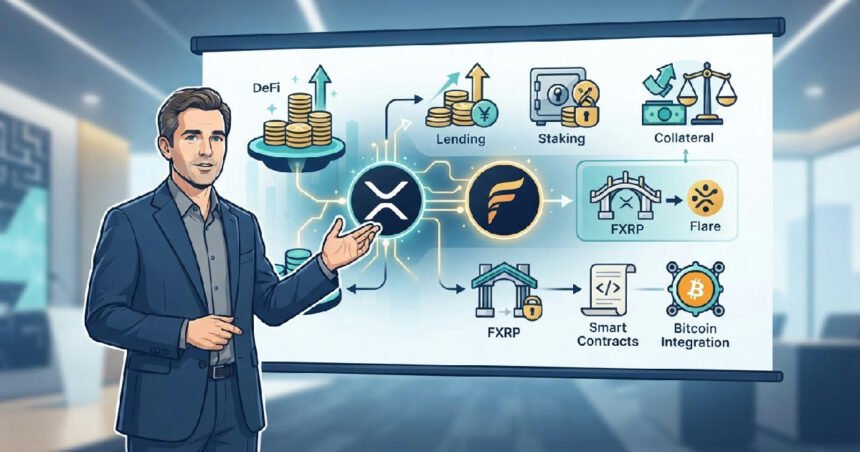
Hugo Philion, the Co-Founder and CEO of Flare Network, is actively championing a significant expansion of XRP’s utility, urging holders to engage with the asset beyond its traditional payment-focused role championed by Ripple. Philion’s vision, first articulated on March 3, 2021, centers on transforming XRP into a programmable asset capable of generating yield and participating in decentralized finance (DeFi) activities through Flare’s ecosystem.
This strategic push aims to make XRP less reliant on Ripple’s core business model. It opens new avenues for XRP holders to leverage their assets in lending, staking, and collateral mechanisms, fundamentally changing how the digital asset can be used within the broader blockchain landscape. Philion emphasizes that Flare Network is designed to enhance what the XRP Ledger can achieve with tokenized real-world assets.
Expanding XRP’s reach through Flare’s FAssets
Flare Network was conceived to address a critical limitation of the native XRP Ledger (XRPL), which lacks intrinsic smart contract capabilities. This absence historically restricted XRP’s direct involvement in the burgeoning DeFi sector. Philion and his team built Flare to bridge this gap, allowing XRP to interact with more complex on-chain applications.
The core of Flare’s solution is the FAssets system, a trustless and over-collateralized mechanism. It enables assets like XRP to be represented as wrapped tokens, known as FAssets, on the Flare network. This process effectively brings XRP into an Ethereum Virtual Machine (EVM)-compatible environment, making it usable across a wide array of DeFi protocols.
The wrapped version of XRP, called FXRP, operates as a 1:1 representation of the underlying asset on Flare. Users can mint FXRP by sending their XRP to a registered agent on the XRPL, with the agent providing collateral in a mix of XRP, Songbird (SGB), and stablecoins.
This collateral is crucial for maintaining security and is typically at least 1.3 times the value of the FXRP being minted.
The FXRP system officially launched live on Flare’s mainnet in September 2025. This marked a pivotal moment, as it immediately allowed XRP holders to begin interacting with DeFi protocols using Flare’s FAssets framework. The initial minting allocation for FXRP, set at 5 million, filled within three hours, demonstrating strong immediate demand from the community.
A subsequent 15 million FXRP cap also filled rapidly, signaling sustained interest. By April 2026, over 150 million FXRP was reported in circulation. These figures underscore the significant appetite among XRP holders for diversified utility and yield-generating opportunities.
FXRP and the DeFi ecosystem: metrics and opportunities
The introduction of FXRP has unlocked a suite of decentralized finance possibilities for XRP holders. Once converted to FXRP, these assets can participate in lending and borrowing markets, engage in staking and yield farming, and contribute to liquidity pools on decentralized exchanges. XRP can now effectively serve as collateral to borrow other digital assets or stablecoins.
Flare’s initiatives have already translated into tangible growth for the ecosystem. As of July 2026, the Total Value Locked (TVL) on Flare exceeded $200 million, largely driven by increased cross-chain activity. This indicates a robust and expanding environment for DeFi operations. Furthermore, the ecosystem has recorded more than 3.4 million FXRP DeFi transactions.
The platform has also seen substantial user adoption, with around 16,500 FXRP users. By October 2025, approximately $86.2 million worth of XRP had been bridged to Flare. This ongoing integration phase, dubbed “XRPFi,” aims to onboard up to 5 billion XRP into the DeFi ecosystem via Flare within six months.
That target represents about 5% of the total XRP supply, highlighting the ambitious scope of this undertaking.
On October 7, 2026, Flare further solidified its DeFi offerings by deploying a new lending market. This market allows investors to borrow the RLUSD stablecoin using wrapped XRP (FXRP) as collateral. As of that same day, October 7, 2026, $7.2 million in RLUSD had been borrowed through this new market, collateralized by 10.8 million FXRP.
These developments come as Flare strengthens its ties with the broader XRP community. On October 28, 2026, the XRP Ledger Foundation officially added Flare Networks to its recommended validator list. This endorsement signifies a growing recognition of Flare’s role in enhancing the utility and capabilities of the XRP ecosystem.
Bridging traditional finance and new frontiers with confidential compute
Flare Network is not only focused on expanding retail DeFi opportunities but also on attracting institutional participation. A key component of this strategy is the integration of Confidential Compute technology. This system, set to launch in the third quarter of 2026, aims to provide institutional-grade privacy while maintaining the verifiability essential for on-chain transactions.
Confidential Compute utilizes trusted execution environments (TEEs) to protect sensitive data during processing. This is particularly vital for financial institutions that require strict confidentiality for trading and lending activities. The technology allows institutions to trade and lend XRP-backed assets privately, a critical feature for broader adoption in traditional finance.
Another innovation is the introduction of Protocol Managed Wallets (PMWs). These wallets empower developers to construct custom smart contract logic that directly interfaces with the XRP Ledger. This means users can lend their XRP directly from their native wallets, circumventing the need to rebuild the XRPL itself for advanced DeFi functions.
These advancements represent a significant step towards enabling private and secure institutional participation in decentralized finance.
Philion also discussed plans to extend Flare’s FAssets technology to Bitcoin (FBTC). This move aims to bring Bitcoin into the DeFi ecosystem, positioning Flare as a versatile liquidity hub, aligning with broader trends of institutional Bitcoin adoption. The integration of enterprise blockchain solutions like these broadens Flare’s ambition to become a universal computation layer for assets that lack native smart contract capabilities.
The vision for Bitcoin integration was confirmed by Philion on March 31, 2026, with an expected launch by the end of the year. He stated via X/Twitter that “we think we are on track both with TEEs and with XRPFi adoption to add Bitcoin later this year.” This strategy demonstrates Flare’s commitment to cross-chain interoperability and maximizing the utility of major cryptocurrencies.
XRP’s evolving role: from payments to yield generation
For years, XRP has primarily been recognized for its role in enabling fast and inexpensive cross-border payments, largely facilitated by Ripple’s On-Demand Liquidity (ODL) product. However, Hugo Philion argues that XRP’s utility is evolving significantly beyond this initial focus. He envisions XRP becoming a productive collateral asset, generating tangible yields within the DeFi space.
“If tens of billions of XRP are used every day, that becomes a true financial product that generates yield beyond a digital asset,” Philion stated, emphasizing the transformative potential. This perspective contrasts with some traditional views of XRP, including those from Ripple’s CTO David Schwartz, suggesting the potential for XRP lending might be greater than initially perceived.
Philion maintains that the goal is to unlock XRP’s potential as “usable capital.” He has consistently urged XRP holders to focus on this paradigm shift rather than solely relying on Ripple to dictate the asset’s value. This approach provides XRP holders with proactive ways to increase their holdings’ value through active participation in DeFi.
While Ripple has proposed its own native lending standard, XLS-66, for the XRPL, this initiative is still undergoing validator voting. Flare’s current offerings provide an immediate and operational alternative for XRP lending and other DeFi activities. This parallel development allows the XRP ecosystem to explore diversified avenues for growth and utility, regardless of the pace of native XRPL upgrades.
The integration of Flare Smart Accounts with wallets like Xaman and D’CENT has further streamlined access to XRP yield products for hardware wallet users. This expanded accessibility makes it easier for a broader base of XRP holders to engage with the Flare ecosystem, providing direct access to yield opportunities.
The path ahead for XRP utility and Flare’s innovation
The next six months are poised to be transformative for XRPFi through Flare, according to Philion. He predicts a significant increase in the amount of XRP flowing into Flare’s DeFi ecosystem, aiming for the 5 billion XRP target. This aggressive growth strategy seeks to solidify Flare’s position as a crucial player in the broader digital asset space.
The deployment of Flare’s Confidential Compute system and the ongoing development of Protocol Managed Wallets are expected to attract more institutional capital, a trend seen with XRP ETP holdings by major financial firms. These privacy-enhancing features are vital for regulatory compliance and risk management, which are paramount for large financial entities considering entry into DeFi.
Flare aims to cater to both retail and institutional demands, ensuring a robust and secure environment.
Looking ahead, Flare’s integration of Bitcoin via FBTC will further enhance its role as an interoperability layer. By allowing Bitcoin to participate in DeFi, Flare is setting a precedent for other non-smart contract-enabled assets. This strategic expansion underscores Philion’s long-term vision of making blockchains more open, connected, and secure for a wider range of digital assets.
The continued growth of FXRP, with over 155 million minted and a high percentage actively deployed in DeFi as of September 2026, indicates strong momentum. With initiatives like the XRP Ledger Foundation adding Flare Networks to its recommended validator list, the collaboration between different entities within the XRP community appears to be strengthening.
These synergies are crucial for the sustained development and the potential for increased institutional XRP holdings and utility.
As Flare continues to innovate, it will likely influence how other layer-1 solutions approach cross-chain compatibility and DeFi integration. The network’s focus on practical utility and secure infrastructure positions it as a key driver in the evolving landscape of decentralized finance. Philion’s consistent advocacy and Flare’s technological advancements are clearly reshaping the narrative around XRP’s potential.