

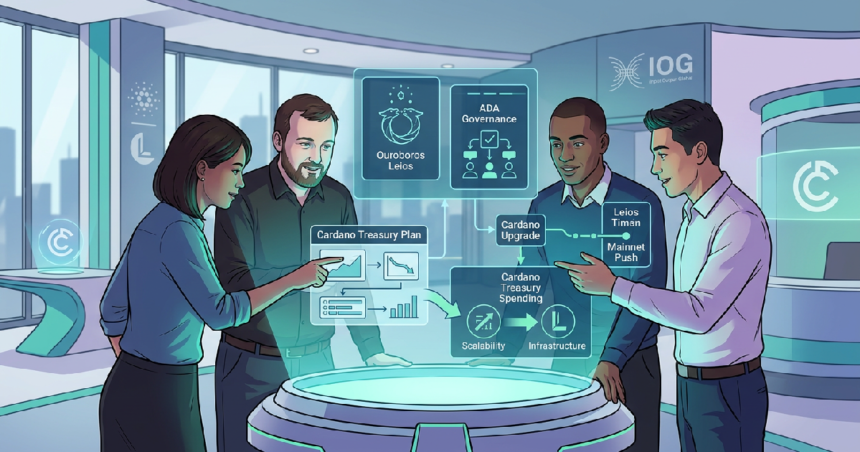
Input Output Global (IOG) has reportedly adjusted its strategy for the Cardano treasury as the ecosystem prepares for the upcoming Leios mainnet upgrade. This shift suggests a move toward fiscal conservatism, as the development firm aims to balance long-term sustainability with the intensive resource requirements of its next major technical milestone. While the Leios upgrade remains a central pillar of the network’s future, the revised treasury plan indicates that the transition to a more decentralized governance model may involve more cautious spending than previously anticipated.
The decision comes at a time when the broader digital asset market is scrutinizing the longevity of foundation-led protocols. By scaling back certain treasury allocations, IOG appears to be prioritizing the completion of core infrastructure over experimental peripheral projects. For a network that has often been characterized by its methodical development pace, this streamlining of financial resources is likely a signal that the engineering team is narrowing its focus to ensure the successful rollout of Ouroboros Leios.
Strengthening the Foundations for Leios Implementation
The Leios upgrade is designed to significantly increase Cardano’s throughput without sacrificing the decentralization that has become the protocol’s hallmark. However, building such a complex mechanism requires a stable and predictable flow of capital. The proposal to scale back certain treasury initiatives is not necessarily a sign of distress but rather a strategic realignment. By tightening the belt now, IOG can ensure that the “Leios mainnet push” has the necessary runway to clear the final hurdles of development and testing.
Current reports suggest that while the upgrade is a priority, development is still in progress. This status has led to a sense of pragmatism within the community. Rather than funding a wide net of community-led proposals through Project Catalyst at previous levels, the new approach seeks to preserve the treasury’s resources for the technical heavy lifting that lies ahead. This fiscal discipline coincides with a period where the Cardano price outlook stability is increasingly tied to the network’s ability to deliver on its technological promises.
The Role of Governance in Resource Allocation
The Cardano ecosystem is also navigating the complexities of the Voltaire era, where the community takes a larger role in decision-making through Delegate Representatives (DReps). The adjusted treasury plan serves as a test for this new governance structure. It forces the community to make choices about which projects provide the most value while the network prepares for a significant leap in its transaction processing capabilities.
And it’s not just Cardano feeling this pressure. Across the industry, high-cap projects are realizing that the era of massive development funds is evolving into a more rigorous era of accountability. We have seen similar shifts where utility shifts dictate 2026 market winners, moving away from speculation and toward functional, high-performance infrastructure.
Technical Hurdles and the Leios Roadmap
The Leios mainnet launch is more than just a simple software patch; it is an overhaul of how blocks are produced and validated. By introducing “input endorsers,” the protocol aims to decouple the process of transaction selection from the process of block creation. This is a sophisticated engineering feat that demands the full attention of researchers and developers. Reports suggest the development timeline is being managed carefully to avoid technical setbacks during large-scale deployment.
Because the project is still in development, the road ahead remains intensive. Scaling back treasury spending now reportedly prevents the risk of financial constraints later in the development cycle. This move mirrors trends in the wider market where even established players are becoming more cautious with capital as they face a narrowing window of opportunity to prove their long-term viability against competing Layer 1 solutions.
What This Means for ADA Stakeholders
For the average ADA holder, the news is a double-edged sword. On one hand, reduced treasury spending might mean fewer small-scale community grants and a slower growth of the immediate dApp ecosystem. On the other hand, it ensures that the project’s primary objective—scaling Cardano to handle global-level traffic—is not compromised by fragmented funding.
The focus is clearly on the technical delivery. If Leios achieves its performance goals, the functional capacity of the network increases significantly. For now, the community must wait for further technical updates. The shift in treasury policy is a clear indicator that IOG is playing the long game, betting that a lean, focused development cycle will yield a more robust result than a period of unchecked expansion. In the current market environment, the success of this “quality over quantity” approach is expected to influence Cardano’s position in the decentralized finance sector.