

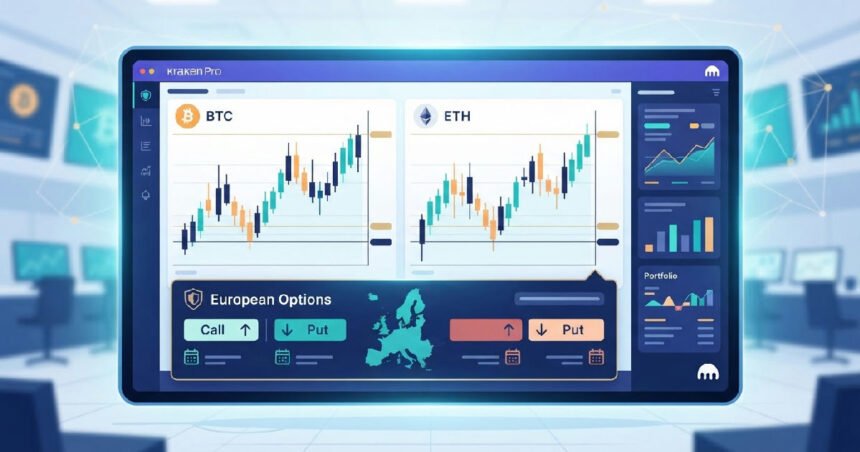
Crypto exchange Kraken has launched European-style, cash-settled options for Bitcoin (BTC) and Ethereum (ETH), making the derivatives available to eligible clients in the European Economic Area (EEA) as of October 26, 2026. The move significantly expands Kraken’s regulated offerings for professional and institutional traders on its Kraken Pro platform.
This European rollout follows an initial launch for professional and institutional clients outside the region on July 16, 2026. By bringing these financial instruments under a regulated European framework, Kraken is making a direct appeal to sophisticated investors seeking compliant ways to gain exposure to digital assets and manage risk.
Kraken Bitcoin and Ethereum options in regulated Europe
The launch is a calculated move to solidify Kraken’s position within the continent’s established financial regulatory systems. The options are provided through Payward Europe Digital Solutions (CY) Limited (PEDSL-CY), a Cypriot investment firm Kraken acquired in 2025 specifically for its Markets in Financial Instruments Directive (MiFID) license.
This MiFID permission is critical, as it allows Kraken to offer these crypto derivatives as regulated financial instruments, a distinction that sets them apart from products on many competing offshore platforms. The firm’s existing European futures business already operates under this same license, which is regulated by the Cyprus Securities and Exchange Commission (CySEC).
Alexia Theodorou, Director of Derivatives at Kraken, emphasized the strategic importance of this approach. “We want to capitalize on that and move crypto options into the regulated sphere in Europe, which is where we are focused next,” she stated, highlighting the goal of meeting growing institutional demand within a compliant structure.
This effort is part of a broader trend where major exchanges are pursuing licenses to offer products like regulated perpetual futures. By doing so, they aim to attract a more cautious class of investor that has so far remained on the sidelines of the crypto derivatives market, wary of regulatory uncertainty.
How the new Bitcoin and Ethereum options work
For eligible traders on Kraken Pro, the new options provide advanced tools for hedging and speculation. The initial offering is built around a specific set of features designed for professional use, with plans for broader functionality in the future. The structure reflects a cautious but deliberate entry into the market.
Product specifications and structure
The contracts are European-style, meaning they can only be exercised at the moment of expiry, not before. This structure is common in traditional finance and provides more predictability for traders writing the options. All contracts are cash-settled in U.S. dollars, ensuring that premium, profit, and loss are all calculated in USD, regardless of the collateral used.
Kraken is offering a flexible range of expiry dates to suit different strategies. These include weekly, monthly, quarterly, and semi-annual maturities. This variety allows traders to construct both short-term tactical positions and longer-term strategic hedges for their Bitcoin and Ethereum holdings.
Trading and margin system
Initially, trading is facilitated through a request-for-quote (RFQ) system rather than a public central limit order book. This allows clients to build a trade with up to five legs, or components, and receive a time-limited quote directly. Accepting the quote creates a binding trade, a mechanism favored by institutions for executing large or complex strategies with price certainty.
The margin system is designed for capital efficiency. Portfolio margin is enabled by default, which can reduce the total collateral required by allowing offsetting positions to balance each other out. Furthermore, the options share the same collateral pool as futures contracts, and traders can post over 30 different currencies and assets as collateral. These derivatives introduce specific risks that traders must manage.
Understanding the inherent risks
Kraken has been clear about the high-risk nature of these products. Options buyers risk losing the entire value of their position if the market moves against them. For options sellers, the risk is even greater, with the potential for losses to substantially exceed the margin posted. In certain scenarios, these losses can be unlimited.
The company’s European derivatives risk disclosure explicitly warns that leverage amplifies both gains and losses. It also states that clients may be required to provide additional collateral on short notice to support their positions. If a portfolio’s collateral becomes insufficient, Kraken can liquidate positions to manage its risk.
Integration with Kraken’s platform ecosystem
The introduction of options is not a standalone product launch but a key integration into Kraken’s wider trading ecosystem. By making these derivatives accessible through existing Kraken Pro accounts and unifying collateral management, the exchange aims to create a seamless experience for its most active clients.
The options use a futures-style margining system where the premium is not paid in full upfront. Instead, profits and losses are marked-to-market against the collateral in the account, similar to how perpetual futures are managed. This integration means existing derivatives clients can immediately start trading options using their shared collateral pool.
This unified approach is a core part of Kraken’s strategy. The platform’s Unified Wallet further streamlines collateral management by pooling spot, futures, and now options balances. This allows for more efficient use of capital, as profits from one position can be used to offset margin requirements for another, all within a single account.
However, it’s important for users to understand the settings. While derivatives share a collateral pool by default, pulling in eligible spot holdings requires a manual opt-in to the full Unified Wallet upgrade. Once enabled, this can expose spot assets to losses from leveraged derivatives positions, a risk traders must actively manage.
The broader context for crypto derivatives in Europe
Kraken’s expansion arrives at a time of growing institutional appetite for regulated crypto investment vehicles. As the digital asset market matures, large-scale investors are demanding the same sophisticated risk management tools they use in traditional finance. Options are a cornerstone of these strategies.
Theodorou noted this trend, stating, “Options are central to how sophisticated investors take positions on price, volatility and time.” She added that Kraken had long anticipated this demand, believing it would grow with “more institutional adoption of crypto.” The need for robust hedging instruments is consistently underscored in this evolving market.
The move also aligns with Europe’s evolving regulatory landscape. With the Markets in Crypto-Assets (MiCA) regulation establishing a comprehensive framework for the industry, exchanges are increasingly seeking licenses to ensure long-term viability in the region. By operating under a MiFID license, Kraken is positioning itself as a compliant and reliable venue for institutional capital.
This regulatory clarity is expected to be a key factor in attracting new market participants. For hedge funds, family offices, and asset managers, the ability to trade derivatives on a regulated platform mitigates counterparty risk and provides a level of oversight that is absent in many corners of the crypto world.
What comes next for Kraken’s derivatives ambitions
The launch of BTC and ETH options in Europe is just one phase of a larger strategy. While the current RFQ system caters to institutional clients, Kraken has indicated that future plans include the addition of a public order book. This would open up trading to a wider range of professional traders and increase market liquidity.
Broader asset coverage is also on the roadmap. While the initial focus is on the two largest crypto assets by market capitalization, success could pave the way for options on other popular altcoins. This expansion would further solidify Kraken Pro as a comprehensive venue for digital asset trading.
The competitive landscape for crypto derivatives is fierce, with established players and decentralized platforms all vying for market share. Kraken’s strategy appears to be one of differentiation through regulation. By building out its licensed offerings in major jurisdictions like Europe, the exchange is betting that trust and compliance will ultimately win over institutional flow.
Ultimately, this move represents another step in the convergence of traditional finance and the digital asset industry. As regulated derivatives become more accessible, it could help stabilize the notoriously volatile crypto markets and pave the way for even more complex financial products to emerge in the future.