

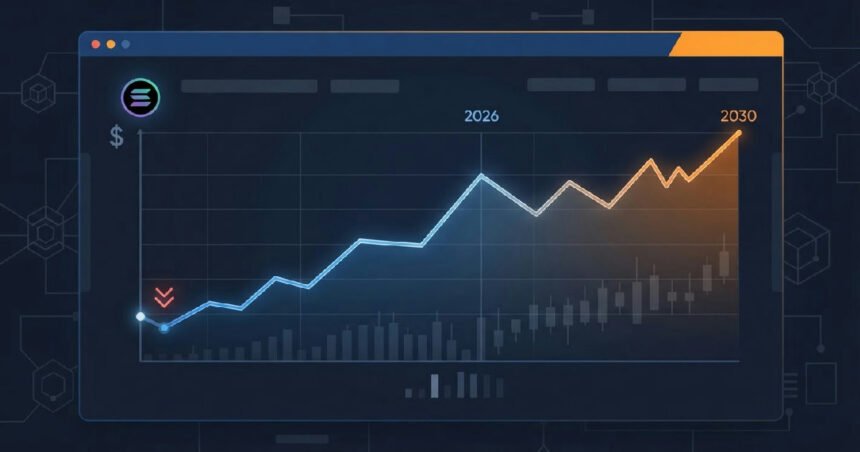
LiteFinance, a prominent financial broker, has published its latest Solana (SOLUSD) price forecast, outlining LiteFinance Solana projects and projections for the cryptocurrency through 2030 and extending to 2050.
The comprehensive analysis, released on September 28, 2026, leverages technical analysis and historical performance data to predict varied price trajectories, reflecting both the inherent volatility of digital assets and the platform’s evolving fundamentals.
LiteFinance Solana projects chart 2026-2030 price trajectory
At the time of the report’s publication, Solana’s price stood at $118.48, experiencing a 24-hour decline of 2.98%, with market sentiment leaning heavily towards a “Buy” position among 63.01% of traders.
These detailed forecasts offer a crucial perspective for investors navigating the often unpredictable cryptocurrency landscape. They suggest a near-term dip before a gradual recovery, highlighting the complex interplay of technical indicators, market sentiment, and the network’s operational strengths and weaknesses. The predictions also underscore the increasing maturity of the crypto market, where analytical tools are continuously refined to provide more nuanced long-term outlooks.
LiteFinance’s analysis provides specific annual price ranges for Solana, indicating a dynamic period for the asset. For 2026, the forecast projects a low of $84.32 and a high of $167.18, with an average price settling around $120.09. This represents a modest 1.36% change from the previous year’s closing price, suggesting a relatively stable, albeit volatile, year.
The projections for subsequent years show a downward trend in average prices, signaling potential consolidation or a bearish turn for Solana. In 2027, the average is expected to be $111.98, a 6.75% decrease from 2026. This continues into 2028, with an average of $103.39 (down 7.67%), and 2029, dropping to $98.04 (down 5.17%).
By 2030, the average Solana price forecast is anticipated to be $94.80, marking a 3.31% decline from 2029 levels, according to LiteFinance’s technical models.
Near-term signals point to lingering bearish sentiment
Earlier in 2026, specifically on March 11, LiteFinance provided another snapshot of Solana’s market condition, which painted a more cautious picture. That analysis indicated a persistent bearish trend, with the price stabilized within the $78–$88 range. Key resistance levels were identified around $89, $95, and $105, while support levels were seen near $86, $82, and $76.
A significant trend reversal at that time would have required Solana to break convincingly above the $95–$100 range. This earlier assessment underscores the fluctuating sentiment and the technical hurdles the asset faces, even as longer-term forecasts provide a broader perspective. The immediate future for Solana could still see it battling these established resistance points.
Long-term outlook presents a spectrum of possibilities for SOL
Beyond the immediate decade, LiteFinance ventures into more generalized long-term scenarios for Solana, recognizing the substantial uncertainty involved in such distant predictions. The firm anticipates Solana reaching $139.62 in approximately five years (around 2031) and maintaining that level for a decade, projecting the same price for 2036. This suggests a period of potential stability or capped growth after initial fluctuations.
Looking even further, LiteFinance suggests Solana could trade around $128.26 by 2050. This long-range projection utilizes a stochastic jump-diffusion model, which indicates a wide potential trading range between $75.76 and $128.26.
The lower end of this range factors in possibilities like market stagnation or increased regulatory pressure, while the higher end assumes widespread crypto adoption and continued advancements in blockchain technology. Solana crypto momentum will largely depend on these macroeconomic factors.
Solana’s architectural strengths and inherent challenges
Solana distinguishes itself with a high-performance blockchain platform, combining a Proof of History (PoH) mechanism for efficient transaction ordering with a Tower BFT consensus built on Proof of Stake (PoS). This innovative architecture is designed to achieve transaction throughput comparable to global payment processors like Visa, all while keeping transaction costs remarkably low.
However, Solana’s journey hasn’t been without significant hurdles. The network has famously experienced several major outages, raising persistent reliability concerns among users and developers. These incidents have fueled skepticism and highlight the delicate balance between speed, decentralization, and stability that all large-scale blockchains must manage.
The competitive landscape is also heating up, with formidable rivals such as Ethereum, Sui, and Aptos vying for market share and developer attention. Beyond direct competition, the platform also faces governance challenges, with efforts toward Solana fairer trades sometimes encountering setbacks.
Network utility and institutional embrace drive adoption
The long-term value and price outlook for SOL fundamentally hinge on the network’s ability to scale effectively without compromising security. Sustained growth, analysts suggest, will not come from speculative demand alone but from tangible, real-world adoption across various sectors.
The ecosystem already supports a robust array of decentralized applications and NFT marketplaces, showcasing its versatility. Critically, institutional interest in Solana has seen a notable uptick, particularly following the launch of exchange-traded funds (ETFs) by financial giants Bitwise and Grayscale. This institutional validation could pave the way for broader investment and mainstream acceptance.
For sustained growth, the network’s long-term price outlook hinges on its ability to scale without sacrificing security, fostering real adoption across decentralized finance, gaming, and payments. Network utility is considered more important than speculative demand in driving this growth.
Historic volatility shapes Solana’s market perception
Solana’s price history is a testament to the extreme volatility inherent in the cryptocurrency market. After its lowest price of $0.51 on May 11, 2020, SOL saw an explosive surge, peaking at an all-time high of $295.45 on January 19, 2025. This meteoric rise captured significant investor attention, establishing Solana as a major player in the blockchain space.
However, the journey was not linear. The collapse of FTX, a major cryptocurrency exchange, severely impacted Solana, causing its price to plummet to the $8–$10 range by the end of 2022. A gradual recovery commenced in 2023, and by 2024, the price demonstrated newfound resilience, never falling below $110.
This roller coaster ride underscores the importance of broader crypto market trends, as Solana’s price often mirrors movements in bellwether assets like Bitcoin.
Balancing innovation with enduring stability
LiteFinance’s forecasts, while extensive, come with an acknowledgment of their limitations; long-term crypto predictions involve substantial uncertainty. The methodology, rooted in technical analysis and historical data, provides a structured framework, but external market forces, regulatory shifts, and technological breakthroughs can significantly alter actual outcomes. This requires investors to approach such projections with a degree of caution and to conduct their own diligent research.
Ultimately, Solana’s ability to realize its ambitious price predictions hinges on its capacity to innovate while simultaneously addressing its Achilles’ heel: network stability. Should it successfully navigate these challenges, continuing to attract developers and users with its high throughput and low costs, it could solidify its position as a dominant force in the decentralized future.
Conversely, unresolved technical issues or intensified competition could cap its growth potential, keeping it within the lower bounds of LiteFinance’s wide long-term projections.
The evolving institutional adoption and the continued development within its ecosystem will be crucial barometers for Solana’s performance. Investors will keenly watch how the platform balances its pursuit of scalability with the imperative of maintaining an uninterrupted, secure network. The coming years will undoubtedly test Solana’s resilience and its promise as a high-performance blockchain solution.