

Manufacturing Expansion Signals Potential for 2017-Style Crypto Rally
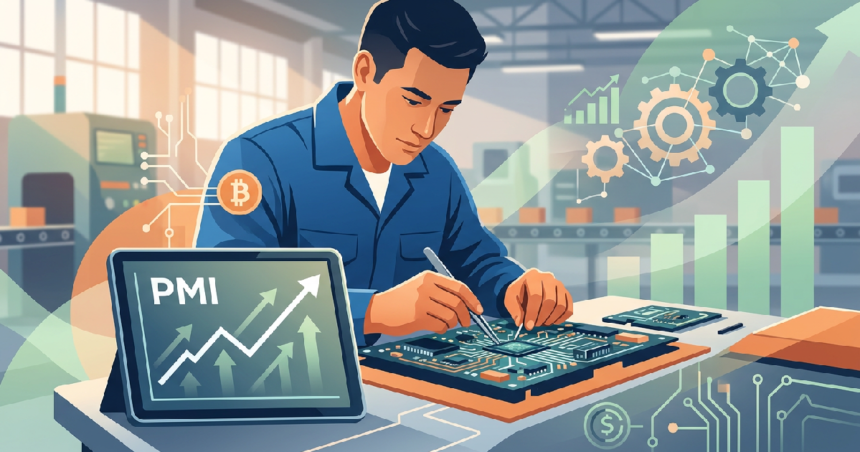
The U.S. manufacturing sector reported its fourth consecutive month of growth this week, with the latest Purchasing Managers’ Index (PMI) data showing a steady expansion that has prompted analysts to draw comparisons to previous historic bull markets. This sustained growth in the industrial backbone comes as a surprise to some, especially as sticky inflation data suggests the Federal Reserve will likely maintain higher interest rates for a longer period.
The latest manufacturing figures have held firmly above the threshold that separates economic contraction from expansion. This streak represents one of the most consistent periods of industrial growth in recent memory, providing a sense of macroeconomic stability that often encourages risk tolerance among both institutional and retail traders. While Bitcoin faces sharp correction risk when broader market sentiment turns cautious, a strengthening industrial base suggests a “soft landing” may be achievable.
And this shift is being felt across the digital asset space. Investors are moving away from a reliance on central bank liquidity and looking instead toward fundamental economic health as a driver for the next cycle.
H2: Industrial Expansion Mirrors Past Market Breakthroughs
Market observers are drawing parallels between the current economic climate and previous expansionary periods, such as those seen in early 2017. During that era, a multi-month climb in manufacturing activity served as a catalyst for a significant retail-driven surge in the cryptocurrency market. A similar pattern emerged in late 2020, just before the digital asset market climbed to new heights over the following year.
While the current expansion has not yet reached the aggressive growth levels typically associated with a full-blown mania, the consistency of the month-over-month gains suggests a transition out of a restrictive phase. This shift is particularly relevant for the altcoin market, where Ether enters rare accumulation phase patterns during intervals of sustained economic optimism.
If the industrial sector maintains this velocity, it could provide the foundational wealth effect needed to support a broader market recovery. The narrative is shifting from “when will rates drop” to “how resilient is the economy,” and so far, the answer appears to favor growth.
H2: Shifting Liquidity Channels and Indirect Growth
The primary engine for market momentum is changing. Earlier hopes for rapid interest rate cuts have largely vanished following recent inflation reports that indicated consumer prices remain stubbornly high. With the Federal Reserve expected to keep borrowing costs elevated to cool the economy, the traditional “cheap money” tailwind for crypto has been replaced by a focus on productivity.
This leaves the “indirect” channel of economic health as the main driver for risk assets. Strong manufacturing output implies that the economy is generating enough internal energy to support investment despite high interest rates. This environment is generally considered more sustainable than a market fueled solely by credit, as it reflects a genuine fundamental expansion rather than speculative fervor.
H2: Altcoin Rotation and the Search for Fundamental Value
As the broader economy stabilizes, capital often begins to rotate away from the largest, safest assets toward higher-beta opportunities within the altcoin sector. Historically, when manufacturing data remains in expansionary territory for more than a single quarter, investors start seeking out projects with specific technological or industrial utility.
So, we are beginning to see renewed interest in platforms that offer tangible settlement solutions or improve cross-border efficiency. For example, XRP momentum restarts have frequently coincided with periods where global liquidity conditions show signs of improvement. If industrial output continues to outpace expectations, the resulting spillover could benefit high-utility digital assets throughout the second half of the year.
The outlook now depends on whether this industrial expansion can accelerate. Should the manufacturing index move into higher growth territory, the comparisons to the historic 2017 rally may move from theory to reality. For now, the transition from a post-pandemic slowdown to a steady expansion phase provides a stable floor for the next stage of the market cycle.
Leave a comment
Leave a comment