

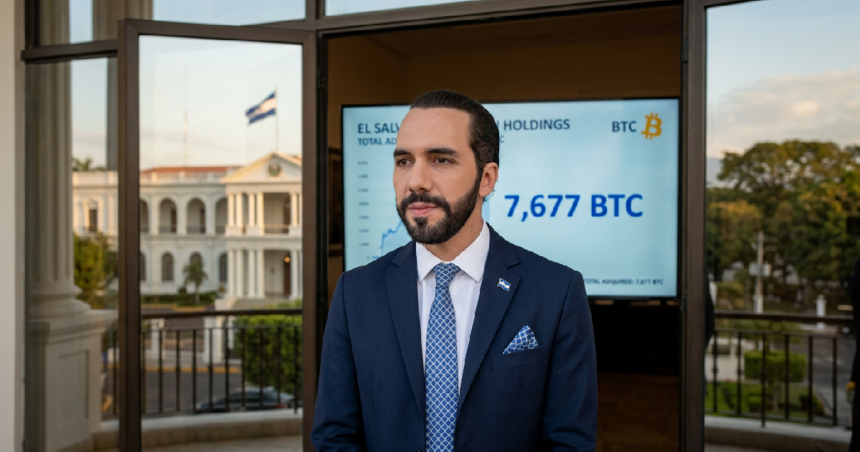
President Nayib Bukele has expanded El Salvador’s sovereign bitcoin holdings to 7,677 BTC, worth approximately $480 million, as the nation marks five years since the passage of its landmark Bitcoin Law. The legislation was originally approved by the country’s Congress on June 8, 2021, with a 62-to-22 vote.
This anniversary highlights a period of persistent accumulation despite significant shifts in the country’s regulatory framework and pressure from global financial institutions.
The government’s current treasury status follows a disciplined acquisition strategy that has accelerated over the last year. Between June 2025 and June 2026, the administration added more than 1,600 BTC to its reserves. These gains were driven by a policy established in November 2022 to purchase one bitcoin per day.
Beyond this daily dollar-cost averaging, the state has engaged in tactical buying during market volatility, such as a November dip where the government reportedly acquired over 1,000 BTC in a single seven-day window.
While the accumulation continues, the legal environment for the asset changed significantly in January 2025. President Nayib Bukele’s administration stripped bitcoin of its mandatory legal tender status, a move required as a condition for securing a $1.4 billion loan package from the International Monetary Fund (IMF).
Under these revised rules, businesses are no longer legally forced to accept the cryptocurrency, although it remains legal tender for voluntary use. The government is also phasing out the Chivo wallet, which served as the original centerpiece of the 2021 rollout.
The financial logic of the Salvadoran bitcoin treasury
Despite the policy pivot regarding mandatory acceptance, the state has not liquidated any of its treasury. The national reserves are currently in a state of substantial unrealized profit. Analysts estimate the average purchase price for the country’s holdings is approximately $45,000 per BTC.
With total investment outlay cited at roughly $300 million, the current valuation represents hundreds of millions in paper gains. This financial cushion allows the administration to maintain its course even when institutional pullback affects broader market sentiment.
The government has also doubled down on tax incentives to attract foreign crypto investors. El Salvador currently offers no capital gains tax on bitcoin or other digital asset transactions. This “all-in” conviction on digital innovation extends to infrastructure projects like the proposed Bitcoin City.
This urban development is designed to be powered by geothermal energy from the Conchagua volcano, which also provides electricity for the government’s sovereign mining operations. And while bitcoin technical pattern volatility remains a constant feature of the market, the state appears committed to long-term ownership.
Assessing the impact on remittances and tourism
A primary goal of the 2021 Bitcoin Law was to transform the country’s remittance industry. El Salvador is heavily dependent on these transfers, which account for nearly 24 percent of its GDP. In the first quarter of 2026, total personal transfers reached $2.43 billion. However, crypto-linked remittances only accounted for $17.
38 million of that total, representing just 0.71 percent of the flow. While this is a nearly 50 percent increase compared to the same period in 2025, it suggests that crypto utility for daily cross-border transfers has not yet reached the scale initially envisioned.
Tourism has proven to be a more immediate beneficiary of the Bitcoin Law. Official reports indicate a 30 percent increase in tourism following the 2021 legislation. Specific sectors, particularly those branded as “Bitcoin Beach,” have seen visitor numbers jump by 300 percent.
This influx of tech tourists and digital nomads has contributed to a real GDP growth rate that has averaged between 2.5 and 3.5 percent over recent years. The increase in international visitors has helped offset the slow adoption of the asset for local retail payments.
Infrastructure and the future of the volcano bonds
The next phase of the strategy involves the long-anticipated issuance of “Volcano Bonds.” These are designated to be backed by bitcoin and are intended to fund the expansion of both the proposed Bitcoin City and the nation’s geothermal mining capabilities.
By using volcanic energy, El Salvador aims to position itself as a hub for sustainable digital asset production. Currently, some portion of the nation’s 7,677 BTC stack is already attributed to these geothermal-powered mining efforts.
The administration’s refusal to sell any coins, even during the negotiation of the $1.4 billion IMF loan, signals a high-conviction approach to state finances. As the government continues toward its goal of acquiring one bitcoin every day, the experiment has moved from a legislative mandate to a permanent fixture of the national reserve policy.
Whether the nation can successfully market its bitcoin-backed bonds will likely be the next test of its unconventional financial trajectory.