

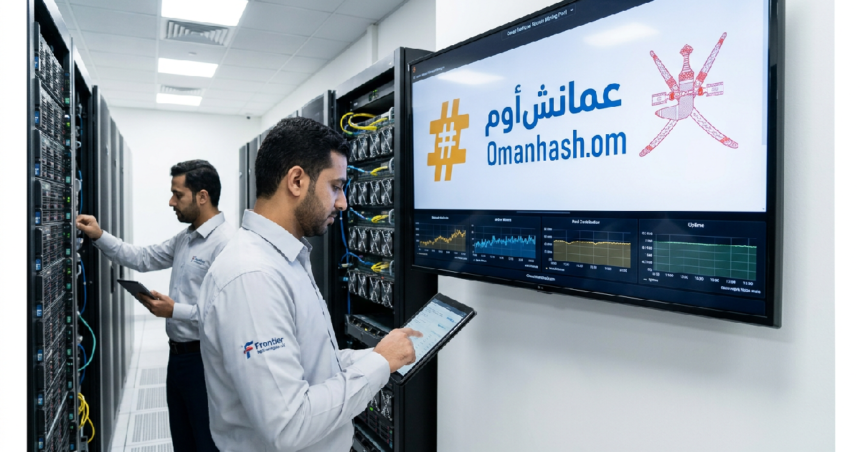
The Ministry of Transport, Communications and Information Technology (MTCIT) of Oman officially launched Omanhash.om on June 17, 2026, establishing a mandatory national Bitcoin mining pool for all licensed operators within the Sultanate.
The state-driven initiative, which went live at 11:17 AM local time, aims to consolidate the nation’s computing power into a single, transparent architecture to enhance government oversight of energy consumption and revenue flows. Muscat-based Frontier Technologies LLC will manage local operations, while Enegix Global provided the underlying technology and liquidity infrastructure for the platform.
This move marks a shift from a fragmented mining environment to a centralized, state-monitored system. By requiring licensed firms to migrate to Omanhash.om, the Sultanate is positioning itself to better track the flow of newly minted digital assets and ensure compliance with national economic goals.
Oman establishes Omanhash.om as mandatory mining pool
The transition is a core component of the Oman Vision 2040 strategy, which seeks to diversify the economy away from a heavy reliance on oil and gas exports by fostering a high-tech industrial sector.
Government officials expect the new pool to manage approximately 10 exahashes per second (EH/s) during its initial phase of operation. This figure represents nearly one-third of the country’s total mining capacity, as Oman currently controls about 3% of the global network hashrate, or roughly 30 EH/s.
By bringing this significant volume of hardware under a single “sovereign” pool, the Ministry can more effectively manage the load on the national power grid.
The MTCIT has designed Omanhash.om to serve as the exclusive hub for industrial-scale miners, utilizing a Full Pay-Per-Share (FPPS) payout model. This structure ensures that participating miners receive predictable daily revenues based on their contributed hashrate, regardless of when the pool successfully solves a block on the Bitcoin network.
Such stability is crucial for firms operating in the Salalah Free Zone, where infrastructure investments have already surpassed $700 million.
Enegix Global, the partner responsible for the pool’s technical backbone, is no stranger to state-backed digital infrastructure. The company previously developed btcpool.kz for Kazakhstan, which served as a prototype for government-accredited mining pools integrated with national tax reporting.
Olzhas Amirov, CBDO of Enegix Global, stated that this second sovereign mandate validates a model where clear licensing frameworks help miners avoid excessive taxation and maintain transparent communication with authorities.
This institutional approach is becoming increasingly common as states seek to balance the lucrative potential of digital assets with grid stability. Even as Bitcoin faces sharp correction risk in broader markets, the Omani government appears focused on the long-term industrial utility of the technology rather than short-term price fluctuations. The pool acts as a bridge between private enterprise and state regulators.
Consolidating the Salalah Free Zone infrastructure
Oman’s mining sector has grown rapidly since 2022, primarily centered around the Salalah Free Zone. Major facilities in this region include a $370 million hydro-cooled site launched four years ago and a 150 MW facility operated by the Italian firm Alps Blockchain, which reached full capacity in mid-2025.
These projects were initially led by operators like Exahertz and Green Data City, who will now transition their output to the national pool.
The centralization of these resources allows the government to execute pilot programs more effectively, particularly those aimed at environmental sustainability. Oman has expressed interest in using flared natural gas—a byproduct of oil extraction—and surplus solar energy to power these energy-intensive data centers. By routing all activity through Omanhash.om, the MTCIT can verify exactly which energy sources are being utilized by specific operators.
Strategic goals for the Oman Vision 2040 initiative
The launch of a national pool is not merely a regulatory hurdle; it is a calculated economic play. Oman is competing with regional neighbors like the United Arab Emirates to become the Middle East’s primary hub for blockchain technology.
By establishing a “sovereign” pool, the Sultanate provides a level of legal certainty that is often missing in other jurisdictions, potentially attracting further foreign direct investment into its free zones.
The project also serves as a mechanism for national revenue security. Managed hashrate provides the state with direct visibility into the “coinbase” rewards—the new Bitcoin generated by the network. While the CFTC is ready to oversee crypto market activity in the United States, Oman is opting for a more direct, participative form of oversight by owning the very infrastructure where the mining occurs.
Yersaiyn Nurtoleuov, CPO of Enegix Global, noted that the company’s broader target is to operate 30 EH/s across its various sovereign and international partnerships. Currently, Enegix manages about 25 EH/s globally. The Omani partnership is expected to be a major tailwind in reaching that goal as more hardware comes online in the Salalah region throughout 2026.
Regulatory clarity versus decentralized ideals
The mandatory nature of the pool has raised questions among proponents of decentralization, as it gives the Omani state significant influence over the block production of miners within its borders. However, for industrial operators, the trade-off is often worth the cost.
Access to subsidized or surplus energy and the protection of a formal licensing regime provide a “moat” that is hard to find in less regulated environments.
Under current Central Bank guidance, Bitcoin is not recognized as legal tender for retail transactions in Oman. However, the government clearly distinguishes between the use of cryptocurrency as a medium of exchange and the industrial production of digital assets. This distinction allows the Sultanate to participate in the global network’s security without upending its traditional financial systems.
Future outlook for Middle Eastern mining
As the initial phase of Omanhash.om settles, the focus will likely shift to further infrastructure expansion. With $700 million already committed to the Salalah Free Zone, the Sultanate has shown it is willing to put significant capital behind its digital ambitions. The success of this mandatory pool could serve as a blueprint for other Gulf Cooperation Council (GCC) nations looking to monetize their energy surpluses.
Miners will continue to monitor the Bitcoin chart signals for profitability, but the Omani model prioritizes steady, industrial growth over speculative trading. By the end of 2026, if the 10 EH/s target is met, Omanhash.om will likely rank among the top ten largest mining pools globally, cementing the Sultanate’s role as a major player in the global Bitcoin network.