

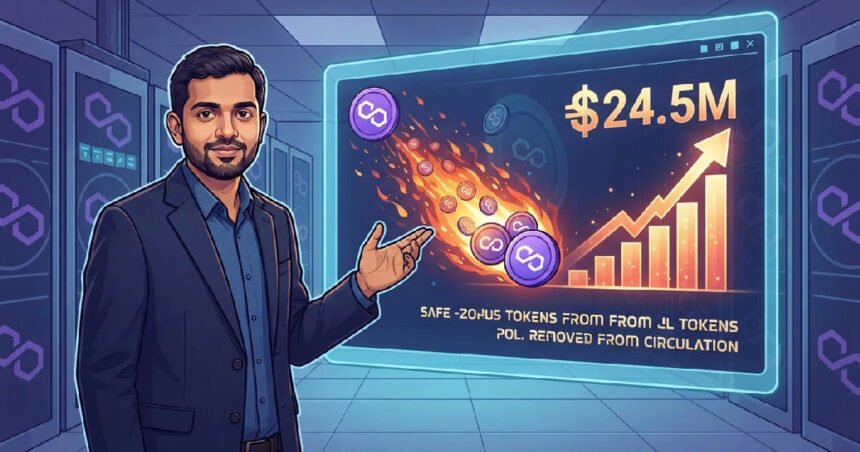
Polygon Foundation CEO Sandeep Nailwal confirmed on X (formerly Twitter) on 2026-09-18 that Polygon intends to permanently burn 100 million POL tokens. This significant deflationary measure comes as the protocol announces impressive year-to-date revenues of $24.5 million, marking a substantial financial milestone.
The proposed burn aims to bolster the POL token’s value, strategically positioning Polygon for the anticipated next crypto market bull cycle. This initiative reflects a broader trend among altcoins to manage token supply actively.
Understanding the POL token burn strategy
The planned 100 million POL token burn represents a bold move to reduce the asset’s circulating supply. According to Mr. Nailwal, the project will deploy a change allowing anyone in the community to trigger this burn, executed via a permissionless smart contract.
This initial event will be followed by manual quarterly burns, reinforcing a long-term deflationary outlook for POL. This substantial token destruction will remove approximately 1% of the total POL circulating supply from the market.
Polygon’s base fees currently accumulate POL in a designated collector wallet, which reportedly holds 121 million POL, valued around $1.2 million. The ability for the community to initiate burns underscores a commitment to decentralized governance, although final Security Council sign-off is still pending.
Revenue Growth Fuels Burn Initiative
The decision to burn tokens is directly tied to Polygon’s robust financial performance. The protocol has recorded $24.5 million in year-to-date revenue, a figure that recently surpassed $25 million in collected annual revenue, reaching a two-year high according to data from DeFiLlama.
This strong revenue generation provides the financial backing and justification for the aggressive deflationary strategy. Polygon has deliberately repositioned its ecosystem, particularly focusing on payments and stablecoin-based transfers.
Mr. Nailwal highlighted the success of this shift, noting that Polygon’s current traction and generated fees are three times higher than Arbitrum’s and five times greater than Near Protocol’s. This operational efficiency and market penetration are critical drivers behind its impressive revenue figures.
POL Token Reacts Amid Market Volatility
News of the 100 million token burn immediately impacted POL’s market performance, driving a 10% price surge. This recent pump was part of a broader 20% weekly recovery for the token, aligning with Bitcoin’s rally above $80,000.
However, the path to sustained growth has been complex for POL. In Q3, the altcoin had seen an impressive 80% rally, climbing from $0.07 to $0.11, before experiencing a sharp pullback in late August. Throughout September, POL largely consolidated above the $0.09 support level, which also serves as its 200-day Moving Average.
Technical Indicators Signal Caution
While the recent recovery is positive, technical indicators suggest a degree of caution for short-term investors. The daily Relative Strength Index (RSI) has not yet entered overbought territory, implying that there might be some room for further upward movement.
However, the Average True Range (ATR) remains flat, indicating low volatility and suggesting that a decisive breakout above the $0.11 resistance level might be difficult to achieve in the immediate future. It’s important to remember that the $0.11 mark previously acted as a significant barrier, stalling an explosive rally in August.
Overcoming this level will be crucial for POL to establish a new upward trend. This interplay of fundamental news and technical resistance highlights the dynamic nature of altcoin trading.
Whale Activity and Future Price Outlook
Compounding the technical resistance, market analytics firm Santiment reported that major whale wallets offloaded over 30 million POL tokens in the last three days. Such significant sell-offs by large holders could exert downward pressure, potentially stalling the recent rally and making it harder for POL to break through the $0.11 resistance.
If POL fails to clear the dynamic resistance near $0.11, a retest of the $0.09 support level cannot be ruled out. Conversely, a successful breach of the $0.11 hurdle could signal the beginning of the next recovery leg.
The token burn is expected to create a supply shock, but its long-term impact will depend on sustained demand and the broader market sentiment, particularly as the crypto ecosystem gears up for the next bull cycle.
Strategic Repositioning and Broader Market Impact
Polygon’s focus on payments and stablecoin transfers is a strategic repositioning that addresses a critical need for efficient, low-cost transactions within the blockchain space. This specialization could attract more institutional adoption and real-world usage, increasing demand for POL. Such moves align with broader industry trends towards institutional engagement, including how the NYSE explored tokenization with Avalanche.
The ongoing efforts by various blockchain projects to improve scalability and transaction throughput are becoming increasingly vital. Robust Layer 2 solutions like Polygon are seen as pivotal for the industry’s future, as their continued development and strategic tokenomics address growing demands for efficient blockchain operations.
Broader Implications for the Altcoin Ecosystem
Polygon’s aggressive token burn strategy, coupled with its strong revenue performance, highlights a maturing trend within the altcoin market. Projects are increasingly moving beyond speculative growth, focusing instead on sustainable economic models and tangible utility. This approach contrasts sharply with earlier phases of crypto development that often prioritized hype over fundamentals.
Understanding tokenomics for sustainable altcoin growth is crucial for investors monitoring such developments. The reduction in supply, when combined with growing demand from real-world applications, could create a powerful upward price pressure for POL. This deliberate market intervention aims to enhance scarcity, a fundamental principle in value creation.
The Security Council’s approval for the burn mechanism will be a critical step. Once implemented, Polygon’s ability to execute manual quarterly burns and allow community-triggered events will set a precedent for other projects contemplating similar deflationary tactics. This blend of centralized oversight and decentralized execution could offer a robust model for managing token economies moving forward.
Furthermore, as regulatory frameworks evolve, particularly concerning tokenized assets, projects like Polygon that demonstrate clear utility and a commitment to sound economic principles may find themselves in a stronger position. Ongoing discussions around regulatory clarity suggest a future where transparency and demonstrable value will be paramount for altcoins seeking mainstream adoption.
What Lies Ahead for Polygon (POL)
The immediate outlook for POL will largely hinge on its ability to overcome the $0.11 resistance and absorb potential selling pressure from whales. Beyond short-term price movements, the success of Polygon’s repositioning as a payments-focused network and its ability to maintain high revenue growth will be crucial.
The long-term impact of the token burn will depend on consistent execution and the continued expansion of Polygon’s ecosystem. If the protocol can sustain its 3x and 5x performance lead over competitors like Arbitrum and Near, respectively, the fundamental case for POL strengthening appears robust.
Investors will be keenly watching the quarterly burn reports and the broader adoption of Polygon’s scaling solutions in the months to come.