

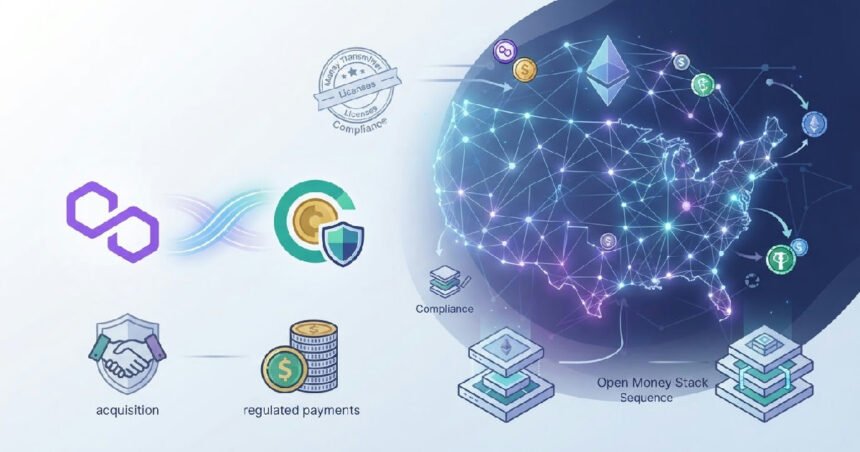
Polygon Labs finalizes its acquisition of crypto payments platform Coinme, a landmark move that equips the blockchain firm with regulatory coverage across 48 U.S. states. The deal, finalized on October 14, 2026, integrates Coinme’s extensive licensing into Polygon’s new Open Money Stack, aiming to create a unified platform for fiat and stablecoin transactions.
The acquisition is a key part of a larger strategic push by Polygon Labs, first announced in January 2026. The combined deal, valued at over $250 million, also included the purchase of Web3 infrastructure company Sequence to build a comprehensive, regulated payments solution for enterprises and financial institutions.
Why Polygon Labs finalizes this acquisition
The core value of the Coinme acquisition lies in its regulatory infrastructure. Polygon Labs now controls 37 state money transmitter licenses and 11 applicable exemptions. This, combined with Coinme’s registration as a money services business with the Financial Crimes Enforcement Network (FinCEN), provides a crucial and hard-to-obtain compliant foundation for its payment ambitions.
This move allows Polygon to sidestep the complex, state-by-state process of securing licenses independently. Such regulatory hurdles have often slowed the expansion of crypto firms in the United States. This strategic purchase instantly positions Polygon as a U.S.-regulated payments business. Across the crypto landscape, firms continually pursue acquisition for expansion to navigate complex regulatory environments and broaden their market reach.
Polygon Labs CEO Marc Boiron emphasized the deal’s importance. “Completing the Coinme acquisition brings regulated U.S. money movement into Open Money Stack, giving us more of the infrastructure to support a payment from the moment funds come in to the moment the recipient gets paid,” he stated. This end-to-end capability is critical for enterprise adoption.
Furthermore, the deal brings Coinme’s established user base and network into the Polygon ecosystem. With over one million existing users and access to approximately 50,000 retail locations through partnerships with MoneyGram and Coinstar, Polygon gains an immediate distribution channel and a proven pathway for users to move between cash and digital assets.
Unpacking the Open Money Stack and its early adopters
The newly acquired licenses are foundational to Polygon’s flagship payments product, the Open Money Stack (OMS). This platform is designed to offer a single, unified integration for businesses to manage both traditional fiat and on-chain digital currency payments. It combines fiat on- and off-ramps, wallets, cross-chain routing, and settlement services into one package.
For businesses, this promises to simplify a fragmented process. Instead of stitching together multiple services for compliance, fund transfers, and settlement, the OMS aims to provide a one-stop solution. This allows enterprises to accept funds, settle transactions in stablecoins, and pay recipients in their local currency with greater efficiency.
Several companies are already building on the platform, showcasing its diverse applications. Cross-border payments firm Tazapay is using the infrastructure for business-to-business transactions. Meanwhile, the fintech platform Mesh is using OMS to add an on-ramp to its extensive network of over 300 wallets, exchanges, and financial services.
Other early customers highlight the global scope of the platform. Toku, a payroll and compensation solutions provider, plans to use OMS to connect stablecoins with compliant payroll and local-currency payouts in more than 100 countries. Similarly, Kira is leveraging the stack to give its clients expanded stablecoin options for accessing U.S. bank accounts and payment channels.
The significance of stablecoin settlement
At the heart of the Open Money Stack is the use of stablecoins for settlement. Polygon is betting that institutional and enterprise clients will increasingly favor stablecoins for their speed, predictable pricing, and reduced reliance on correspondent banks, which often add delays and fees to international transfers.
Polygon Chain has already processed over $3 trillion in cumulative stablecoin transfer volume, demonstrating the network’s capacity to handle large-scale value transfer. By providing a regulated and integrated stack, Polygon Labs hopes to capture a significant share of the growing market for on-chain enterprise payments.
A two-part deal to build a payments powerhouse
The Coinme transaction was the second part of a dual-acquisition strategy announced in January. The first part, the purchase of wallet infrastructure company Sequence, closed earlier in the year. Together, these two acquisitions provide the pillars for Polygon’s ambitious payments platform, with a combined value exceeding $250 million.
Sequence provides critical Web3 technology, including advanced wallet infrastructure and capabilities for 1-click cross-chain transactions. This technology handles the on-chain complexity, allowing for smoother user experiences. The broader ecosystem also sees advancements in simplifying user interactions, including the development of XRP Ledger embedded wallets.
Neil Bergquist, CEO and co-founder of Coinme, explained the synergy. “By combining Coinme’s regulated payment access with Polygon’s settlement layer, we’re building the vertically integrated stack the market needs; turning stablecoin infrastructure from fragmented services into a unified enterprise platform,” he said. Following the deal, Coinme will operate as a wholly-owned subsidiary of Polygon Labs.
The initial plan outlined in January saw the Sequence transaction closing quickly, while the more complex, regulation-dependent Coinme deal was slated for the second quarter of 2026. The final closing in October marks the culmination of nearly a year of strategic planning and regulatory navigation.
Navigating restructuring and the road ahead
The finalization of the Coinme acquisition follows a period of internal adjustment at Polygon Labs. In July 2026, the company reduced its workforce as part of a strategic restructuring. At the time, CEO Marc Boiron stated the changes were intended to help the company achieve profitability by 2027 while preparing for the integration of its new acquisitions.
Despite the job cuts, Boiron noted that the integration of Coinme’s team was expected to raise the company’s overall headcount. This suggests the restructuring was less about simple downsizing and more about realigning resources toward the high-priority goal of building its regulated payments business.
The Open Money Stack continues to evolve, with its unified integration currently in a technical preview for select customers. Polygon has been actively expanding its stablecoin support, making PayPal USD (PYUSD) natively available through OMS in July and adding TRON support on October 8. These moves broaden the platform’s appeal and interoperability.
A persistent industry theme remains the provision of secure and regulated digital asset custody.
Looking forward, the key challenge for Polygon Labs will be to transition the Open Money Stack from a technical preview to a widely adopted enterprise solution. The company must now leverage its powerful combination of regulatory licenses, on-chain settlement capabilities, and wallet infrastructure to attract major clients from the fintech and corporate worlds, positioning itself as a leader in the next generation of global payments.