

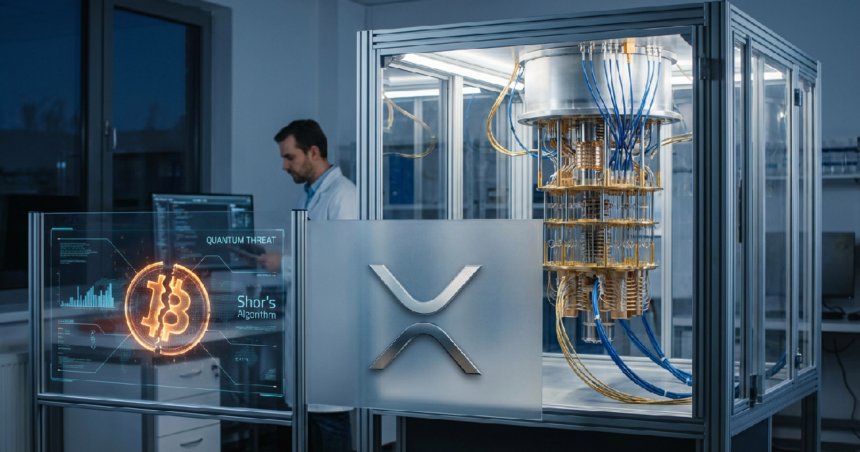
For as long as Bitcoin has existed, the strength of its encryption has been treated as an objective truth. The cryptographic walls protecting billions of dollars in digital wealth are built on mathematical problems that would take today’s most powerful supercomputers trillions of years to solve. But a new kind of machine, operating on the strange laws of subatomic physics, is moving from theoretical research into reality, and it threatens to tear those walls down.
Quantum computing isn’t just a faster version of your laptop. While a traditional computer uses bits—ones and zeros—to process information, a quantum computer uses qubits. Thanks to a phenomenon called superposition, these qubits can exist in multiple states simultaneously. This allow them to perform specific types of mass calculations at speeds that make current silicon chips look like an abacus. For the world of cryptography, and specifically for Bitcoin, this speed is a direct threat to the Elliptic Curve Digital Signature Algorithm (ECDSA) that secures every transaction.
The math that keeps Bitcoin safe is under fire
To understand the danger, you have to look at how a Bitcoin wallet actually works. Your “address” is derived from a public key, which in turn is generated from a private key. In current computing, it is easy to go from a private key to a public key, but mathematically impossible to go the other way. It is a one-way street.
Shor’s Algorithm, a famous mathematical proof, changed that equation. It demonstrates that a sufficiently powerful quantum computer could reverse-engineer a private key from a public key. If an attacker has your private key, they own your Bitcoin. They can sign a transaction and move your funds to their own wallet, and the network—seeing a valid signature—would have no way to stop it.
This isn’t an immediate “press a button and steal everything” scenario. Most modern Bitcoin addresses use a double-hash mechanism that keeps the public key hidden until the moment you decide to spend your coins. However, the second you broadcast a transaction to the mempool, your public key is revealed. A quantum attacker could theoretically intercept that broadcast, calculate your private key in seconds, and “front-run” you by sending a different transaction with a higher fee to the miners.
Beyond the wallet: The threat to the blockchain
The danger extends beyond individual theft. Bitcoin relies on SHA-256 hashing to secure the entire history of the ledger. While hashing is generally considered more “quantum-resistant” than the signatures used for wallets, it isn’t immune. A quantum machine could technically solve the mining puzzles far faster than any ASIC rig currently in a warehouse in Texas or Iceland.
If a single entity gained access to quantum hardware before the rest of the network, they could achieve a 51% attack with ease. They could rewrite history, double-spend coins, and effectively destroy the trust that the entire ecosystem is built upon. While the utility of digital assets is being tested in other ways this year, the quantum threat represents an existential risk to the underlying technology itself.
Is there a path to safety?
The Bitcoin developer community is well aware of the “Quantum Apocalypse” narrative. The solution lies in “Post-Quantum Cryptography” (PQC). Just as Bitcoin has undergone upgrades like SegWit and Taproot, it could theoretically undergo a soft fork to implement new, quantum-resistant signature schemes.
But the transition would be messy. It would require every single Bitcoin holder to move their funds from their old “vulnerable” addresses to new, quantum-secure ones. Any “lost” coins—including the million or so Bitcoin attributed to Satoshi Nakamoto—would likely be stuck in vulnerable addresses forever, eventually becoming a massive honeypot for whichever government or corporation cracks the quantum code first.
We aren’t there yet. Current quantum computers still struggle with “noise” and error correction. They don’t have enough stable qubits to crack ECDSA today. But as labs from Google to IBM continue to hit new milestones, the window for Bitcoin to prepare is getting narrower. As we’ve seen with other long-term projections for assets like XRP, the timeline for technological shifts often moves faster than the market expects.
Frequently Asked Questions
Can a quantum computer mine all remaining Bitcoin instantly?
Not exactly. While quantum computers could solve hashes faster, Bitcoin’s difficulty adjustment would likely kick in to compensate. The real danger in mining is a “quantum-advantaged” miner gaining 51% control before the rest of the network can upgrade their hardware.
When will quantum computers be strong enough to crack Bitcoin?
Estimates vary wildly among physicists. Some say we are decades away; others believe specialized “cryptographically relevant” quantum computers could appear in the early 2030s. It depends on how quickly researchers can solve the problem of qubit stability.
If I use a hardware wallet, am I safe from quantum attacks?
Not necessarily. A hardware wallet stores your keys offline, which protects you from internet hackers. However, if the underlying math of the Bitcoin network (ECDSA) is broken, the device holding your keys won’t matter—the math itself would be the point of failure once you attempt to move your funds.