

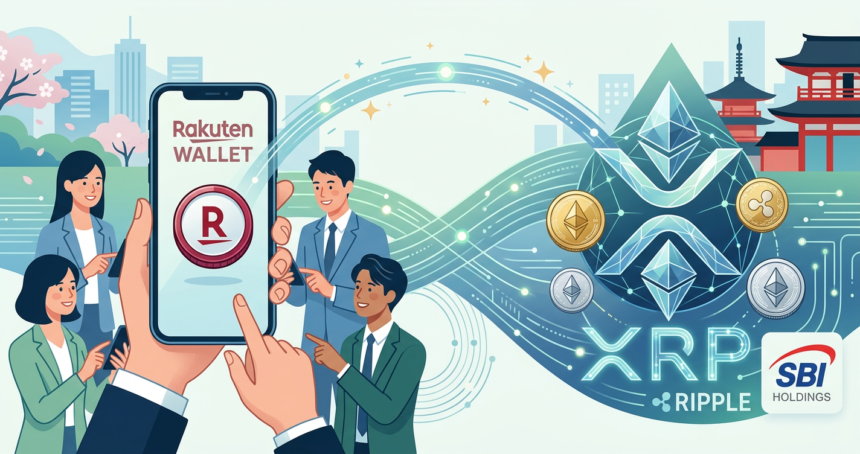
The Japanese crypto market just received a fresh injection of liquidity and accessibility as Rakuten Wallet officially integrated XRP into its trading ecosystem. By bringing one of the industry’s most prominent digital assets to its platform, the exchange isn’t just adding another ticker; it is exposing XRP to a significant user base within the Rakuten ecosystem, which reportedly includes a large portion of the Japanese population.
This move highlights a growing trend where traditional e-commerce and retail giants in Asia are no longer viewing digital assets as a fringe experiment. Instead, they are being treated as a core component of digital finance strategy. For XRP, a token long associated with institutional cross-border settlements, this retail-focused expansion provides a different kind of validation. It suggests that while the Ripple nexus is often discussed in terms of banks and payment corridors, its appeal to the average consumer remains a potent force in Asia’s second-largest economy.
Building a Bridge to Millions of Rakuten Users
Rakuten, often dubbed the “Amazon of Japan,” occupies a unique position in the lives of Japanese consumers. Its ecosystem spans everything from online shopping and banking to mobile networks and travel services. When Rakuten Wallet decides to list a specific asset, it isn’t just about providing a chart for speculators. It’s about integrating that asset into a loyalty and payment structure that Japanese shoppers already trust. And this integration occurs as the digital asset industry faces a final test for global utility, where assets must prove they serve a purpose beyond simple trading.
The integration means that users of the Rakuten system can now interact with XRP with ease, reportedly using their accumulated “Rakuten Points” to acquire the digital asset. This lowered barrier to entry is critical. Most people don’t want to navigate complex overseas exchanges or deal with the technical hurdles of hardware wallets. They want to buy, hold, and trade within the apps they already use to buy their groceries and pay their phone bills. In Japan, XRP’s utility has often been viewed through a lens of efficiency, particularly in a culture that still uses high levels of bank-to-bank transfers for daily business.
Japan’s Enduring Relationship with XRP
It is no secret that Japan is one of the more active regions for XRP engagement. Much of this stems from the long-standing partnership between Ripple and SBI Holdings, the Japanese financial services giant. The local market understands the value proposition of fast, low-cost transfers in a way that some other western markets have been slower to adopt. For Rakuten to follow suit and prioritize XRP integration is a logical progression of this regional sentiment. Indeed, XRP price gains often follow regulatory hope, and Japan’s Financial Services Agency (FSA) has provided a relatively clear framework for how exchanges must operate.
This regulatory clarity allows companies like Rakuten to move forward with confidence, knowing they are unlikely to face sudden enforcement actions for listing a mainstream asset. But it’s not all about the technology. Sentiment in the Japanese market often moves in tandem with the availability of localized support. Rakuten Wallet provides a level of customer service and domestic security that international platforms cannot match. For a massive domestic user base, that peace of mind is often the deciding factor in whether they choose to enter the crypto market or stay on the sidelines.
The Path Forward for Retail Adoption
How this affects the global price of XRP remains a topic of intense discussion. While local Japanese demand is a significant factor, it is only one piece of a much larger puzzle involving global liquidity and institutional sentiment. Some market participants look at these developments and see the groundwork for future growth, while others take a more measured approach based on mathematical constraints. For instance, there is a constant debate regarding the logic behind a high-value XRP valuation, which depends heavily on the volume of transactions moving through the ledger.
If Rakuten eventually allows XRP to be used for actual purchases across its e-commerce site, that volume could shift from speculative to functional. This is the “holy grail” of crypto adoption: moving from an asset people buy to an asset people spend. Looking ahead, the success of this integration will likely be measured by how many of Rakuten’s customers actually bother to open a wallet. If even a small percentage of the customer base adopts XRP for daily use or long-term holding, it could solidify Japan’s status as a global epicenter for XRP activity. In a world where many digital assets are still searching for a reason to exist, XRP’s deep roots in the Japanese financial system give it a level of permanence that is hard to ignore.


