

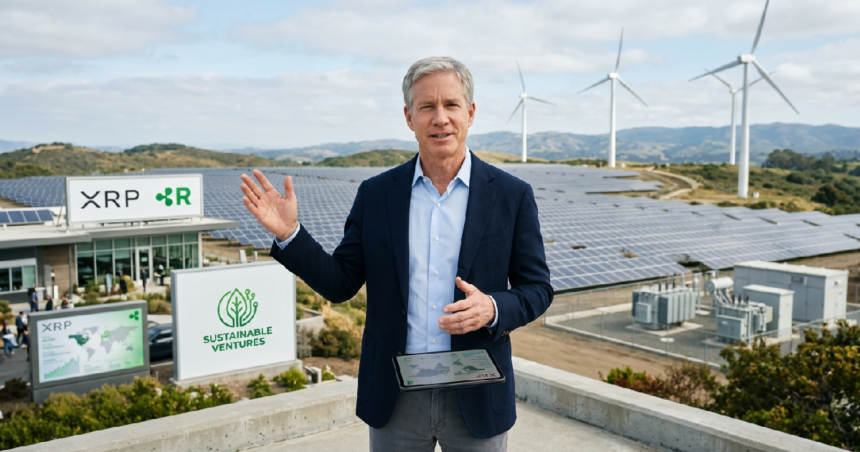
The landscape of crypto wealth is shifting as Chris Larsen, the co-founder and former CEO of Ripple, reportedly begins a massive reallocation of his personal holdings. Industry sources indicate that Larsen is moving to pivot a significant portion of his XRP fortune—estimated to be worth roughly $1 billion—into a new venture focused on the intersection of blockchain and sustainable energy infrastructure.
This isn’t just another tech investment. For years, Larsen has been one of the most vocal advocates for cleaning up the digital asset industry’s carbon footprint. He notoriously funded a campaign to change Bitcoin’s code from Proof of Work to a more energy-efficient model, a move that met stiff resistance from the mining community. Now, he appears to be putting his capital where his mouth is, moving beyond advocacy and into direct development.
Beyond the Ripple SEC Saga
The timing of this pivot is particularly revealing. While Ripple continues to navigate the final stages of its long-running legal battle with the SEC, the company’s founders are clearly looking at the “next act” for the XRP Ledger. The move suggests a decoupling of personal ambition from the day-to-day regulatory grind that has defined Ripple’s existence since 2020.
Larsen’s new initiative, though still in its early stages of public disclosure, reportedly aims to leverage the XRP Ledger’s inherent efficiency to track and trade carbon credits and renewable energy certificates. It’s a move that aligns with the broader industry shift where utility or obsolescence is becoming the definitive test for digital assets. For Larsen, the goal is to prove that the ledger can do more than settle cross-border payments; it can serve as the backbone for a green global economy.
Capital Flight or Ecosystem Expansion?
Whenever a high-profile founder moves a ten-figure sum, the market notices. Some skeptics view the move as a diversification play—a way to hedge against the volatility that has personal wealth tied up in a single asset. XRP has faced a unique set of challenges, and while some analysts project diverging paths for its future value, Larsen’s move suggests he believes the underlying technology is ready for a second massive use case.
But the logistics of moving $1 billion in XRP are not simple. The market is sensitive to large sell-offs, and such a pivot is likely being handled through over-the-counter (OTC) desks or structured over a multi-year period to avoid crashing the price. This isn’t a “dump”; it’s a strategic redeployment of capital into a sector that Larsen believes will dominate the next decade of institutional finance.
The Climate Challenge in Crypto
The new venture is expected to focus on high-fidelity carbon tracking. Current carbon credit markets are often criticized for being opaque, double-counted, or outright fraudulent. By putting these credits on a transparent ledger like XRP, the hope is to create a “source of truth” that major corporations can use to meet their ESG (Environmental, Social, and Governance) requirements.
And it’s not just about tracking. The integration of AI into these networks—similar to how decentralized GPU networks are pivoting to AI compute—could allow for real-time optimization of power grids. Larsen’s venture is rumored to be exploring how blockchain can incentivize the building of massive “green” data centers that the AI revolution desperately requires.
What Lies Ahead for XRP and Larsen
As we head into the middle of 2026, the era of “speculative-only” crypto is ending. Larsen’s pivot reflects a growing consensus among the industry’s “old guard” that long-term survival depends on solving real-world problems. Whether the market reacts positively to this shift in focus remains to be seen, but the sheer scale of the investment makes it impossible to ignore.
The success of this venture will likely depend on whether Larsen can convince traditional energy companies to adopt a technology that is still, in many circles, synonymous with the wild west of finance. But with $1 billion in the war chest, he has more than enough firepower to make a serious run at it.
Frequently Asked Questions
Is Chris Larsen leaving Ripple?
No, there is no indication that Larsen is severing his ties with Ripple. He remains a major stakeholder and a central figure in the company’s history. This new venture is a personal project funded by his private holdings, intended to expand the utility of the XRP Ledger in a new industry sector.
Will $1 billion in XRP being sold crash the market?
It’s unlikely that such an amount would be sold all at once on public exchanges. Historically, founders and large institutional holders use OTC trades or long-term “drip” schedules to liquidate positions. This minimizes price impact while allowing the capital to be moved into new investments over time.
Why is he focusing on green energy?
Chris Larsen has been a vocal environmentalist for years. He believes that for blockchain technology to be globally adopted by governments and major corporations, it must be demonstrably carbon-neutral or carbon-negative. This venture is an attempt to turn the XRP Ledger into the primary tool for the emerging green finance market.