

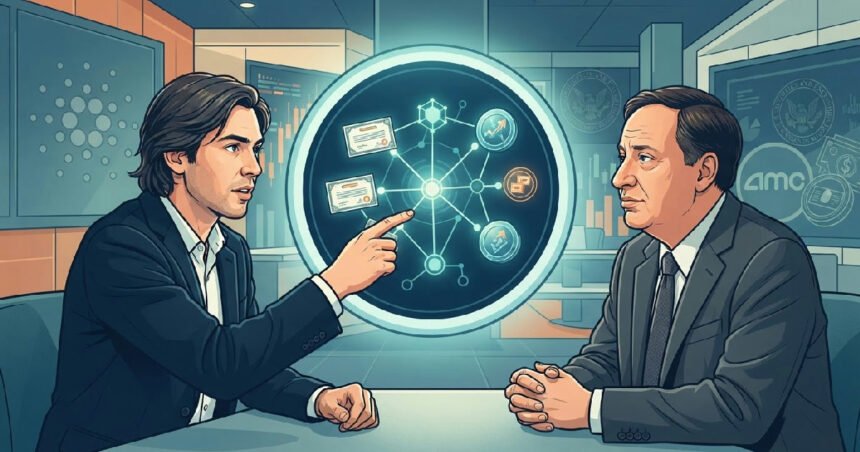
Robinhood CEO Vlad Tenev has intensified his public battle with AMC Entertainment CEO Adam Aron. Tenev declares that public companies should not have veto power over the creation of stock tokens, which are tokenized financial products based on their shares.
This dispute, playing out on social media and financial news networks, strikes at the heart of a burgeoning debate. It concerns the tokenization of real-world assets and the rights of corporate issuers in a decentralized world.
Aron decries ‘fictitious synthetic equity market’
The feud ignited when Aron publicly condemned Robinhood for offering tokens linked to AMC shares without the company’s consent. He threatened to involve the U.S. Securities and Exchange Commission (SEC).
Tenev’s rebuttal argues that once shares are publicly traded, they are fair game for inclusion in other financial products. This principle is well-established in traditional markets, reflecting the expansion of modern digital finance.
The conflict began after Robinhood expanded its international stock token program to include shares of AMC and over 190 other U.S. companies. Adam Aron blasted the move on X (formerly Twitter).
AMC’s CEO called Robinhood’s offering a “fictitious synthetic equity market.” He did not mince words, labeling the practice “contemptible, outrageous, disgusting, detestable, inexcusable, vile.”
Aron’s core argument centers on corporate sovereignty and investor protection. He contends that Robinhood’s actions create a market bearing AMC’s name without its consent or oversight.
This, he argues, could potentially weaken AMC’s ability to raise capital. It also risks creating significant confusion among investors about what rights they actually possess.
“Playing fast and loose with U.S. securities laws is not something that brings honor to Robinhood,” Aron stated. He added it damages the “integrity or credibility to financial markets.”
He publicly called on Robinhood to “voluntarily CEASE AND DESIST,” warning of legal action. Aron believes the products “pretend to be some form of stock ownership,” despite disclosures.
He further stressed that these tokens “are not ownership and they deprive investors of their rights.”
Tenev’s defense: An old principle on a new blockchain
In response, Vlad Tenev has mounted a robust defense. He argues that Robinhood’s stock tokens are simply the next evolution of a long-standing financial practice.
Speaking on CNBC and posting on X, Tenev drew parallels to established financial instruments like options, American Depositary Receipts (ADRs), and exchange-traded funds (ETFs). None of these require explicit consent from the underlying company.
“A company should control the rights attached to its shares — not every lawful use of those shares once they’re in investors’ hands,” Tenev wrote. He asserts the technology is irrelevant; legal and financial principles matter.
“Going onchain shouldn’t give the issuer a veto it never had offchain.”
Tenev did, however, draw a clear line. He conceded that issuer consent should be required if a product fundamentally alters the shares themselves. This includes changes to shareholder rights.
“If a product purports to change the rights attached to the underlying shares, replaces the company’s official stock ledger, or imposes new obligations on the company or its transfer agent, the issuer should be involved,” he explained. In his view, Robinhood’s tokens do none of these things. This approach aligns with developments in blockchain transaction transparency.
How Robinhood’s stock tokens actually work
Understanding the debate requires a look under the hood of Robinhood’s product. The stock tokens are not available in the United States or to U.S. persons.
They are also not registered under American securities laws. They are issued by Robinhood Assets (Jersey) Limited, a separate entity based in a well-known offshore financial center.
Legally, these tokens are structured as debt securities. Each token is backed one-to-one by a corresponding share of the underlying company, held in collateral by a custodian.
This structure provides the token holder with economic exposure to the stock’s price movements and any dividends paid. Crucially, it does not provide traditional shareholder rights, such as voting on corporate matters.
This distinction is key to Robinhood’s legal argument. The company, backed by its chief legal officer and former SEC commissioner Dan Gallagher, contends it is not creating new AMC shares.
Instead, Robinhood is creating a separate derivative product that references them. Robinhood first launched these products in the European Union in June 2025.
The offering later expanded globally to over 120 countries. This strategy aims to provide global investors with access to U.S. equities.
A pivotal test case for regulators and the market
The public spat has already had a tangible impact on the market. When Aron first aired his grievances, AMC’s stock leaped as much as 15% in premarket trading.
This surge was fueled by attention from its dedicated retail investor base. The controversy also reportedly caused a speculative surge in an unrelated token named CINEMA.
This illustrates how corporate drama can create unpredictable ripples in the highly interconnected crypto markets. Such market movements demonstrate the dynamic nature of digital asset valuations.
Beyond the immediate market moves, this feud represents a critical test case for the tokenization of real-world assets. A central question is whether a third party can tokenize a company’s public stock without permission.
Regulators, particularly the SEC, have yet to definitively answer this. AMC’s threatened complaint could force the issue, setting a precedent with wide-ranging implications for the entire digital asset industry.
This is not just about a meme stock and a retail brokerage. It is about defining the boundaries of ownership and control in an economy increasingly moving on-chain.
This granular dispute over equity tokenization will determine the future architecture of on-chain finance. It highlights the regulatory challenges facing the entire digital assets ecosystem.
The road ahead: Investor rights and the on-chain future
As the dust settles, the core issues remain. Aron’s concerns about investor confusion are not without merit.
The distinction between a token that provides economic exposure and an actual share conferring ownership rights is subtle. It could easily be lost on less-sophisticated investors, despite disclosures.
The “fully backed” nature of Robinhood’s tokens is fundamentally different from being “fully owned.” Clarity on these distinctions remains crucial for market integrity.
Conversely, Tenev’s argument for innovation and access cannot be dismissed. He contends that his product gives AMC access to a “whole new shareholder base” of global investors.
These investors might otherwise be unable to buy U.S. stocks. For Robinhood, offering thousands of assets across over a hundred countries without individual company negotiation is key to its scalable business model.
Ultimately, the resolution of this conflict, whether through regulatory intervention or market consensus, will help define the rules of the road for tokenized securities. It will clarify the future of on-chain equities.
The outcome will determine if the future is one of permissionless innovation, as Tenev hopes, or requires explicit corporate consent, as Aron demands. Every company and investor with a stake in the tokenized future will watch closely. The need for clear guidelines affects all participants in the evolving stablecoin market infrastructure.