

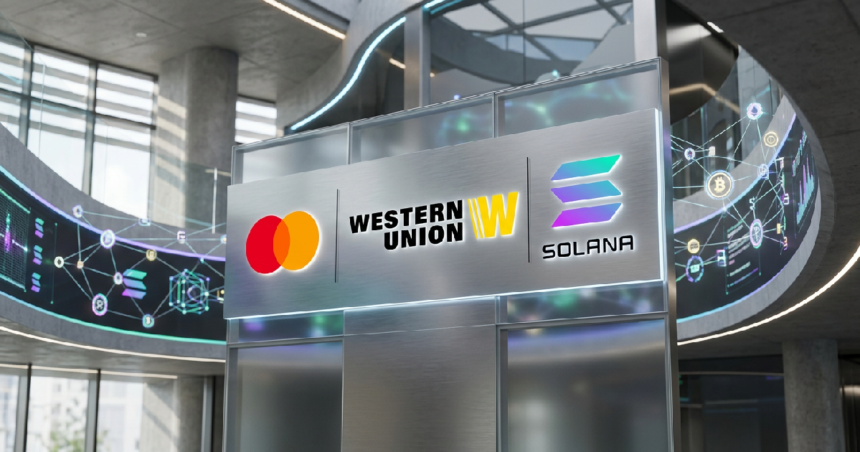
Solana’s push for mainstream utility took a massive leap forward today with the debut of a new developer platform focused on institutional-grade financial services. The rollout is notably supported by global payments giants Mastercard and Western Union, signaling a shift in how legacy finance views the high-throughput blockchain.
The new initiative aims to bridge the gap between traditional banking infrastructure and decentralized ledgers. By providing a sandbox and a suite of compliance-ready tools, the platform allows major financial institutions to build applications that settle transactions in seconds while adhering to strict regulatory requirements. It marks one of the most significant integrations of “web2” financial powerhouses into the Solana ecosystem to date.
Mastercard and Western Union Target On-Chain Settlements
For Mastercard, this move isn’t a sudden pivot but rather an evolution of its ongoing blockchain experiments. The payments network has been exploring ways to reduce the friction of cross-border settlements, and Solana’s low latency offers a compelling alternative to existing systems. While Mastercard has worked with various chains in the past, the focus on a dedicated developer environment suggests a more permanent commitment to building on Solana.
Western Union’s involvement is perhaps even more telling. The remittance giant has spent years defending its market share against low-cost crypto alternatives. By joining this platform, they appear to be adopting a “if you can’t beat them, join them” strategy. The goal is to see if Solana’s architecture can handle the volume and security necessary for global money transfers, which would theoretically lower costs for consumers and speed up delivery times that currently take days in some corridors.
The platform includes pre-built modules for Know Your Customer (KYC) and Anti-Money Laundering (AML) checks. This “compliance-first” approach is likely what attracted these partners, as the lack of verifiable identity has long been a dealbreaker for institutional adoption of public blockchains. As the crypto industry faces its final test for global utility, these types of corporate partnerships are becoming the primary gauge for long-term survival.
Why Solana Won the Institutional Bid
While Ethereum remains the leader in total value locked, Solana’s technical specifications—specifically its “Proof of History” consensus—provide the kind of predictability that high-frequency financial applications require. Banks don’t just need decentralization; they need to know that their transaction won’t be stuck in a mempool for ten minutes because of a sudden spike in gas fees.
But it’s not all smooth sailing. Skeptics often point to Solana’s history of network outages as a reason for caution. However, the developers behind this new platform have indicated that significant upgrades over the last year have hardened the network against the kind of congestion that previously paralyzed it. For Mastercard and Western Union to put their names on a Solana-based product, they clearly feel the reliability risks have been sufficiently mitigated.
This development arrives at a time when the broader market is shifting away from speculative trading toward tangible use cases. With the utility window narrowing in 2026, the race is on to prove that blockchain can do more than host memecoins. If a customer in Manila can receive funds from London via Western Union on the Solana rail in under five seconds for a fraction of the current cost, the argument for blockchain’s necessity is effectively won.
The Road Ahead for Traditional Finance on Solana
The launch of this platform is just the first phase. In the coming months, we expect to see the first pilot programs for tokenized deposits and credit card settlement trials. The integration of Mastercard’s Multi-Token Network (MTN) could eventually allow for a seamless flow of value between private bank ledgers and the public Solana network.
There are also implications for the regulatory landscape. By building on a platform that has the “blessing” of these financial titans, Solana may find it easier to navigate the tightening grip of global regulators. If the very companies the government trusts to move money are using this technology, it becomes much harder to categorize the underlying network as a purely “renegade” offshore entity.
For now, the focus remains on the developers. The success of this platform depends on how many financial engineers swap their legacy coding environments for Solana’s Rust-based framework. If the tools are as seamless as advertised, the “flippening” of financial infrastructure might happen sooner than many anticipated.
Frequently Asked Questions
What makes this platform different from regular Solana development?
This specific platform is built with “permissioned” features that banks require. While it uses the public Solana blockchain, it provides tools for restricted access, identity verification, and advanced compliance reporting that aren’t typically required for standard decentralized finance apps.
Will this make Western Union transfers cheaper for regular people?
That is the ultimate goal. By using Solana as the “settlement layer,” Western Union can avoid the many intermediary banks that take a cut of every transaction. While they might keep some of those savings as profit, the efficiency gains should eventually lead to lower fees for the end user.
Does Mastercard’s involvement mean they are launching a coin?
Not exactly. Mastercard is more interested in the “rails”—the infrastructure used to move money. They are likely to use the platform to settle existing fiat currencies or regulated stablecoins rather than launching a volatile “Mastercard Coin.”