

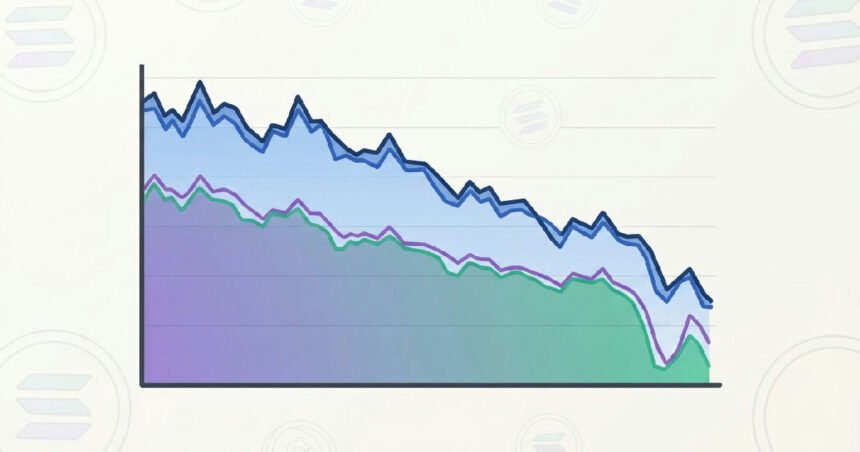
Digital asset exchange-traded funds (ETFs) experienced a turbulent period last week, marked by significant capital shifts. Spot Ether ETFs extended their nine-day outflow streak, shedding $542.1 million, their worst performance since January. Meanwhile, spot Solana funds registered their largest weekly outflow since launching, ending a remarkable 14-week inflow run, according to data analysis from The Block and SoSoValue.
This broad-based redemption activity also saw Bitcoin funds snap a three-week inflow streak, collectively contributing to an estimated $1.25 billion in outflows across the three major cryptocurrency ETF categories. The trend underscores a notable shift in investor sentiment within the volatile digital asset market, moving away from recent bullish momentum.
Ether ETFs Face Persistent Headwinds
The latest data confirms a challenging period for spot Ether ETFs, which recorded $542.1 million in net outflows last week. This marks their most significant weekly loss since January, extending a continuous outflow streak to nine trading days that began on September 29.
Over this nine-day period, a total of $697.2 million has exited these funds. This current run ties a previous June 17-30 streak as the third-longest outflow period in the history of Ether ETFs, highlighting a sustained decline in investor confidence.
BlackRock’s iShares Ethereum Trust (ETHA), the largest Ether fund by assets under management, bore the brunt of these redemptions. It lost a staggering $477.0 million over the week, accounting for approximately 88% of the category’s total outflows.
This represents ETHA’s largest weekly outflow since mid-December 2025 and its third-largest since its launch in July 2024. The heaviest single trading day for Ether products occurred last Tuesday, with $201.9 million in redemptions, exclusively from ETHA, coinciding with its 1-for-3 reverse share split.
Grayscale’s Ethereum Trust (ETHE) also contributed to the negative trend, recording the second-largest weekly outflow among Ether funds at $31.9 million. This marks the second consecutive negative week for the category, following $138.0 million in outflows the week prior, with Fidelity’s Ethereum Fund (FETH) seeing $74.1 million depart.
Solana Funds’ Inflow Streak Ends Amid Record Outflows
In a surprising reversal, spot Solana funds ended their unprecedented 14-week inflow streak, logging $24.8 million in outflows last week. This represents the largest weekly outflow for Solana ETFs since their debut in late October 2025.
Bitwise’s Solana Staking ETF (BSOL), the largest fund in the category with $1.20 billion in net assets, led this decline. BSOL saw $20.9 million withdrawn, making up about 84% of the overall Solana fund outflows.
This figure also stands as BSOL’s largest weekly outflow on record, surpassing a $17.0 million outflow recorded in the week ending July 31. The Solana products experienced outflows in all five trading sessions last week, marking their longest daily losing streak to date.
The previous record for weekly outflows was $8.9 million, set in the week ending February 6. This significant shift comes just two weeks after Solana funds attracted a record $188.2 million in weekly inflows, underscoring the rapid swings in crypto investor sentiment.
Staking Features and Investor Appeal
Unlike the initial launches of Bitcoin and Ethereum ETFs, Solana ETFs were introduced with built-in staking capabilities. This feature allows investors to earn on-chain yield in addition to gaining price exposure to the SOL token, potentially enhancing their overall returns.
Bitwise’s BSOL, for instance, targets average annual staking rewards of over 7%. This integrated yield generation may have contributed to the strong 14-week inflow streak that just concluded, attracting investors seeking additional income streams from their digital asset investments.
Broader Market Shifts and Bitcoin’s Role
The capital flight wasn’t exclusive to Ether and Solana. Spot Bitcoin ETFs also saw substantial redemptions, losing $681.1 million last week, effectively ending a three-week inflow streak. This marked Bitcoin funds’ worst week since June 26, when they shed $1.79 billion.
The outflows were concentrated mid-week, with $487.1 million exiting funds last Wednesday. However, Bitcoin products did manage to return to inflows on Friday, albeit modestly, with $21.1 million.
The combined effect of these movements resulted in approximately $1.25 billion flowing out of the three largest cryptocurrency ETF categories last week. This broad market retreat suggests a moment of caution or profit-taking among investors after periods of significant inflows across various digital assets.
This recent shift contrasts with earlier market sentiment that showed capital appearing to favor Bitcoin. Research from early October indicated Bitcoin’s market dominance was building, potentially drawing funds away from other assets like Ethereum.
Regulatory Context and Product Evolution
The regulatory landscape continues to shape the trajectory of these digital asset products. The U.S. Securities and Exchange Commission (SEC) approved spot Ether ETFs on May 23, 2024, with trading beginning in July 2024, classifying Ether as a commodity.
Solana ETFs followed, receiving SEC approval in October 2025, with products launching later that month. These approvals signify a gradual acceptance of major cryptocurrencies into traditional financial frameworks, despite ongoing volatility.
A notable evolution in crypto ETFs involves staking. Initially, spot Ether ETFs were restricted from offering staking due to regulatory concerns. However, Grayscale and Fidelity have since announced plans or implemented staking features for their respective Ether funds, a development that could influence future investor interest.
The approval on October 2, 2026, of 3x leveraged Bitcoin and Ethereum ETFs on Cboe BZX further indicates the expanding complexity and offerings in the crypto ETF space. These products cater to short-term traders, amplifying daily returns but also carrying higher risks and costs.
What Comes Next for Digital Asset Funds
The recent outflows across Ether, Solana, and Bitcoin ETFs suggest a period of reassessment for digital asset investors. While inflows can be rapid, redemptions can also accelerate, reflecting the inherent volatility and speculative nature of the crypto market.
The long-term appeal of these regulated products remains tied to their ability to provide exposure to cryptocurrencies without direct ownership. However, sustained outflows could signal investor fatigue or a shift towards other investment vehicles, traditional or crypto-native.
Market participants will closely monitor upcoming flow data and broader crypto price movements to gauge whether these outflows are a temporary blip or the start of a more prolonged trend. The integration of staking into more Ether ETFs, mirroring the Solana model, could also play a crucial role in attracting and retaining capital in the future, providing a new dimension for value.
The contrasting performance of these funds highlights the dynamic nature of cryptocurrency investment. As regulators continue to refine their stance and product offerings evolve, investors will need to adapt to these shifts. The market will undoubtedly continue to evolve, presenting both opportunities and challenges for fund managers and investors alike.