

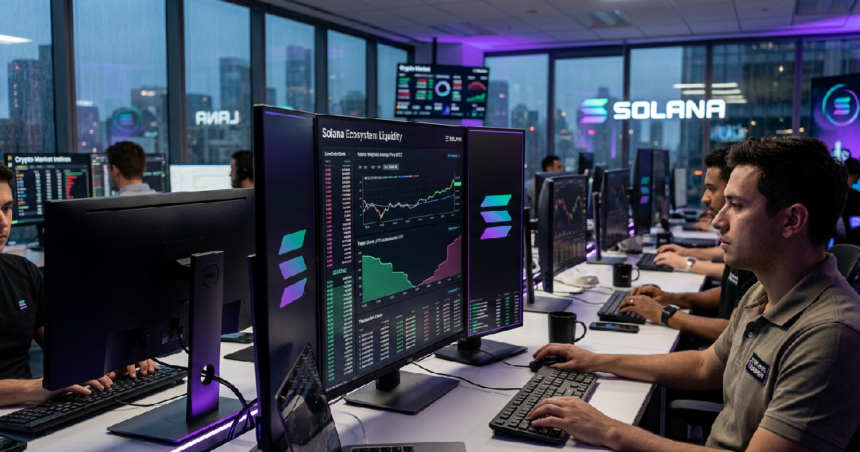
Liquidity isn’t just a technical metric for Solana anymore; it has become the primary psychological driver for a market that looks increasingly disparate from the cycles of 2021. While the previous bull run was defined by the sheer novelty of DeFi, the 2026 landscape is being shaped by where capital can move most efficiently. For SOL holders and onlookers, the recent surge in on-chain volume suggests that “Fear of Missing Out” (FOMO) is no longer about hypothetical tech, but about the very real depth of the order books.
The network’s ability to handle high-frequency trading and meme-coin fever has turned it into a primary destination for retail capital. But as the ecosystem matures, the focus is shifting. Traders are less interested in the next big protocol and more interested in the ease with which they can enter and exit positions without suffering massive slippage. This shift in sentiment is redefining how we value the network compared to its peers.
The Shift from Architecture to Activity
For a long time, the bull case for Solana was built on its architecture—the Proof-of-History consensus and its high transactions per second. However, in the current market, technology has taken a backseat to liquidity. We are seeing a concentrated influx of stablecoin issuance on the network, which acts as the “dry powder” for any potential rally. When liquidity pools are deep, institutional players feel more comfortable stepping in, creating a feedback loop that sustains price action.
And it is not just about the big players. Retail participants are flocking to Solana decentralized exchanges (DEXs) because the costs are negligible. When you can swap $10 worth of a token and not lose $5 to gas fees, the velocity of money increases. This high velocity is what generates the “liquidity signal” that many analysts now use as a leading indicator for SOL’s price performance.
Why Depth Matters More than Hype
In previous years, a project’s success was often measured by its social media mentions or the pedigree of its venture capital backers. Today, the metric that matters is liquidity depth. If a token on Solana can sustain millions in daily volume with minimal price impact, it proves the robustness of the underlying network. This “liquidity moat” makes it harder for competing Layer 1 blockchains to siphon away users.
But there is a flip side to this. The concentration of liquidity in specific sectors—like meme coins or AI-focused tokens—can create a sense of artificial stability. If that capital is “mercenary” in nature, it could exit just as quickly as it arrived. For now, however, the data shows that once capital enters the Solana ecosystem, it tends to rotate within the network rather than bridging back to Ethereum or other chains.
Looking Toward a Multi-Chain Reality
As we head further into 2026, the distinction between “fast” chains and “liquid” chains is blurring. Solana has managed to be both. The recent stability of the network, which faced significant uptime challenges in its earlier years, has bolstered confidence. This reliability is the foundation upon which the current liquidity is being built.
The broader market is currently grappling with a narrowing window for digital asset utility. As noted in recent industry analysis, the pressure is on for blockchains to prove they have a reason to exist beyond speculation. Solana’s pivot toward becoming a liquidity hub for real-world assets and high-speed trading suggests it is leaning into a specific, high-value niche.
The Psychology of the Liquidity Signal
FOMO is a powerful emotion, and in 2026, it is being triggered by the sight of consistent, high-volume candles. When traders see that Solana is outpacing other networks in DEX volume, it creates a “gravity well” effect. Investors don’t want to be in a quiet market; they want to be where the action is. This is why liquidity is the ultimate marketing tool—it provides its own proof of concept every single day.
Frequently Asked Questions
Why is liquidity considered a FOMO signal for SOL?
High liquidity means traders can buy and sell large amounts of SOL or its ecosystem tokens without significantly moving the price. When people see massive volumes and deep pools, they feel the network is “safe” and active, which triggers the desire to jump in before the next leg up.
Is Solana’s liquidity sustainable?
It depends on the source. Currently, a lot of the volume is driven by speculative retail trading. However, the increasing presence of institutional-grade stablecoins and decentralized physical infrastructure (DePIN) projects suggests that more “sticky” capital is entering the ecosystem.
How does this affect the price of SOL?
While liquidity itself isn’t a price guarantee, it usually precedes price volatility. Deep liquidity allows for more significant price discovery. If the sentiment remains positive, this depth can support an upward trend by reducing the impact of sell orders.


