

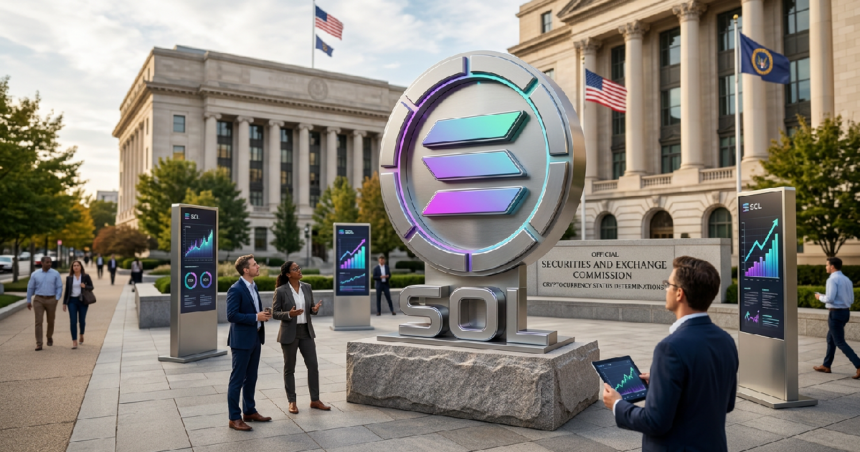
The regulatory dark clouds that have hung over the Solana ecosystem for years finally parted this week. In a move that has sent shockwaves through the digital asset industry, the Securities and Exchange Commission (SEC) has effectively walked back its long-held stance, signaling that many major crypto assets—specifically Solana—will not be treated as securities under current federal laws.
The shift follows a series of bruising legal battles and a changing political climate in Washington. For Solana (SOL), this represents more than just a legal victory; it is a fundamental reset of its market position. Since 2023, the SEC had classified SOL as an investment contract in various lawsuits against major exchanges, a designation that led several American trading platforms to delist the token to avoid regulatory heat.
But the commission’s new direction suggests those days are over. By removing the “security” tag, the SEC has cleared a path for broader institutional adoption and potentially paved the way for a spot Solana ETF, an event that seemed impossible only twelve months ago.
How the SEC pivot changes the game for SOL
For most of the last two years, the “securities” label acted as a ceiling for Solana’s growth in the United States. While the network continued to attract developers and high-speed trading volume, large-scale institutional funds remained cautious. Management firms often have strict mandates that prevent them from holding assets entangled in active SEC litigation.
That friction is now dissolving. The immediate impact was felt across brokerage desks as talk of reintegration began almost instantly. If SOL is no longer viewed as a security, it moves into a regulatory category similar to Bitcoin and Ethereum. This allows it to be integrated into traditional financial products without the risk of the SEC suing the provider for selling unregistered securities.
The timing is particularly relevant given the broader market context. As we’ve seen recently, institutional shifts are driving a resilient crypto market outlook. Large players who were previously sidelined by legal uncertainty are now re-evaluating their portfolios with Solana front and center.
The knock-on effect for decentralized finance
The SEC’s concession doesn’t just help the token price; it breathes new life into the developers building on the blockchain. When an asset is labeled a security, the decentralized applications (dApps) that use it—such as lending protocols or decentralized exchanges—face a mountain of compliance costs that often make them unviable for U.S. users.
With this weight lifted, we are likely to see a resurgence in Solana-based DeFi. Developers can now focus on engineering rather than legal defensive strategies. This is crucial as the digital asset industry faces its final test for global utility. The industry is moving away from pure speculation and toward actual use cases, and Solana’s high-throughput architecture is better positioned than most to lead that charge now that the “security” threat has been neutralized.
However, the SEC’s move isn’t a total free-for-all. The commission has indicated it will still go after fraudulent projects and “pump and dump” schemes. The distinction now is that the underlying technology and the SOL token itself aren’t being treated as inherently illegal from the jump.
What this means for the 2026 market
Market observers are already looking toward the next milestone: Wall Street integration. With the SEC backing down, the paperwork for a Solana ETF is widely expected to move to the top of the pile. And while some analysts warned of institutional pullbacks in other sectors recently, the clarity surrounding Solana has created a unique “safe haven” narrative within the altcoin space.
What remains to be seen is how this affects other high-performance chains like Near or Avalanche. If the SEC has conceded on Solana, it becomes increasingly difficult for them to maintain a “securities” argument for other similarly structured proof-of-stake networks. We are likely entering an era of “regulatory peace” that could define the second half of the decade.
Frequently Asked Questions
Does this mean Solana is now officially a commodity?
While the SEC hasn’t explicitly used the word “commodity” in every filing, removing the “security” label effectively pushes Solana into the jurisdiction of the CFTC or leaves it as a non-security digital asset. This aligns it closely with how Bitcoin and Ethereum are currently treated by federal regulators.
Can U.S. exchanges relist SOL without fear?
Yes, the primary risk for exchanges was a “wells notice” or a lawsuit for facilitating the trade of unregistered securities. With the SEC declaring SOL is not a security, the legal basis for those threats has largely evaporated, making it much safer for platforms to offer the token to American retail investors.
Will this lead to an immediate Solana ETF?
It certainly removes the biggest hurdle. Before this, an ETF was a non-starter because the underlying asset was considered illegal to sell to the public without a prospectus. Now that the SEC has pivoted, several major fund managers are expected to update their filings, though the approval process will still take months of back-and-forth regarding market manipulation safeguards.