

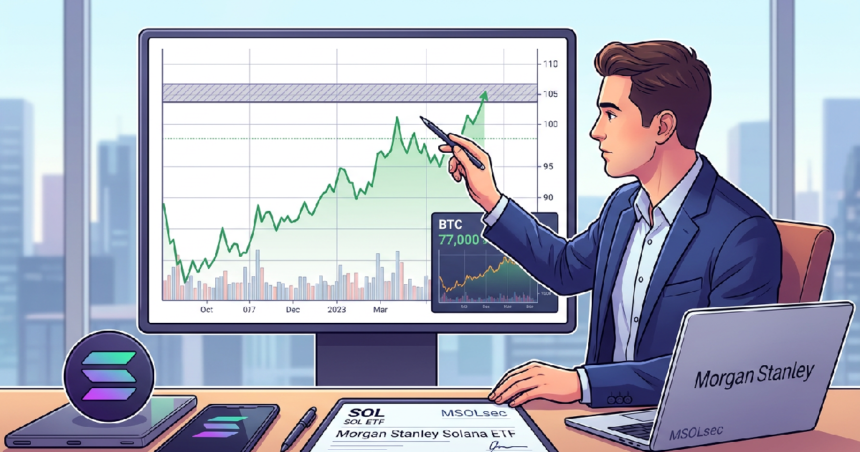
Solana (SOL) is trading near $87 as of May 22, 2026, as buyers attempt to push the token through a stubborn double-top resistance zone that has capped market gains since late 2025. This localized pattern is centered in the $95 to $100 region, where the asset has faced repeated rejection. Risk appetite across the broader cryptocurrency market improved modestly after Bitcoin reclaimed the $77,000 level, providing a more stable backdrop for major altcoins like Solana to recover from recent intraday losses.
Institutional interest is providing a significant tailwind for the ecosystem. Morgan Stanley has reportedly refiled a Solana ETF product with staking support under the ticker \u201cMSOLsec,\u201d according to documents cited in recent market reports. This refiling comes at a time when asset managers are actively expanding their exposure to staking-enabled funds in search of yield-bearing assets. This momentum is further supported by firms like Bitwise, which have seen resilient capital inflows into Solana-linked investment products during a volatile month in May.
The token recently experienced a sharp decline from its mid-May high of $98.40 to nearly $89.92, following a period where it traded as low as $86.33 on May 17. This current price point represents a roughly 70% decrease from its all-time high of $293. While price action remains compressed, Morgan Stanley expanding its digital asset reach underscores the growing institutional appetite for regulated investment vehicles in the sector.
Solana faces technical hurdles near the triple digit mark
From a technical standpoint, Solana continues to trade below its 200-day moving average, which is currently situated near $107.89. The formation of a double-top pattern on both daily and weekly charts suggests that the $95 to $100 range remains a heavy supply zone. Market participants are closely watching the 0.382 Fibonacci retracement region between $87 and $90. Sustained closes above this area could signal a transition away from the current consolidation phase and potentially expose liquidity near the $95 mark.
Support levels for SOL are currently tiered, with immediate classical pivot point support levels identified at $90.23, $88.27, and $86.61. A more critical support region was identified by analysts in the $84 to $85 range. Despite the recent pressure, analyst Javon Marks noted in a May 22 update that Solana is holding a long-term support area that has historically preceded price increases of 80% and 165%. Marks is currently monitoring for a climb toward $233.80, though this would require reclaiming the $100 psychological barrier first.
Traders are also monitoring derivatives data for clues about the next major move. According to CoinGlass liquidation heatmaps, dense clusters of short positions are concentrated between $90 and $95. If the price moves decisively into this cluster, it could trigger forced liquidations and accelerate upward momentum. Recent market data shows that short sellers have absorbed nearly five times more liquidation pressure than long position holders.
On-chain growth and infrastructure revenue reach record highs
Beneath the surface of price volatility, Solana’s fundamentals remain constructive. In April 2026, the network’s Decentralized Physical Infrastructure (DePIN) ecosystems generated a record combined revenue of approximately $2.9 million. This surge was largely driven by projects like Helium, Render, and Hivemapper, which are expanding the network’s utility in AI compute, mapping, and wireless connectivity. These real-world applications are creating a valuation layer that some traders believe differentiates Solana from purely speculative assets.
Enterprise adoption continues to build, with payment titan Visa integrating Solana’s infrastructure into its stablecoin settlement operations. Additionally, Meta has reportedly explored utilizing Solana rails for USDC-based creator payouts. These integrations are often viewed as long-term support for the network’s utility. As the market develops, new liquidity surges in other tokens show that institutional interest is diversifying across highly functional blockchains.
Solana’s Total Value Locked (TVL) has also shown signs of stabilizing following several months of contraction. Historically, a stabilized or recovering TVL has been a precursor to stronger spot demand for SOL. While funding rates remain near neutral territory, suggesting a healthy environment for future growth, traders remain cautious. A rejection at the $95 to $100 resistance zone could lead to a pullback toward $70, particularly if Bitcoin loses its footing near current support levels.