

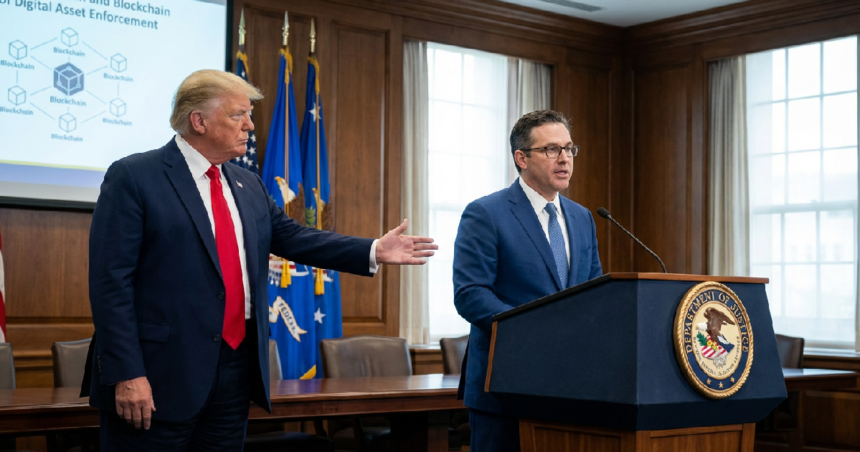
The Department of Justice has undergone a significant leadership shift as President Donald Trump named Todd Blanche as the interim U.S. Attorney General. Blanche, who previously served as the President’s personal defense attorney and more recently as Deputy Attorney General, takes the helm of the nation’s top law enforcement agency at a time when digital asset policy is being aggressively rewritten.
For the cryptocurrency industry, Blanche is a known quantity with a specific track record. He is the primary author of the recent Department of Justice (DOJ) crypto enforcement memo, a document that has served as the blueprint for how federal prosecutors approach digital asset crimes, money laundering, and exchange compliance. His elevation to interim Attorney General suggests that the administration intends to double down on the strategies laid out in that directive.
The Blanche Memo and Federal Enforcement
Blanche’s rise to the top of the DOJ comes only months after he circulated a defining memorandum regarding crypto enforcement. That document signaled a shift away from scattershot litigation toward a more structured, aggressive approach to “unregulated” financial pathways. Under his guidance, the DOJ has prioritized the prosecution of mixers, non-compliant cross-border payments, and offshore entities that provide services to American citizens without seeking the proper federal licensing.
And while some in the industry hoped for a lighter touch under the current administration, Blanche’s history indicates he views clear, firm enforcement as a prerequisite for institutional adoption. He has argued in the past that “clarity comes through the elimination of bad actors,” a stance that has polarized the decentralized finance (DeFi) community. Critics argue his approach leans too heavily on traditional banking surveillance, while proponents suggest it provides the “clean” environment needed for major Wall Street firms to enter the space.
From Defense Table to the Justice Department
Blanche’s trajectory is unusual even by Washington standards. He left a high-profile career in private practice to defend Trump in several high-stakes legal battles before moving into the public sector. His rapid ascent from the defense team to the Deputy Attorney General’s office—and now to the interim Attorney General role—consolidates power within a small circle of loyalists who share the President’s vision for a revamped executive branch.
His appointment follows a period where the New Clarity Act has already begun tightening the screws on stablecoin interest payments. With Blanche now overseeing the entire DOJ apparatus, the industry is bracing for a seamless integration of legislative restrictions and prosecutorial action. There is little reason to believe there will be any “grace periods” for firms still operating in the gray areas of the law.
What This Means for Digital Asset Markets
The market reaction to the news has been one of cautious observation. Blanche isn’t viewed as “anti-crypto” in the way some of his predecessors were, but he is fundamentally a prosecutor. His focus remains on the “on-ramps and off-ramps”—the points where digital assets collide with the traditional fiat system. This enforcement focus is a key reason why many analysts believe the crypto market window is narrowing for projects that lack clear utility or regulatory paths.
So, what should firms expect in the coming months? Legal experts suggest a surge in “preparatory” actions—subpoenas and requests for information sent to medium-sized exchanges and DeFi protocols. Blanche has often said that the DOJ shouldn’t just react to fraud after it happens but should create an environment where fraud is technically and legally difficult to execute. That sounds like a move toward mandatory KYC (Know Your Customer) for almost every facet of the industry.
A Permanent Fixture or a Placeholder?
The “interim” tag is a detail that shouldn’t be overlooked. While it allows Blanche to take control immediately without a lengthy Senate confirmation process, it also puts him in the position of proving his effectiveness to both the President and a skeptical Congress. If he manages to secure high-profile wins against major illicit actors in the crypto space, his stay at the top of the DOJ might become permanent.
For now, the DOJ is expected to maintain its current momentum. With Blanche at the wheel, the memo he wrote is no longer just a set of suggestions—it is the official roadmap of the United States Attorney General. Whether that leads to a safer market or a more restricted one remains the central question for 2026.
Frequently Asked Questions
Who is Todd Blanche?
Todd Blanche is a veteran prosecutor and defense attorney who rose to prominence as the personal lawyer for Donald Trump. He served as the Deputy Attorney General before being named the interim Attorney General in April 2026. He is best known in the tech world for drafting the DOJ’s primary crypto enforcement strategies.
What is the “Blanche Memo” often cited by crypto lawyers?
It is a Department of Justice directive that outlines how federal prosecutors should handle crimes involving digital assets. It emphasizes targeting “unhosted” wallets, decentralized mixers, and exchanges that do not comply with strict anti-money laundering (AML) laws. It effectively ended the era of “soft enforcement” for DeFi protocols.
Will crypto regulations get stricter under Blanche?
While the administration is generally seen as pro-innovation, Blanche’s role as interim Attorney General suggests a high priority on law and order. Digital asset firms should expect more intense scrutiny of their compliance departments and a faster response time from federal prosecutors when irregularities are detected.


