

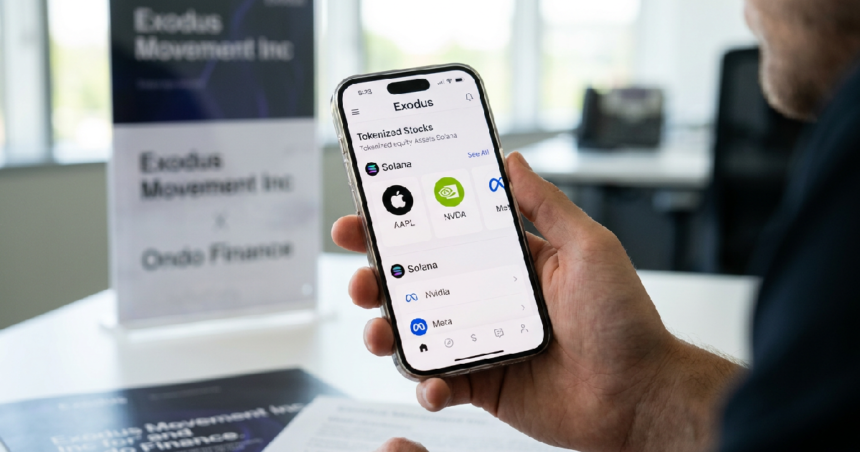
Exodus Movement, Inc. (EXOD) and Ondo Finance launched over 200 tokenized stocks and ETFs on the Solana blockchain today, June 12, 2026, via the new Exodus Markets platform.
Led by CEO JP Richardson and Ondo Finance CEO Ian De Bode, the partnership allows eligible customers to trade real-world assets (RWAs) directly through the Exodus self-custodial app. The initiative includes major U.S.
equities such as Apple (AAPL), Nvidia (NVDA), and Meta, marking a major shift for the Omaha-based wallet provider as it transitions into a full-service financial hub.
The move represents a significant evolution for Exodus Movement, Inc., which first experimented with blockchain-based securities by tokenizing its own stock in 2021. By integrating Ondo Finance’s infrastructure, the platform now offers a massive catalog of traditional instruments to a crypto-native audience.
These assets are total-return trackers, meaning they mirror the price action and dividends of the underlying securities without granting direct legal ownership of the stocks themselves.
Solana was selected as the host network due to its high transaction speeds and minimal costs, which are essential for high-frequency trading of tokenized assets. This launch follows a period of rapid growth for the sector; by April 2026, the total value of on-chain RWAs had surged to $24.6 billion. As the com/crypto-market-forecast-2026-narrowing-window-analysis/”>crypto market window closes on purely speculative tokens, the industry is pivoting toward assets with tangible underlying value.
How tokenized stocks work on the Solana blockchain
Every token issued within Exodus Markets is backed 1:1 by the corresponding U.S. stock or ETF. These reserves are held by licensed custodial broker-dealers in the United States to ensure financial transparency.
Because these are total-return instruments, any dividends issued by the underlying companies are automatically reinvested into the tokens after accounting for tax withholdings. This allows users to gain exposure to equity growth while remaining entirely within a decentralized environment.
One of the most practical upgrades is the 24/5 liquidity model. Unlike traditional stock exchanges that operate on strict 9:30 AM to 4:00 PM schedules, these tokenized assets can be minted or redeemed at any hour during the work week. This flexibility mirrors the “always-on” nature of cryptocurrency markets, providing a bridge for investors who find traditional brokerage hours restrictive.
Maintaining self-custody in traditional finance
Unlike centralized brokerage accounts, Exodus Markets operates on a non-custodial basis. This means users retain the private keys to their tokenized holdings. JP Richardson, CEO and Co-founder of Exodus, noted that tokenized stocks represent one of the most vital developments in modern finance because they give customers the same direct control over equities that they expect from Bitcoin or Ether.
The integration aims to simplify the user experience by housing trading, spending, and asset management within a single interface. Ian De Bode, CEO at Ondo Finance, emphasized that scaling tokenized markets requires meeting users where they already manage their money.
By using the Exodus app, which already serves one of the largest self-custodial audiences in the industry, the partnership hopes to bring institutional-quality products to the retail masses.
Ondo Finance expands its footprint in the RWA sector
Ondo Finance has rapidly become a dominant force on the Solana network, where its Global Markets assets now account for roughly 65% of all tokenized real-world assets by count. To support this growth, the firm recently hired former Invesco ETF Chief John Hoffman as its managing director and head of product portfolios.
This hire signals a long-term strategy to blend traditional exchange-traded fund expertise with blockchain transparency.
The expansion into Exodus is part of a broader trend where utility shifts dictate which platforms survive the current market cycle. Investors are increasingly looking beyond tokens with no clear purpose toward those that provide a service or represent a real-world claim.
The availability of 200 different assets, including the S&P 500 tracker (SPY) and the Nasdaq 100 tracker (QQQ), makes Solana a primary destination for this capital.
Market response and regional availability
While the launch is live as of today, service availability is restricted to eligible customers in select jurisdictions. Users must update to the latest version of the Exodus app to access the “Markets” section. While some regions remain restricted due to local securities laws, the companies are targeting global markets where access to U.S.-listed equities is often difficult or expensive through traditional channels.
The broader crypto ecosystem has shown mixed reactions to the rise of tokenized stocks. While enthusiasts praise the accessibility, some analysts warn that the underlying volatility of the crypto market could impact trading during periods of high stress. We have seen how com/bitcoin-volatility-warning-institutional-pullback-2026/”>institutional pullback signals can lead to sharp corrections, and it remains to be seen how tokenized stocks will behave during a generalized crypto flash crash.
Future outlook for tokenized equities and Solana
The arrival of over 200 tokenized assets suggests that the line between “crypto” and “finance” is permanently blurring. Exodus Movement, Inc. and Ondo Finance have moved beyond simple stablecoins to offer a diverse portfolio that includes tech giants like Meta and Alphabet. This diversity allows crypto users to hedge their portfolios with traditional assets without ever converting back to fiat or off-ramping to a bank.
Looking ahead, the success of Exodus Markets will likely depend on continued regulatory clarity and the technical stability of the Solana network. If the platform can maintain its uptime and security, it could set a precedent for other major wallet providers.
For now, the move places Solana at the center of the real-world asset conversation, proving that high-speed blockchains are capable of handling more than just meme tokens and NFTs.