

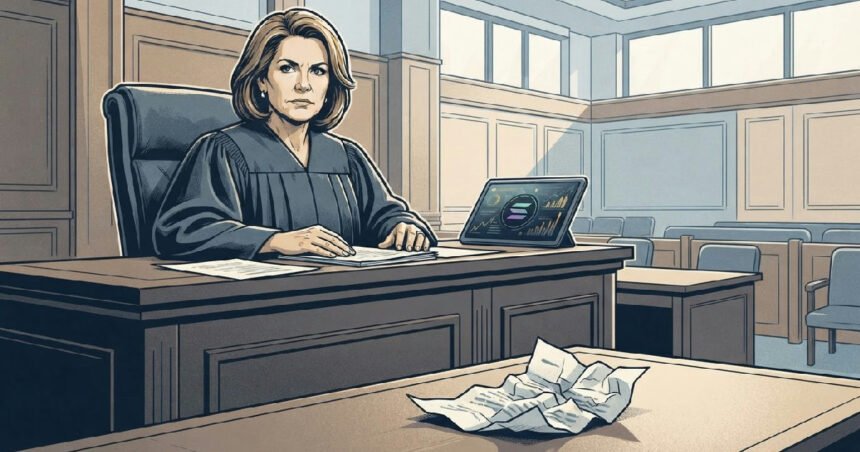
A U.S. federal judge dismissed the LIBRA memecoin lawsuit, closing a key legal avenue for investors seeking over $250 million in losses. S. federal judge has dismissed a class-action lawsuit connected to the LIBRA memecoin, a token famously promoted by Argentine President Javier Milei.
The ruling effectively closes a key legal avenue for thousands of investors seeking to recover more than $250 million in estimated losses from the token’s dramatic collapse on the Solana blockchain.
In a decision dated September 29, 2026, Judge Jennifer L. Rochon of the Southern District of New York dismissed the case “with prejudice,” meaning it cannot be refiled in her court. The lawsuit targeted venture capital firm Kelsier Ventures, its founders, and Meteora co-developer Benjamin Chow over the disastrous launches of the LIBRA and M3M3 memecoins.
Technical knockout: why the LIBRA memecoin lawsuit failed
The investors’ case stumbled on a high legal hurdle: the Racketeer Influenced and Corrupt Organizations (RICO) Act. This federal law, designed to prosecute organized crime, requires plaintiffs to demonstrate a “pattern” of criminal activity. Judge Rochon determined the plaintiffs failed to show the alleged scheme had sufficient “continuity” to qualify under the statute.
The court noted that the alleged fraudulent activity, spanning from October 2024 to the lawsuit’s filing in March 2025, lasted only about six months. Citing precedent in the Second Circuit, the judge found this timeframe too short to establish the long-term criminal conduct RICO targets. Periods of less than two years are typically viewed as insufficient.
Judge Rochon denied the plaintiffs’ request to file a second amended complaint. She found the proposed amendments, which aimed to add claims related to tokens like $MELANIA, $ENRON, and $TRUST, would be “futile” and would not cure the fundamental deficiencies in their argument.
This reliance on strict legal definitions often creates challenges when applying older statutes to the fast-paced crypto world. The volatile nature of digital assets can lead to massive losses in a short period, a scenario that doesn’t always fit neatly into existing legal frameworks for understanding what drives bitcoin price volatility.
A complex web of defendants and protocols
Beyond the central RICO failure, the case against individual defendants crumbled for separate reasons. The state-law claims against Kelsier Ventures and its founders—Hayden, Gideon, and Thomas Davis—were tossed due to a lack of personal jurisdiction. The court found that using nationwide social media and crypto infrastructure wasn’t enough to tie them specifically to New York for legal purposes.
Claims against Benjamin Chow, a former CEO and co-developer of the DeFi protocol Meteora, were dismissed because of pleading defects. The judge ruled that the plaintiffs had not provided sufficient allegations to prove fraudulent intent on his part. This highlights the difficulty of pinning legal responsibility on individuals within diffuse crypto projects.
Perhaps most significantly for the decentralized finance space, claims against Meteora itself also failed. The defendants successfully argued that Meteora is merely software, not a legal association or partnership that can be sued. Judge Rochon agreed, leaving investors unable to target the underlying protocol through which the tokens were launched.
The shadow of ‘Cryptogate’ and Javier Milei’s involvement
While not a defendant in the U.S. lawsuit, the affair’s most prominent figure is Argentine President Javier Milei. His promotion of the Solana-based LIBRA token on X (formerly Twitter) on February 14, 2025, sent the memecoin’s value soaring. At its peak, LIBRA reached a market capitalization of over $4 billion before crashing by more than 90%, affecting an estimated 44,000 investors.
Milei deleted his promotional post later that day, but the damage was done. The incident has since spiraled into a political scandal in Argentina dubbed “Cryptogate.” An Argentine congressional committee concluded in November 2025 that Milei may have used his office to promote a scam and recommended Congress evaluate his actions.
There is also an ongoing federal investigation in Argentina that names the president as a person of interest.
Forensic analysis of a phone belonging to crypto lobbyist Mauricio Novelli, a key figure who reportedly introduced Kelsier’s Hayden Davis to Milei, has added fuel to the fire. The analysis uncovered details of an alleged $5 million payment agreement tied to Milei’s promotion and evidence of coordinated communications around the time of the token launch.
The rapid rise and fall of such projects has become a common theme in the market. While some investors chase high-risk opportunities, the landscape is constantly shifting as altcoins eye new peaks and developers launch new tokens daily, often with little more than a name and a social media push.
What the ruling means for Solana memecoin investors
The dismissal is a significant blow for LIBRA investors who put their money into the Solana-based project. The ruling was procedural, focusing on whether the plaintiffs’ claims met the strict requirements of the laws they sued under. It was not a judgment on whether the defendants’ conduct was actually lawful, but it effectively shuts the door on this specific recovery effort in U.S. federal court.
This case underscores the immense risks associated with the memecoin ecosystem, which has been a major source of activity and transaction volume on the Solana network. The allure of quick profits, often amplified by celebrity or influencer endorsements, can obscure the lack of underlying value or the potential for insider manipulation.
The lawsuit also revealed the limited power of enforcement in a decentralized environment. In May 2025, stablecoin issuer Circle temporarily froze approximately $110 million in funds linked to the LIBRA launch. However, the freeze was lifted just a few months later in August 2025, showing the complex and often temporary nature of such interventions.
The explosive growth of projects on various blockchains continues to attract both legitimate builders and bad actors. This dynamic is particularly evident within the Solana ecosystem, where memecoins like LIBRA have seen rapid launches and subsequent collapses.
A difficult road ahead for recovering losses
For the thousands of investors left with near-worthless LIBRA tokens, the path forward is uncertain. The dismissal “with prejudice” prevents this group of plaintiffs from simply fixing their complaint and trying again in the same court. While the ruling does not impact the separate investigation proceeding in Argentina, recovering funds across international borders from a failed crypto project is an arduous task.
The decision also serves as a cautionary tale about the legal challenges of pursuing developers of decentralized protocols. By successfully arguing that Meteora was just software, the defendants have reinforced a legal defense that could be used in future cases, making it harder to hold platforms accountable for activities that occur on them.
Ultimately, the LIBRA saga stands as a stark reminder of the “buyer beware” reality of the memecoin market. The case illustrates how difficult it can be to apply traditional legal frameworks to the novel and often chaotic world of cryptocurrency, leaving many retail investors without recourse when a high-profile project implodes.