

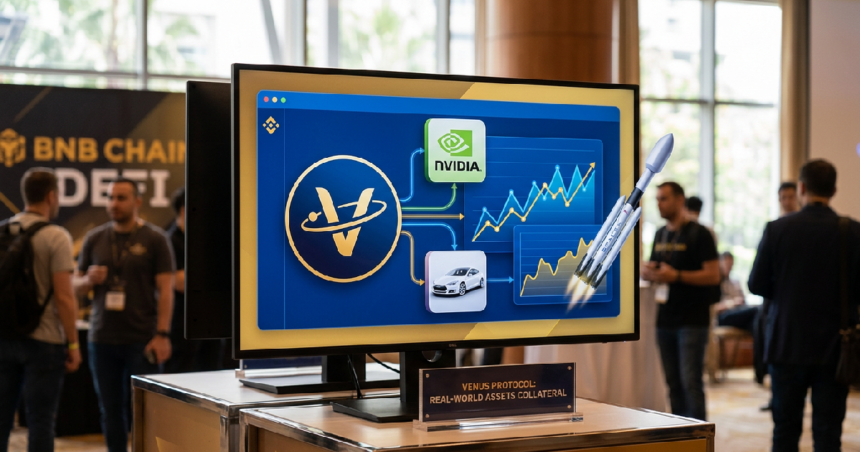
Venus Protocol officially integrated tokenized stocks as collateral on the BNB Chain on June 19, 2026, marking a significant bridge between traditional equity markets and decentralized finance (DeFi). The protocol now allows users to deposit “bStocks”—on-chain representations of major U.S. equities—into its Core Pool to borrow liquid stablecoins like USDT and USDC.
This launch specifically supports tokenized versions of Tesla (TSLAB), Nvidia (NVDAB), and SpaceX (SPCXB), alongside a dedicated S&P 500 index-tracking ETF.
The move represents the first time Venus Protocol has supported equities as collateral, expanding its existing liquidity market that already features BTC, ETH, and tokenized gold (XAUm). By enabling these Real-World Assets (RWA), the platform allows investors to maintain long-term exposure to high-growth tech stocks and market indices while simultaneously unlocking on-chain liquidity.
Venus Protocol integrates bStocks to expand DeFi collateral options
Users can access these services 24/7 through standard interfaces like Binance Wallet and Trust Wallet, or by acquiring the bStock assets via PancakeSwap.
And while the integration of RWA is often discussed in abstract terms, this deployment offers immediate utility for traders who want to hedge their portfolios without triggerring taxable sales of their equity holdings. The protocol, which launched in 2020, has evolved into one of the largest algorithmic money markets on the BNB Chain.
However, the addition of volatile equities as collateral introduces a new layer of risk management for the community-driven governance system.
The introduction of bStocks into the Venus Core Pool signals a shift in how DeFi protocols view asset classes outside of the native crypto ecosystem. By including Nvidia and Tesla-backed tokens, Venus is betting that users want the same flexibility with their brokerage accounts that they currently enjoy with their crypto wallets.
This expansion aims to narrow the gap between the rigid hours of traditional stock exchanges and the “always-on” nature of blockchain finance.
This development follows a period where crypto market utility shifts have begun to dictate which protocols survive long-term. Venus is positioning itself as a “super-app” for liquidity, where a user’s entire net worth—from gold and stocks to digital assets—can be put to work as a single, unified capital base.
The protocol uses an over-collateralized model, meaning users must provide more value in bStocks than the total amount of USDT or USDC they intend to borrow.
Supported assets and accessibility for retail users
At launch, the selection of bStocks focuses on high-liquidity names that frequently dominate retail trading volumes. Nvidia (NVDAB) and Tesla (TSLAB) provide the tech-heavy volatility that DeFi traders often seek, while the S&P 500 ETF offers a more stable foundation for conservative borrowers.
The inclusion of SPCXB (SpaceX) is a unique addition, offering on-chain exposure to a private company that remains largely inaccessible through traditional retail brokerage accounts.
Governance for these new listings remains under the control of XVS token holders. The XVS governance token, which has a fixed supply of 30 million, saw its value hover around $2.69 on June 20, 2026. This community-led approach ensures that any changes to collateral factors or liquidation thresholds for bStocks must pass through a transparent on-chain voting process before implementation.
Managing risks in the age of tokenized equities
Despite the utility of tokenized stocks, the move is not without significant danger. Venus Protocol has a spotted history, including a $200 million price manipulation event in 2021 and a $100 million bad debt incident following the 2022 BNB bridge hack. Most recently, on March 15, 2026, the protocol suffered a $3.
7 million “donation attack” involving the THENA token, which highlighted the lingering concentration risks within the BNB Chain ecosystem.
The volatility of the underlying stock market also presents a liquidation threat. If a company like Tesla should see a sudden 20% drop in overnight trading, on-chain oracles must update quickly to prevent the protocol from accumulating bad debt.
Unlike crypto, which trades 24/7, the pricing of bStocks depends on external market data that may be less liquid during weekend hours, potentially creating “gap” risks where positions are liquidated before a user can add more collateral.
Furthermore, regulatory hurdles for tokenized assets continue to evolve. While Venus is permissionless, the entities actually tokenizing the stocks must navigate strict securities laws in the United States and elsewhere. Any regulatory crackdown on the issuers of bStocks could lead to a sudden loss of liquidity for these assets, leaving borrowers in a precarious position if they cannot easily exit their collateralized loans.
Forward outlook for BNB Chain and RWA integration
The success of the bStocks launch will likely determine if Venus expands into other asset classes like tokenized real estate or corporate bonds. For now, the protocol is focusing on the most recognizable names in finance to build trust. As com/precous-metals-rise-silver-target-analysis-2026/”>precious metals and other hard assets continue to find their way onto the blockchain, the role of a unified money market lender becomes increasingly central to the broader DeFi thesis.
Ultimately, the marriage of Tesla and Nvidia stocks with BNB Chain liquidity is a test of market appetite. If users embrace the ability to borrow against their shares at 3:00 AM on a Sunday, it will validate the push toward total tokenization.
But if the risks of smart contract vulnerabilities or price oracle lag lead to further bad debt for Venus, it may serve as a cautionary tale about moving too fast into the world of traditional securities.